Advertisements
Advertisements
Question
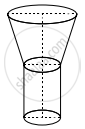
An oil funnel made of tin sheet consists of a cylindrical portion 10 cm long attached to a frustum of a cone. If the total height is 22 cm, diameter of the cylindrical portion is 8 cm and the diameter of the top of funnel is 18 cm. Find the area of tin required to make the funnel.
Advertisements
Solution
Given: Total height of the funnel = 22 cm
For Cylindrical Portion:
Height (h1) = 10 cm
Radius (r2) = `"Diameter"/2` = `8/2` = 4 cm
For Frustum of a Cone:
Height (h2) = Total height − h1
= 22 – 10
= 12 cm
Top radius (r1) = `"Top diameter"/2`
= `18/2`
= 9 cm
Bottom radius = Same as the cylinder radius (r2) = 4 cm
1. Finding Slant Height of Frustum (l):
`l = sqrt(h_2^2 + (r_1 - r_2)^2`
= `sqrt(12^2 + (9 - 4)^2`
= `sqrt(144 + 5^2)`
= `sqrt(144 + 25)`
= `sqrt(169)`
= 13 cm
2. Finding Total Area of Tin Sheet Required:
Total Area = Curved Surface Area of Cylinder + Curved Surface Area of Frustum
Total Area = 2πr2h1 + π(r1 + r2)l
= (2 × π × 4 × 10) + [π × (9 + 4) × 13]
= 80π + (13 × 13π)
= 80π + 169π
= 249π
Using π = `22/7`:
Total Area = `249 xx 22/7`
= `5478/7`
≈ 782.57 cm2
