Advertisements
Advertisements
Question
An object is placed in front of a convex mirror of focal length 25 cm. By scale, a drawing shows the formation of image and states the nature of image.
Given that v = 10 cm.
Advertisements
Solution
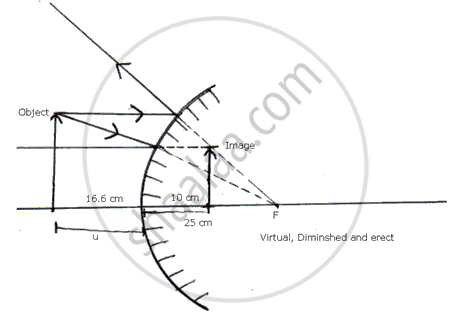
The image formed is virtual, Diminished, and erect.
APPEARS IN
RELATED QUESTIONS
David is observing his image in a plane mirror. The distance between the mirror and his image is 4 m. If he moves 1 m towards the mirror, then the distance between David and his image will be ______.
Draw a figure describing the following.
The reflecting surface of two mirrors make an angle of 90∘ with each other. If a ray incident of one mirror has an angle of incidents of 30∘, draw the ray reflected from the second mirror. What will be its angle of reflection?
A light ray is incident normally on a plane mirror. What is the direction of reflected ray? Show it on a diagram.
An object OA is placed on the principal axis of a concave mirror as shown in the figure. Copy and complete the diagram to show the formation of image.
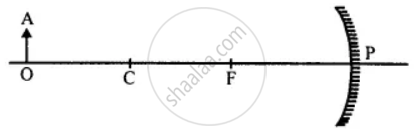
Copy the figure and complete it, by drawing two rays to show the formation of the image of the object AB. State the size, position and nature of image formed.
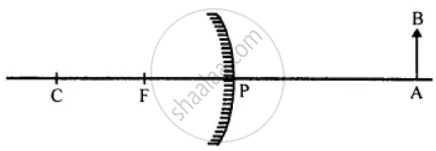
Draw two sets of rays of light to show the formation of an image of the letter as shown in figure p.

Find the odd one.
sun, candle, torch, pen
Match the following:
| 1. | Rubber | a. | Erect |
| 2. | Greased paper | b. | Inverted |
| 3. | Real image | c. | Opaque medium |
| 4. | Virtual image | d. | Translucent medium |
