Advertisements
Advertisements
Question
An equilateral triangle ABC is inscribed in a circle with centre O. The measures of ∠BOCis
Options
30°
60°
90°
120°
Advertisements
Solution
120°
We are given that an equilateral ΔABC is inscribed in a circle with centre O. We need to find ∠BOC
We have the following corresponding figure:

We are given AB = BC = AC
Since the sides AB, BC, and AC are these equal chords of the circle.
So, the angle subtended by these chords at the centre will be equal.
Hence
`angleAOB + angleBOC + angleAOC = 360`
`angleBOC + angleBOC + angleBOC = 360`
`3angleBOC = 360`
`angleBOC = 360/3`
`angleBOC = 120°`
APPEARS IN
RELATED QUESTIONS
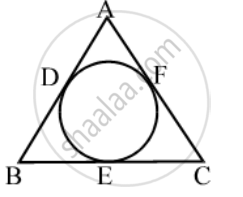
In Fig., if AB = AC, prove that BE = EC
Fill in the blanks:
A point, whose distance from the centre of a circle is greater than its radius lies in __________ of the circle. (exterior/ interior)
true or false
A circle is a plane figure.
A triangle PQR is drawn to circumscribe a circle of radius 8 cm such that the segments QT and TR, into which QR is divided by the point of contact T, are of lengths 14 cm and 16 cm respectively. If area of ∆PQR is 336 cm2, find the sides PQ and PR.
Find the missing values in the following table for the circles with radius (r), diameter (d) and Circumference (C).
| radius (r) | diameter (d) | Circumference (C) |
| 1760 cm |
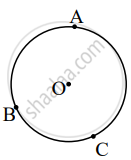
A, B, C are any points on the circle with centre O. If m(arc BC) = 110° and m(arc AB) = 125°, find measure arc AC.
In a circle with centre P, chord AB is parallel to a tangent and intersects the radius drawn from the point of contact to its midpoint. If AB = `16sqrt(3)`, then find the radius of the circle.
C(O, r1) and C(O, r2) are two concentric circles with r1 > r2 AB is a chord of C(O, r1) touching C(O, r2) at C then ______
Prove that angle bisector of any angle of a triangle and perpendicular bisector of the opposite side if intersect, they will intersect on the circumcircle of the triangle.
In the following figure, O is the centre of the circle. Name all radii of the circle.

