Advertisements
Advertisements
Question
An equation which can be put in the form ax + by + c = 0 is called a linear equation, where:
- x and y are variables.
- a, b and c are real numbers and
- a and b are both not zero.
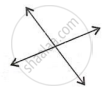
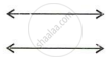
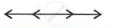
On drawing a graph for the two linear equations on the same plane, it is seen that only one of the following three possibilities can happen:
- the two lines intersect at one point.
- the two lines do not intersect (i.e. the lines are parallel to each other)
- the two lines coincide (i.e. the lines have infinite number of solutions).
|
For two linear equations \[a_1x + b_1y + c_1 = 0\] and \[a_2x + b_2y + c_2 = 0\],
|
On comparing the ratios \[\frac{a_1}{a_2}, \frac{b_1}{b_2}\text{ and }\frac{c_1}{c_2}\], find out whether the lines representing the following pairs of linear equations intersect at a point, are parallel or coincident.
- 7x − 5y + 10 = 0
6x + 2y − 15 = 0 - 5x + 2y + 8
15x + 6y + 24 = 0 - 4x − 8y + 9 = 0
2x − 4y + 7 = 0 - x − 2y = 0
3x − 4y − 20 = 0 - 2x + 3y − 9 = 0
4x + 6y − 18 = 0 - x + 2y − 4 = 0
2x + 4y − 12 = 0
Case Study
Advertisements
Solution
- Given the equations 7x − 5y + 10 = 0 and 6x + 2y − 15 = 0
\[a_1 = 7, \ b_1 = -5, \ c_1 = 10\]
\[a_2 = 6, \ b_2 = 2, \ c_2 = -15\]
\[\frac{a_1}{a_2} = \frac{7}{6}, \quad \frac{b_1}{b_2} = \frac{-5}{2}\]
Since \[\frac{a_1}{a_2} \neq \frac{b_1}{b_2}\], the lines intersect at a point. - Given the equations 5x + 2y + 8 = 0 and 15x + 6y + 24 = 0:
\[a_1 = 5, \ b_1 = 2, \ c_1 = 8\]
\[a_2 = 15, \ b_2 = 6, \ c_2 = 24\]
\[\frac{a_1}{a_2} = \frac{5}{15} = \frac{1}{3}, \quad \frac{b_1}{b_2} = \frac{2}{6} = \frac{1}{3}, \quad \frac{c_1}{c_2} = \frac{8}{24} = \frac{1}{3}\]
Since \[\frac{a_1}{a_2} = \frac{b_1}{b_2} = \frac{c_1}{c_2}\], the lines are coincident. - Given the equations 4x − 8y + 9 = 0 and 2x − 4y + 7 = 0:
\[a_1 = 4, \ b_1 = -8, \ c_1 = 9\]
\[a_2 = 2, \ b_2 = -4, \ c_2 = 7\]
\[\frac{a_1}{a_2} = \frac{4}{2} = 2, \quad \frac{b_1}{b_2} = \frac{-8}{-4} = 2, \quad \frac{c_1}{c_2} = \frac{9}{7}\]
Since \[\frac{a_1}{a_2} = \frac{b_1}{b_2} \neq \frac{c_1}{c_2}\], the lines are parallel. - Given the equations x − 2y = 0 and 3x − 4y − 20 = 0:
\[a_1 = 1, \ b_1 = -2, \ c_1 = 0\]
\[a_2 = 3, \ b_2 = -4, \ c_2 = -20\]
\[\frac{a_1}{a_2} = \frac{1}{3}, \quad \frac{b_1}{b_2} = \frac{-2}{-4} = \frac{1}{2}\]
Since \[\frac{a_1}{a_2} \neq \frac{b_1}{b_2}\], the lines intersect at a point. - Given the equations 2x + 3y − 9 = 0 and 4x + 6y − 18 = 0:
\[a_1 = 2, \ b_1 = 3, \ c_1 = -9\]
\[a_2 = 4, \ b_2 = 6, \ c_2 = -18\]
\[\frac{a_1}{a_2} = \frac{2}{4} = \frac{1}{2}, \quad \frac{b_1}{b_2} = \frac{3}{6} = \frac{1}{2}, \quad \frac{c_1}{c_2} = \frac{-9}{-18} = \frac{1}{2}\]
Since \[\frac{a_1}{a_2} = \frac{b_1}{b_2} = \frac{c_1}{c_2}\], the lines are coincident. - Given the equations x + 2y − 4 = 0 and 2x + 4y − 12 = 0:
\[a_1 = 1, \ b_1 = 2, \ c_1 = -4\]
\[a_2 = 2, \ b_2 = 4, \ c_2 = -12\]
\[\frac{a_1}{a_2} = \frac{1}{2}, \quad \frac{b_1}{b_2} = \frac{2}{4} = \frac{1}{2}, \quad \frac{c_1}{c_2} = \frac{-4}{-12} = \frac{1}{3}\]
Since \[\frac{a_1}{a_2} = \frac{b_1}{b_2} \neq \frac{c_1}{c_2}\], the lines are parallel.
shaalaa.com
Is there an error in this question or solution?
