Advertisements
Advertisements
Question
An electric current is passed through a metallic wire. The wire gets heated up. Give the reason. Is it possible to melt the wire by passing a heavy current?
Advertisements
Solution
The metallic wire gets heated up on passing an electric current through it due to collisions of free electrons and energy is transferred to the positive ions which begin to vibrate more violently, causing to produce heat. It is possible to melt the wire by passing a heavy current. The wire will melt when its temperature due to heating reaches its melting point.
RELATED QUESTIONS
What is consumed using different electrical appliances, for which electricity bills are paid?
An electric heater of resistance 8 Ω takes a current of 15 A from the mains supply line. Calculate the rate at which heat is developed in the heater.
Which of the following is the most likely temperature of the filament of an electric light bulb when it is working on the normal 220 V supply line?
(a) 500°C
(b) 1500°C
(c) 2500°C
(d) 4500°C
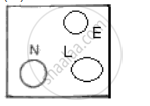
The diagram 31 shows a 3 terminal plug socket.
(i) What is the purpose of the terminal E?
(ii) To which part of the appliance is the terminal E connected?
(iii) To which wire L or N, is the fuse connected and why?
Mention three uses of the carbon arc.
Of the three connecting wires in a household circuit: Which two of the three wires are at the same potential? In which of the three wires should the switch be connected?
With reference to the diagram shown below calculate:

(i) The equivalent resistance between P and Q.
(ii) The reading of ammeter.
(iii) The electrical power between P and Q.
Find the energy released by a current of 0.25 amperes flowing through a heater for 5 minutes. The p.d. is 230 V.
The average work done by a human heart while it beats once is 0.5 Joule. The power used by heart if it beats 72 times in a minute:
