Advertisements
Advertisements
Question
An aluminium rod of length 50 cm whose mass per unit length is 0.15 kg/m is joined with a steel rod of length 50 cm whose mass per unit length is 0.45 kg/m as shown in the figure below.
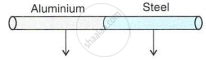
At what point should the rod be supported so that it remains in equilibrium horizontally?
Advertisements
Solution
Given,
Length of aluminium rod = 50 cm = 0.5 m
Length of steel rod = 50 cm = 0.5 m
Mass per unit length of aluminium rod = 0.15 kg m−1
Mass per unit length of steel rod = 0.45 kg m−1
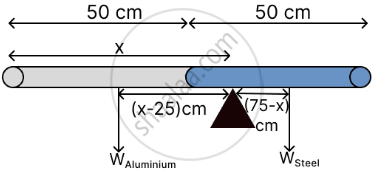
Let, the rod is balanced at point which is at a distance of x cm from aluminium rod’s end as shown below.
Then,
Mass of aluminium rod = 0.15 × 0.5 = 0.075 kg
Mass of steel rod = 0.45 × 0.5 = 0.225 kg
Since mass of steel rod is greater than the mass of aluminium rod which means the equilibrium point must be towards steel end.
Also, weight of each rod is situated at its mid point i.e., at 25 cm of each rod.
So, Perpendicular distance for aluminium rod = (x − 25) cm
and Perpendicular distance for steel rod = (75 − x) cm
Now, Anticlockwise moment of force due to aluminium rod = 0.075 × (x − 25) kg cm
Clockwise moment of force due to steel rod = 0.225 × (75 − x) kg cm
For equilibrium,
Anticlockwise moment of force due to aluminium rod = Clockwise moment of force due to steel rod.
0.075 × (x − 25) = 0.225 × (75 − x)
⇒ `x - 25 = 0.225/0.075 xx (75 - x)`
⇒ `x - 25 = 225/75 xx (75 - x)`
⇒ x − 25 = 3 × (75 − x)
⇒ x − 25 = 225 − 3x
⇒ x + 3x = 225 + 25
⇒ 4x = 250
⇒ x = `250/4`
⇒ x = 62.5 cm
Hence, the rod should be supported at 62.5 cm mark from aluminium end so that it remains in equilibrium horizontally.
