Advertisements
Advertisements
Question

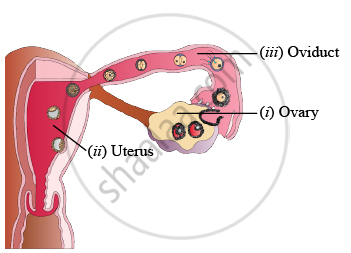
After observing the above figure, answer the following.
- Read the following statements and label them in the figure.
- The part which produces female gametes.
- The part where development of the baby takes place.
- The part through which the developing embryo passes to reach the uterus.
- Explain the future development of the embryo that would take place after it gets embedded in the uterus.
Answer in Brief
Advertisements
Solution
- The embryo continues to grow and develop after it gets embedded in the uterus. It divides and differentiates into three germ layers, which give rise to different body : parts such as hands, legs, head, eyes, ears, etc. This stage where all the body parts are distinct and easily identified in a developing embryo is called foetus.
A human embryo becomes a foetus after about 8 weeks of pregnancy. After completion of development of the foetus (i.e., after about 38 weeks or 9 months), mother gives birth to the baby.
shaalaa.com
Embryo Formation in Viviparous and Oviparous Animals - Young Ones to Adults
Is there an error in this question or solution?
APPEARS IN
RELATED QUESTIONS
______ is an oviparous animal.
Match the following.
| 1. | Zycote | Asexual Reproduction |
| 2. | Viviparous | Elephant |
| 3. | Endangered animal | Cat |
| 4. | Mudhumalai | Fertilised Egg |
| 5. | Fragmentation | Rhinoceros |
Differentiate between oviparous and viviparous animals.
Stages in the life cycle of silkworm are given below. Write them in sequential order.
| pupa, silkworm, egg, silkmoth |
Hens and frogs are both oviparous exhibiting different types of fertilisation. Explain.
