Advertisements
Advertisements
Question
About 8% of the human male population suffers from colour blindness, whereas only about 0.4% of the human female population suffers from this disease. Write an explanation to show how it is possible.
Advertisements
Solution
Colour blindness is a sex-linked disorder and is caused by a recessive gene located on the X chromosome. The Y chromosome of male does not carry any gene for colour vision and the defect appears in the presence of a single recessive gene (XcY). As a result, colour blindness is more common in males (8%) as compared to females (0.4%).
RELATED QUESTIONS
Match the column-I with column-II and re-write the matching pairs.
| Column-I | Column-II |
| 1. 21 trisomy | a. Turner’s syndrome |
| 2. X-monosomy | b. Klinefelter’s syndrome |
| 3. Holandric traits | c. Down's syndrome |
| 4. Feminized male | d. Hypertrichosis |
A short stature with webbing of neck and low posterior hairline indicates ______ syndrome.
In sickle-cell anaemia, shape of RBCs under oxygen tension becomes ______.
Extra chromosome ‘X’ is present in which one of the following cases?
Placed below is a karyotype of a human being.
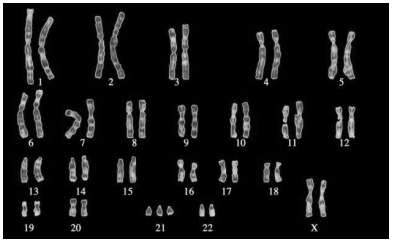
On the basis of this karyotype, which of the following conclusions can be drawn: ______
Short stature in females, webbed neck absence of menstrual cycle and sterility are characteristics which of the following disease?
Lipoprotein lipase deficiency (LPLD)is a genetic disorder in which a person has a defective gene for lipase. This leads to high triglycerides, stomach pain, and fat deposits under the skin. It may eventually affect the liver, pancreas and may also cause diabetes. The disorder occurs if a child acquires defective genes from both parents (autosomal recessive). ERT (enzyme replacement treatment) is one of the treatments offered to patients with LPLD.
-
- What procedure is followed in ERT?
- What could be one possible drawback of ERT?
- How can LPLD be treated using Biotechnology? Elaborate.
What is the genotype of Turner's Syndrome?
Describe Turner's syndrome.
Jacob is genetically a carrier of the disorder that affects the shape of the RBCs, as shown in the diagram below. His son James suffers from the same disorder.

- Give the biochemical reason for the disorder that changes the shape of the RBCs, as shown above.
- Draw a Punnett square to show the genotype of the mother of James.
- Name and define the type of 'point mutation' responsible for this disorder.
