English

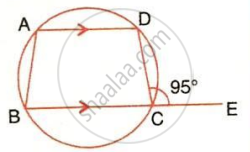
ABCD is a trapezium with AD parallel to BC. Side BC is produced to point E and angle DCE = 95°. Angle B is equal to:
Advertisements
Advertisements

Question

ABCD is a trapezium with AD parallel to BC. Side BC is produced to point E and angle DCE = 95°. Angle B is equal to:

The image displays a circle with points $A$, $B$, $C$, and $D$ on the circumference forming an inscribed quadrilateral $ABCD$, parallel line segments $AD$ and $BC$ marked with arrowheads, a line extending from vertex $C$ to an external point $E$, and an exterior angle measuring $95^\circ$. It illustrates circle geometry problems involving parallel chords, cyclic quadrilaterals, exterior angles, and angle relationships within a circle.

Options

  • 85°

  • 105°

  • 95°

  • 175°

MCQ
Advertisements

Solution

85°

Explanation:

Given,

AD || BC

Since,

Side BC is produced to point E.

We can say that,

AD || BE

From figure,

∠ADC = ∠DCE = 95° (Alternate angles are equal)

We know that,

The opposite angles of a cyclic quadrilateral are supplementary.

∴ ∠ADC + ∠CBA = 180°

⇒ ∠CBA = 180° − ∠ADC

= 180° − 95°

= 85°

shaalaa.com
  Is there an error in this question or solution?
Chapter 17: Circles - EXERCISE 17 (B) [Page 265]

APPEARS IN

Selina Concise Mathematics [English] Class 10 ICSE
Chapter 17 Circles
EXERCISE 17 (B) | Q 1. (a) | Page 265
Share
Notifications

Englishहिंदीमराठी


      Forgot password?
Use app×