Advertisements
Advertisements
Question
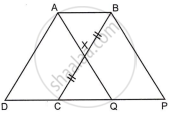
ABCD is a parallelogram, X is the midpoint of BC. AX is produced to meet DC produced at Q. ABPQ is a parallelogram.
Prove that
- ΔABX ≅ ΔQCX
- DC = CQ = QP
Advertisements
Solution
Given:
ABCD is a parallelogram.
X is the midpoint of BC.
AX is produced to meet DC produced at Q.
ABPQ is a parallelogram.
To Prove:
1. ΔABX ≅ ΔQCX
2. DC = CQ = QP
Proof:
1. Since ABCD is a parallelogram, AB || DC and AD || BC and opposite sides are equal:
AB = DC and AD = BC.
2. X is the midpoint of BC.
Therefore, BX = XC.
3. Since ABPQ is a parallelogram with vertices A, B, P, Q, AB || PQ and AP || BQ.
Also, AB = PQ and AP = BQ.
4. AX is produced to meet DC at Q.
So, points A, X and Q are collinear.
5. Consider triangles ABX and QCX:
AB = DC ...(Opposite sides of parallelogram ABCD)
BX = XC ...(Since X is midpoint of BC)
∠ABX = ∠QCX ...(Alternate interior angles, since AB || DC and BX and CX are transversals).
6. By SAS congruence criterion, ΔABX ≅ ΔQCX.
7. From congruency (CPCT - corresponding parts of congruent triangles), AX = QX, ∠AXB = ∠CXQ and so on.
8. Since ABPQ is a parallelogram and AB = PQ, PQ = AB = DC.
9. From the setup and congruent triangles, CQ = DC because Q lies on the extension of DC and since Q is constructed such that ABPQ is a parallelogram, the lengths CQ and QP also equal DC and AB respectively.
So, DC = CQ = QP.
