Advertisements
Advertisements
Question
A solid, consisting of a right circular cone standing on a hemisphere, is placed upright, in a right circular cylinder, full of water and touches the bottom. Find the volume of water left in the cylinder, having given that the radius of the cylinder is 3 cm and its height is 6 cm; the radius of the hemisphere is 2 cm and the height of the cone is 4 cm. Give your answer to the nearest cubic centimetre.
Advertisements
Solution
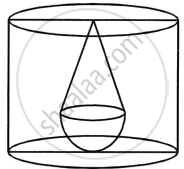
Radius of cylinder = 3 cm
Height of cylinder = 6 cm
Radius of hemisphere = 2 cm
Height of cone = 4 cm
Volume of water in the cylinder when it is full
= πr2h
= π × 3 × 3 × 6
= 54π cm3
Volume of water displaced = Volume of cone + Volume of hemisphere
= `1/3 pir^2h + 2/3 pir^3`
= `1/3 pir^2 (h + 2r)`
= `1/3 pi xx 2 xx 2(4 + 2 xx 2)`
= `1/3 pi xx 4 xx 8`
= `32/3 pi cm^3`
Therefore, volume of water which is left
= `54 pi - 32/3 pi`
= `130/3 pi cm^3`
= `130/3 xx 22/7 cm^3`
= `2860/21 cm^3`
= 136.19 cm3
= 136 cm3
RELATED QUESTIONS
Assuming the earth to be a sphere of radius 6370 km, how many square kilo metres is area
of the land, if three-fourth of the earth’s surface is covered by water?
A cylinder of same height and radius is placed on the top of a hemisphere. Find the curved
surface area of the shape if the length of the shape be 7 cm.
Eight metallic spheres; each of radius 2 mm, are melted and cast into a single sphere. Calculate the radius of the new sphere.
A solid sphere of radius 15 cm is melted and recast into solid right circular cones of radius 2.5 cm and height 8 cm. Calculate the number of cones recast.
A hollow sphere of internal and external radii 6 cm and 8 cm respectively is melted and recast into small cones of base radius 2 cm and height 8 cm. Find the number of cones.
The ratio between the volume of a sphere and volume of a circumscribing right circular cylinder is
A cone, a hemisphere and a cylinder stand on equal bases and have the same height. The ratio of their volumes is
Find the surface area of a sphere, if its volume is 38808 cubic cm. `(π = 22/7)`
From a rectangular solid of metal 42 cm by 30 cm by 20 cm, a conical cavity of diameter 14 cm and depth 24 cm is drilled out. Find: the weight of the material drilled out if it weighs 7 gm per cm3.
The radius of a hemispherical balloon increases from 6 cm to 12 cm as air is being pumped into it. The ratios of the surface areas of the balloon in the two cases is ______.
