Advertisements
Advertisements
प्रश्न
A solid, consisting of a right circular cone standing on a hemisphere, is placed upright, in a right circular cylinder, full of water and touches the bottom. Find the volume of water left in the cylinder, having given that the radius of the cylinder is 3 cm and its height is 6 cm; the radius of the hemisphere is 2 cm and the height of the cone is 4 cm. Give your answer to the nearest cubic centimetre.
Advertisements
उत्तर
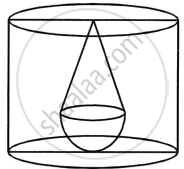
Radius of cylinder = 3 cm
Height of cylinder = 6 cm
Radius of hemisphere = 2 cm
Height of cone = 4 cm
Volume of water in the cylinder when it is full
= πr2h
= π × 3 × 3 × 6
= 54π cm3
Volume of water displaced = Volume of cone + Volume of hemisphere
= `1/3 pir^2h + 2/3 pir^3`
= `1/3 pir^2 (h + 2r)`
= `1/3 pi xx 2 xx 2(4 + 2 xx 2)`
= `1/3 pi xx 4 xx 8`
= `32/3 pi cm^3`
Therefore, volume of water which is left
= `54 pi - 32/3 pi`
= `130/3 pi cm^3`
= `130/3 xx 22/7 cm^3`
= `2860/21 cm^3`
= 136.19 cm3
= 136 cm3
APPEARS IN
संबंधित प्रश्न
Find the total surface area of a hemisphere of radius 10 cm. [Use π = 3.14]
A certain number of metallic cones, each of radius 2 cm and height 3 cm are melted and recast into a solid sphere of radius 6 cm. Find the number of cones.
The surface area of a solid metallic sphere is 2464 cm2. It is melted and recast into solid right circular cones of radius 3.5 cm and height 7 cm. Calculate:
- the radius of the sphere.
- the number of cones recast. (Take π = `22/7`)
A solid sphere of radius 15 cm is melted and recast into solid right circular cones of radius 2.5 cm and height 8 cm. Calculate the number of cones recast.
The surface area of a solid sphere is increased by 12% without changing its shape. Find the percentage increase in its:
- radius
- volume
The diameter of a sphere is 6 cm. It is melted and drawn into a wire of diameter 0.2 cm. Find the length of the wire.
Find the volume of a sphere whose surface area is 154 cm2.
If a sphere is inscribed in a cube, find the ratio of the volume of cube to the volume of the sphere.
The total area of a solid metallic sphere is 1256 cm2. It is melted and recast into solid right circular cones of radius 2.5 cm and height 8 cm. Calculate: the number of cones recasted [π = 3.14]
A spherical cannon ball, 28 cm in diameter is melted and recast into a right circular conical mould, the base of which is 35 cm in diameter. Find the height of the cone, correct to one place of decimal.
