Advertisements
Advertisements
Question
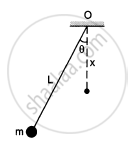
A simple pendulum of length L with a bob of mass m is deflected from its rest position by an angle θ and released (following figure). The string hits a peg which is fixed at a distance x below the point of suspension and the bob starts going in a circle centred at the peg. (a) Assuming that initially the bob has a height less than the peg, show that the maximum height reached by the bob equals its initial height. (b) If the pendulum is released with \[\theta = 90^\circ \text{ and x = L}/2\] , find the maximum height reached by the bob above its lowest position before the string becomes slack. (c) Find the minimum value of x/L for which the bob goes in a complete circle about the peg when the pendulum is released from \[\theta = 90^\circ \]
Advertisements
Solution
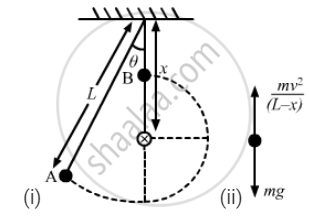
(a) When the bob has an initial height less than the distance of the peg from the suspension point and the bob is released from rest (Fig.(i)),
let body travels from A to B then by the principle of conservation of energy (total energy should always be conserved)
Total energy at A = Total energy at B
\[\text{ i . e }. \left( \text{ K . E .} \right)_A + \left( P . E . \right)_A = \left( K . E . \right)_B + \left( P . E . \right)_B \]
\[ \Rightarrow \left( P . E . \right)_A = \left( P . E . \right)_B \]
\[\text{ because }\left( K . E . \right)_A = \left( K . E . \right)_B = 0\]
So, the maximum height reached by the bob is equal to the initial height of the bob.
(b) When the pendulum is released with θ \[= 90^\circ \text{ and x }= \frac{L}{2},\]
Let the string become slack at point C, so the particle will start making a projectile motion.
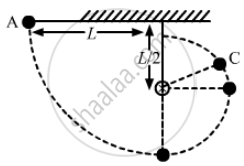
Applying the law of conservation of emergy
\[ \Rightarrow V_c^2 = gL \left( 1 - \cos \alpha \right) . . . (i)\]
From equations (i) and (ii),
\[ \Rightarrow 1 - \cos \alpha = \frac{1}{2} \cos \alpha\]
\[ \Rightarrow \frac{3}{2} \cos \alpha = 1\]
\[ \Rightarrow \cos \alpha = \left( \frac{2}{3} \right) . . . (\text{iii})\]
\[ = \frac{L}{2} + \frac{L}{2} \times \frac{2}{3}\]
\[ = L \left( \frac{1}{2} + \frac{1}{3} \right)\]
\[\text{ So, BF }= \left( \frac{5L}{6} \right)\]
Again, applying energy conservation principle between A and C
\[\left( \frac{1}{2} \right) \text{m}\nu_c^2 - 0 = \text{mg}\left( OC \right)\]
\[ \Rightarrow \left( \frac{1}{2} \right) \text{m}\nu_c^2 = \text{mg}\left\{ L - 2 \left( \text{L - x} \right) \right\}\]
\[ = mg \left( 2\text{x - L} \right)\]
\[ \Rightarrow \nu_c^2 = 2g \left( 2\text{x - L} \right) . . . (\text{ii})\]
From equations (i) and (ii),
\[g \left( L - \text{ x }\right) = 2g \left( 2\text{x - L} \right)\]
\[ \Rightarrow\text{ L - x = 4x - 2L}\]
\[ \Rightarrow 5x = 3L\]
\[ \therefore \frac{x}{L} = \frac{3}{5} = 0 . 6\]
\[\text{ So, the minimum value of } \left( \frac{x}{L} \right) \text{ shoule be }0 . 6 .\]
APPEARS IN
RELATED QUESTIONS
A ball is given a speed v on a rough horizontal surface. The ball travels through a distance l on the surface and stops. what are the initial and final kinetic energies of the ball?
A ball is given a speed v on a rough horizontal surface. The ball travels through a distance l on the surface and stops. What is the work done by the kinetic friction?
Consider the situation of the previous question from a frame moving with a speed v0 parallel to the initial velocity of the block. (a) What are the initial and final kinetic energies? (b) What is the work done by the kinetic friction?
The US athlete Florence Griffith-Joyner won the 100 m sprint gold medal at Seoul Olympics in 1988, setting a new Olympic record of 10⋅54 s. Assume that she achieved her maximum speed in a very short time and then ran the race with that speed till she crossed the line. Take her mass to be 50 kg. Calculate the kinetic energy of Griffith-Joyner at her full speed.
A scooter company gives the following specifications about its product:
Weight of the scooter − 95 kg
Maximum speed − 60 km/h
Maximum engine power − 3⋅5 hp
Pick up time to get the maximum speed − 5 s
Check the validity of these specifications.
A block of mass 30 kg is being brought down by a chain. If the block acquires a speed of 40 cm/s in dropping down 2 m, find the work done by the chain during the process.
A small block of mass 200 g is kept at the top of a frictionless incline which is 10 m long and 3⋅2 m high. How much work was required (a) to lift the block from the ground and put it an the top, (b) to slide the block up the incline? What will be the speed of the block when it reaches the ground if (c) it falls off the incline and drops vertically to the ground (d) it slides down the incline? Take g = 10 m/s2.
Following figure following shows a smooth track, a part of which is a circle of radius R. A block of mass m is pushed against a spring of spring constant k fixed at the left end and is then released. Find the initial compression of the spring so that the block presses the track with a force mg when it reaches the point P, where the radius of the track is horizontal.
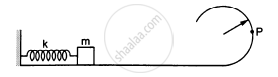
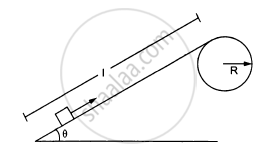
Figure ( following ) shows a smooth track which consists of a straight inclined part of length l joining smoothly with the circular part. A particle of mass m is projected up the incline from its bottom. Find the minimum projection-speed \[\nu_0\] for which the particle reaches the top of the track.
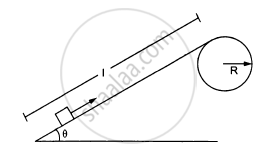
Figure ( following ) shows a smooth track which consists of a straight inclined part of length l joining smoothly with the circular part. A particle of mass m is projected up the incline from its bottom. Assuming that the projection-speed is \[\nu_0\] and that the block does not lose contact with the track before reaching its top, find the force acting on it when it reaches the top.
A chain of length l and mass m lies on the surface of a smooth sphere of radius R > l with one end tied to the top of the sphere. Find the tangential acceleration \[\frac{d\nu}{dt}\] of the chain when the chain starts sliding down.
A smooth sphere of radius R is made to translate in a straight line with a constant acceleration a. A particle kept on the top of the sphere is released at zero velocity with respect to the sphere. Find the speed of the particle with respect to the sphere as a function of the angle θ it slides.
A man, of mass m, standing at the bottom of the staircase, of height L climbs it and stands at its top.
- Work done by all forces on man is equal to the rise in potential energy mgL.
- Work done by all forces on man is zero.
- Work done by the gravitational force on man is mgL.
- The reaction force from a step does not do work because the point of application of the force does not move while the force exists.
Give example of a situation in which an applied force does not result in a change in kinetic energy.
Suppose the average mass of raindrops is 3.0 × 10⁻⁵ kg and their average terminal velocity 9 ms–1. Calculate the energy transferred by rain to each square metre of the surface at a place which receives 100 cm of rain in a year.
A rocket accelerates straight up by ejecting gas downwards. In a small time interval ∆t, it ejects a gas of mass ∆m at a relative speed u. Calculate KE of the entire system at t + ∆t and t and show that the device that ejects gas does work = `(1/2)∆m u^2` in this time interval (neglect gravity).
