Advertisements
Advertisements
Question
A Saturn year is 29.5 times the earth year. How far is the Saturn from the sun if the earth is 1.50 ×10⁸ km away from the sun?
Advertisements
Solution 1
Distance of the Earth from the Sun, re = 1.5 × 10⁸ km = 1.5 × 10¹¹ m
Time period of the Earth = Te
Time period of Saturn, Ts = 29. 5 Te
Distance of Saturn from the Sun = rs
From Kepler’s third law of planetary motion, we have
T = `((4pi^2r^3)/"GM")^(1/2)`
For Saturn and Sun, we can write
`(r_s^3)/(r_e^3) = (T_s^2)/(T_e^2)`
`r_s = r_e (T_s/T_e)^(2/3)`
`=1.5 xx 10^11 ((29.5T_e)/T_e)^(2/3)`
`=1.5 xx 10^11 (29.5)^(2/3)`
`= 1.5 xx 10^11xx 9.55`
`=14.32 xx 10^11` m
Hence, the distance between Saturn and the Sun is `1.43 xx 10^(12)` m.
Solution 2
We know that `T^2 oo R^3`
`:.(T_s^2)/(T_e^2) = (R_s^3)/(R_e^3)`
where subscript s and e refer to the Saturn and Earth respectively.
Now `T_s/T_e = 29.5`[given]; `R_e = 1.50 xx 10^8` km
`(R_s/R_e)^3 = (T_s/T_e)`
`R_s = R_exx [(29.5)^2]^(1/3)`
`= 1.50 xx 10^8 xx (870.25)^"1.3" `km
`= 1.43 xx 10^9 km = 1.43 xx 10^12` m
∴Distance of saturn from Sum `= 1.43 xx 10^(12)` m
APPEARS IN
RELATED QUESTIONS
State Kepler's laws of planetary motion.
In the Following figure shows the elliptical path of a planet about the sun. The two shaded parts have equal area. If t1 and t2 be the time taken by the planet to go from a to b and from c to d respectively,
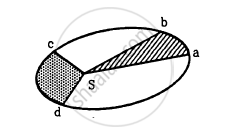
Answer the following question.
State Kepler’s law of the period.
The orbit of a planet revolving around a star is ______.
Observe the given figure and answer these following questions.
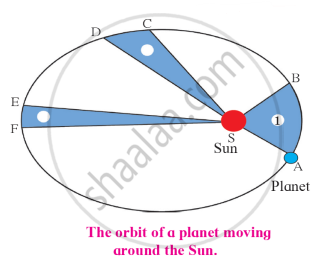
- What is the conclusion about the orbit of a planet?
- What is the relation between velocity of planet and distance from sun?
- ASB, CSD and ESF relation between areas explain.
Write the Kepler’s laws.
State Kepler’s laws.
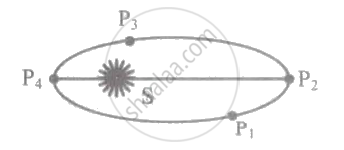
A planet is revolving around the sun in an elliptical orbit as shown in figure. At which point will its K.E. be maximum?
The mass and radius of earth is 'Me' and 'Re' respectively and that of moon is 'Mm' and 'Rm' respectively. The distance between the centre of the earth and that of moon is 'D'. The minimum speed required for a body (mass 'm') to project from a point midway between their centres to escape to infinity is ______.
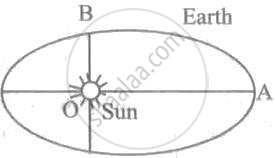
The earth moves around the sun in an elliptical orbit as shown in the figure. The ratio, `"OA"/"OB"` = x. The ratio of the speed of the earth at Band at A is ______.
To verify Kepler's third law graphically four students plotted graphs. Student A plotted a graph of T (period of revolution of planets) versus r (average distance of planets from the sun) and found the plot is straight line with slope 1.85. Student B plotted a graph of T2 v/s r3 and found the plot is straight line with slope 1.39 and negative Y-intercept. Student C plotted graph of log T v/s log r and found the plot is straight line with slope 1.5. Student D plotted graph of log T v/s log r and found the plot is straight line with slope 0.67 and with negative X-intercept. The correct graph is of student
If the sun and the planets carried huge amounts of opposite charges ______.
- all three of Kepler’s laws would still be valid.
- only the third law will be valid.
- the second law will not change.
- the first law will still be valid.
If the sun and the planets carried huge amounts of opposite charges ______.
- all three of Kepler’s laws would still be valid.
- only the third law will be valid.
- the second law will not change.
- the first law will still be valid.
Earth’s orbit is an ellipse with eccentricity 0.0167. Thus, earth’s distance from the sun and speed as it moves around the sun varies from day to day. This means that the length of the solar day is not constant through the year. Assume that earth’s spin axis is normal to its orbital plane and find out the length of the shortest and the longest day. A day should be taken from noon to noon. Does this explain variation of length of the day during the year?
A satellite is in an elliptic orbit around the earth with aphelion of 6R and perihelion of 2 R where R= 6400 km is the radius of the earth. Find eccentricity of the orbit. Find the velocity of the satellite at apogee and perigee. What should be done if this satellite has to be transferred to a circular orbit of radius 6R ?
[G = 6.67 × 10⁻¹¹ SI units and M = 6 × 1024 kg]
A planet revolving in an elliptical orbit has:
- a constant velocity of revolution.
- has the least velocity when it is nearest to the sun.
- its areal velocity is directly proportional to its velocity.
- areal velocity is inversely proportional to its velocity.
- to follow a trajectory such that the areal velocity is constant.
Choose the correct answer from the options given below:
Halley's Comet revolves around the sun for a time period of 76 years. The aphelion distance if perihelion is given by 8.9 × 10¹⁰ m, will be ______.
(Take, the mass of sun = 2 × 1030 kg and G = 6.67 × 10⁻¹¹ Nm3/kg2)
What is one practical use of Kepler’s laws?
