Advertisements
Advertisements
Question
A researcher carried out an experiment in which she took two carrots of similar size. She placed one carrot in plain water and the other carrot in concentrated salt solution (Fig.). After 24 hours she recorded her observations.
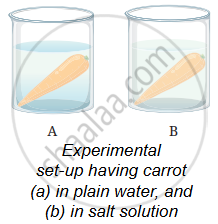
- What hypothesis does she want to test through this experiment?
- What would you suggest for the improvement of this experiment?
- Why does the carrot in plain water stay stiff and crunchy, but the carrot in concentrated salt solution become rubbery and limp?
Very Long Answer
Advertisements
Solution
- The researcher wants to test the effects of osmosis on plant tissue under both hypertonic (salt solution) and hypotonic (plain water) situations. In ordinary water, she expects that water will enter the carrot cells and leave them in a salt solution.
- She may improve this experiment in the ways listed below:
- To accurately determine the starting and final weights, use a digital balance.
- To ensure a fair comparison, cut carrots into equal-sized pieces.
- Every time, use a salt solution with the same concentration.
- To ensure accuracy, repeat the experiment.
- Because water enters the cells through osmosis and increases turgidity, the carrot in simple water remains stiff and crunchy. Because of the increased external salt concentration, the carrot in the salt solution becomes limp and rubbery as water escapes the cells. resulting in plasmolysis, or loss of turgidity.
shaalaa.com
Is there an error in this question or solution?
