Advertisements
Advertisements
Question
Read the following carefully.
| 1. | A recent survey was conducted among 2,000 college students and young professionals to analyse preferences for different types of jobs, including corporate roles, personal start-ups or family businesses, and service professions (example - defense, nursing, police). The study aimed to identify trends in career aspirations, the factors influencing these preferences, and their implications for workforce planning and education systems. Participants were asked to rank their preferences on a five-point scale. |
| 2. | The study covered respondents across urban and semi-urban areas, representing diverse educational, economic, and cultural backgrounds. Researchers ensured diversity in gender, socioeconomic status, and career stages to make the findings representative of a broad spectrum of opinions. Data collection involved online questionnaires and in-person interviews, ensuring a comprehensive understanding of job preferences. The data was displayed as a bar graph given below.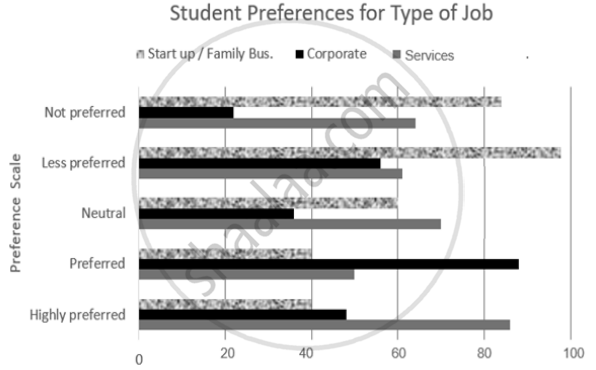 |
| 3. | Corporate jobs were commonly associated with financial stability, growth opportunities, and access to structured career paths. Start-ups and family businesses, on the other hand, appealed to those valuing autonomy, creativity, and the chance to work in more flexible environments. Service professions were perceived as fulfilling and prestigious, especially among individuals motivated by a sense of duty. |
| 4. | The survey also highlighted several challenges. Geographic variations were significant, with urban respondents gravitating more toward corporate roles, while semi-urban participants showed a stronger inclination for service professions and family businesses. Respondents indicated limited mentorship opportunities and a lack of clarity about the long-term prospects of non-corporate careers as barriers influencing their decisions. |
| 5. | The findings provide a foundation for further research into how cultural, regional, and generational influences shape career choices. Future studies could explore factors such as gender-based preferences, emerging industries, mentorship availability, and the role of technological advancements in shaping job markets. Additionally, longitudinal research could track how these preferences evolve as respondents advance in their careers. This could help educational institutions and employers develop tailored strategies to better align with the aspirations and values of young job seekers. Moreover, policies encouraging skill development and mentorship programmes may bridge the gaps identified in this survey, ensuring more informed career decisions among youth. |
Answer the following questions, based on the given passage.
I. What was the main purpose of the survey conducted among 2,000 college students and young professionals? (1)
- To determine the popularity of specific jobs in rural areas versus urban areas.
- To explore patterns in career aspirations and the factors influencing them.
- To analyse the success rate of startups and family businesses.
- To assess the salary expectations of young professionals opting for jobs.
II. Fill in the blank with the correct option from those given in brackets. (1)
The study ensured diversity in gender, socioeconomic status, and career stages to make the findings ______ (accurate/representative/specific).
III. Fill in the blank with reference to the given bar graph chart. (1)
The profession preference for which policymakers primarily need to provide encouraging incentives is ______.
Advertisements
Solution
I. To explore patterns in career aspirations and the factors influencing them.
II. The study ensured diversity in gender, socioeconomic status, and career stages to make the findings representative.
III. The profession preference for which policymakers primarily need to provide encouraging incentives is start-ups/family business.
