Advertisements
Advertisements
Question
| A ray of light travels from a denser to a rarer medium. After refraction, it bends away from the normal. When we keep increasing the angle of incidence, the angle of refraction also increases till the refracted ray grazes along the interface of two media. The angle of incidence for which it happens is called critical angle. If the angle of incidence is increased further the ray will not emerge and it will be reflected back in the denser medium. This phenomenon is called total internal reflection of light. |
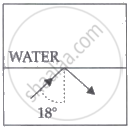
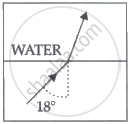
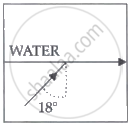
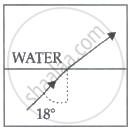
A ray of light travels from a medium into the water at an angle of incidence of 18°. The refractive index of the medium is more than that of water and the critical angle for the interface between the two media is 20°. Which one of the following figures best represents the correct path of the ray of light?
Options
Advertisements
Solution
Explanation:
The incidence angle is smaller than the critical angle. The refracted light will therefore deviate from the normal due to normal refraction from denser to rarer material.
APPEARS IN
RELATED QUESTIONS
When light is refracted, which of the following does not change?
| A ray of light travels from a denser to a rarer medium. After refraction, it bends away from the normal. When we keep increasing the angle of incidence, the angle of refraction also increases till the refracted ray grazes along the interface of two media. The angle of incidence for which it happens is called critical angle. If the angle of incidence is increased further the ray will not emerge and it will be reflected back in the denser medium. This phenomenon is called total internal reflection of light. |
For which of the following media, with respect to air, the value of critical angle is maximum?
What happens to the speed of light when it travels from an optically denser medium to an optically rarer medium?
Which equation is Snell’s law for refraction between two media?
In which medium does light travel faster: a rarer medium or the denser medium with which it is compared?
At the critical angle, what are the angle of incidence and the angle of refraction?
What does Snell’s law become at the critical angle?
After using \[\sin 90^\circ=1\], which equation relates the critical angle to the refractive indices?
Which expression gives the sine of the critical angle for a denser-to-rarer transition?
When \[i=i_c\], what is the angle of refraction?
