Advertisements
Advertisements
Question
A ray of light is incident on a prism whose refractive index is 1.52 at an angle of 40°. If the angle of emergence is 60°, calculate the angle of the prism.
Advertisements
Solution
Given :
`mu = 1.52` `i = 40^circ`
`e = 60^circ` A = ?
`mu = sin i/sin r`
`1.52 = sin 40^circ/sin r`
`therefore sin r = 0.6427/1.52`
`sin r = 0.4228`
`therefore r = sin^-1(0.4228)`
`r = 25.01^circ`
`1/mu = (sin r')/sin e ⇒ sin r' = sin e/mu`
⇒ `sin r' = sin 60^circ/1.52 = 0.866/1.52 = 0.57`
⇒ `r' = sin^-1(0.57) = 34.75^circ`
`therefore A = r + r' = 25.01^circ + 34.75^circ = 59.76^circ`
APPEARS IN
RELATED QUESTIONS
Plot a graph to show the variation of the angle of deviation as a function of the angle of incidence for light passing through a prism. Derive an expression for the refractive index of the prism in terms of angle of minimum deviation and angle of the prism.
A ray of light passes through an equilateral glass prism such that the angle of incidence is equal to the angle of emergence and each of these angles is equal to 3/4 of angle of prism. Find the angle of deviation.
What is a dispersion of light?
Can the dispersive power \[\omega = \frac{\mu_u - \mu_r}{\mu - 1}\] be negative? What is the sign of ω if a hollow prism is immersed into water?
A thin prism of crown glass (μr = 1.515, μv = 1.525) and a thin prism of flint glass (μr = 1.612, μv = 1.632) are placed in contact with each other. Their refracting angles are 5.0° each and are similarly directed. Calculate the angular dispersion produced by the combination.
Calculate dispersive power of a transparent material given : nv = 1.56, nr = 1.54, ny = 1.55.
A narrow beam of monochromatic light, PQ, is incident normally on one face of an equiangular glass prism of refractive index 1.45. When the prism is immersed in a certain liquid, the ray makes a grazing emergence along the other face (See figure). Find the refractive index of this liquid. 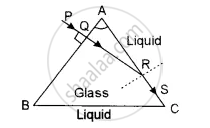
What is meant by the dispersive power of transparent material?
For any prism, obtain a relation between the angle of the prism (A), the angle of minimum deviation (δm) and the refractive index of its material (μ or n).
What is meant by a thin prism?
