Advertisements
Advertisements
Question
A person makes two types of gift items A and B requiring the services of a cutter and a finisher. Gift item A requires 4 hours of the cutter's time and 2 hours of finisher's time. Fifth item B requires 2 hours of the cutter's time and 4 hours of finisher's time. The cutter and finisher have 208 hours and 152 hours available time respectively every month. The profit on one gift item of type A is ₹ 75 and on one gift item of type, B is ₹ 125. Assuming that the person can sell all the gift items produced, determine how many gift items of each type should he make every month to obtain the best returns?
Advertisements
Solution
Let x: number of gift item A
y: number of gift item B
As numbers of the items are never negative
X ≥ 0; y ≥ 0
| A (x) | B (y) | Max.time available | |
| Cutter | 4 | 2 | 208 |
| Finisher | 2 | 4 | 152 |
| Profit | 75 | 125 |
Total time required for the cutter = 4x + 2y
Maximum available time 208 hours
∴ 4x+ 2y ≤ 208
Total time required for the finisher 2x +4y
Maximum available time 152 hours
∴ 2x+ 4y ≤ 152
Total Profit is 75x + 125y
∴ L.P.P. of the above problem is
Minimize Z = 75x + 125y
Subject to 4x+ 2y ≤ 208
2x + 4y ≤ 152
x ≥ 0 ; y ≥ 0
Graphical solution
| 2x + y = 104 | ||
| x | 0 | 52 |
| y | 104 | 0 |
| (0 , 104) (52 , 0) | ||
| x + 2y = 76 | ||
| x | 0 | 0 |
| y | 38 | 76 |
| (0 , 38) (76 , 0) | ||
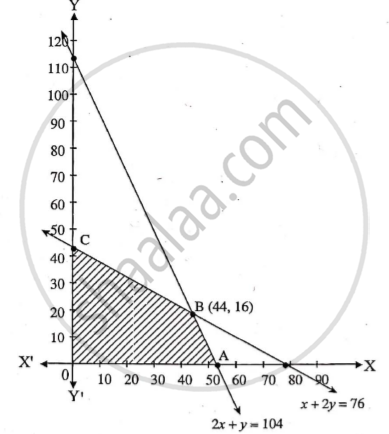
Corner points
Now, Z at
Z = (75x + 125y)
0(0, 0) = 75 x 0 + 125 x 0 = 0
A(52, 0) = 75 x 52 + 125 x 0 = 3900
B(44, 16) = 75 x 44 + 125 x 16 = 5300
C(O, 38) = 75 x 0 + 125 x 38 = 4750
∴ A person should make 44 items of type A and 16 items of type Band his returns are ₹ 5,300.
