Advertisements
Advertisements
Question
A particle A with a charge of 2.0 × 10⁻⁶ C and a mass of 100 g is placed at the bottom of a smooth inclined plane of inclination 30°. Where should another particle B, with the same charge and mass, be placed on the incline so that it may remain in equilibrium?
Advertisements
Solution
Given:
Magnitude of charge on particles A and B, q = 2.0 × 10⁻⁶ C
Mass of particles A and B, m = 100 g = 0.1 kg
Let the separation between the charges be r along the plane.
By Coulomb's Law, force (F) on B due to A,
\[F = \frac{1}{4\pi \epsilon_0}\frac{q^2}{r^2}\] For equilibrium:
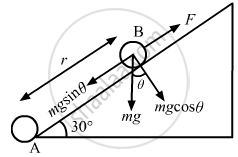
For equilibrium along the plane,
\[F = \text{ mg}\sin\theta\]
\[ \Rightarrow \frac{9 \times {10}^9 \times \left( 2 \times {10}^{- 6} \right)^2}{r^2} = 0 . 1 \times 9 . 8 \times \frac{1}{2}\]
\[ \Rightarrow r^{{}_2} = 7 . 34 \times {10}^{- 2} \]m
\[ \Rightarrow r = 0 . 271 \]m
So, the charge should be placed at a distance of 27 cm from the bottom.
