मराठी
कर्नाटक बोर्ड पी.यू.सी.पीयूसी विज्ञान इयत्ता ११

A Particle a with a Charge of 2.0 × 10⁻⁶ C and a Mass of 100 G is Placed at the Bottom of a Smooth Inclined Plane of Inclination 30°. - Physics

Advertisements
Advertisements

प्रश्न

A particle A with a charge of 2.0 × 10⁻⁶ C and a mass of 100 g is placed at the bottom of a smooth inclined plane of inclination 30°. Where should another particle B, with the same charge and mass, be placed on the incline so that it may remain in equilibrium? 

टीपा लिहा
Advertisements

उत्तर

Given:
Magnitude of charge on particles A and B, q =  2.0 × 10⁻⁶ C
Mass of particles A and B, m = 100 g = 0.1 kg
Let the separation between the charges be r along the plane. 
By Coulomb's Law, force (F) on B due to A,      

\[F = \frac{1}{4\pi \epsilon_0}\frac{q^2}{r^2}\] For equilibrium:
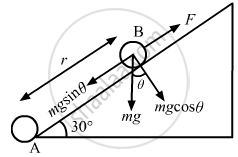
For equilibrium along the plane,

\[F = \text{ mg}\sin\theta\] 

\[ \Rightarrow   \frac{9 \times {10}^9 \times \left( 2 \times {10}^{- 6} \right)^2}{r^2} = 0 . 1 \times 9 . 8 \times \frac{1}{2}\] 

\[ \Rightarrow  r^{{}_2}  = 7 . 34 \times  {10}^{- 2} \]m

\[ \Rightarrow   r = 0 . 271 \]m

So, the charge should be placed at a distance of 27 cm from the bottom.

shaalaa.com
  या प्रश्नात किंवा उत्तरात काही त्रुटी आहे का?
पाठ 7: Electric Field and Potential - Exercises [पृष्ठ १२२]

APPEARS IN

एचसी वर्मा Concepts of Physics Vol. 2 [English] Class 11 and 12
पाठ 7 Electric Field and Potential
Exercises | Q 30 | पृष्ठ १२२

संबंधित प्रश्‍न

Three-point charges q, – 4q and 2q are placed at the vertices of an equilateral triangle ABC of side 'l' as shown in the figure. Obtain the expression for the magnitude of the resultant electric force acting on the charge q

(b) Find out the amount of the work done to separate the charges at infinite distance.


Write any two important points of similarities and differences each between Coulomb's law for the electrostatic field and Biot-Savart's law of the magnetic field ?


Plot a graph showing the variation of coulomb force (F) versus ,`(1/r^2)` where is the distance between the two charges of each pair of charges: (1 μC, 2 μC) and (2 μC, − 3 μC). Interpret the graphs obtained.


At what separation should two equal charges, 1.0 C each, be placed, so that the force between them equals the weight of a 50 kg person? 


Two equal charges are placed at a separation of 1.0 m. What should be the magnitude of the charges, so that the force between them equals the weight of a 50 kg person?


Find the electric force between two protons separated by a distance of 1 fermi (1 fermi = 10−15 m). The protons in a nucleus remain at a separation of this order. 


Suppose all the electrons of 100 g water are lumped together to form a negatively-charged particle and all the nuclei are lumped together to form a positively-charged particle. If these two particles are placed 10.0 cm away from each other, find the force of attraction between them. Compare it with your weight.


Four equal charges of 2.0 × 10⁻⁶ C each are fixed at the four corners of a square of side 5 cm. Find the Coulomb's force experienced by one of the charges due to the other three. 


Ten positively-charged particles are kept fixed on the x-axis at points x = 10 cm, 20 cm, 30 cm, ...., 100 cm. the first particle has a charge 1.0 × 10⁻⁸ C, the second 8 × 10⁻⁸ C, the third 27 × 10−8 C and so on. The tenth particle has a charge 1000 × 10−8 C.  Find the magnitude of the electric force acting on a 1 C charge placed at the origin. 


Two identically-charged particles are fastened to the two ends of a spring of spring constant 100 N m−1 and natural length 10 cm. The system rests on a smooth horizontal table. If the charge on each particle is 2.0 × 10⁻⁸ C, find the extension in the length of the spring. Assume that the extension is small as compared to the natural length. Justify this assumption after you solve the problem.  


Two identical particles, each with a charge of 2.0 × 10⁻⁴ C and mass of 10 g, are kept at a separation of 10 cm and then released. What would be the speed of the particles when the separation becomes large?


Solve numerical example.

Three equal charges of 10×10-8 C respectively, each located at the corners of a right triangle whose sides are 15 cm, 20 cm, and 25cm respectively. Find the force exerted on the charge located at the 90° angle.


For charges q1 and q2 separated by a distance R the magnitude of the electrostatic force is given by ______.


The law, governing the force between electric charges is known as ______.

Coulomb’s law is true for ______.

Two identical thin rings, each of radius a meter, are coaxially placed at a distance R meter apart. If Q1 coulomb and Q2 coulomb are respectively the charges uniformly spread on the two rings, the work done in moving a charge q coulomb from the centre of one ring to that of the other is ______.


Two point charges +2 C and +6 C repel each other with a force of 12 N. If a charge of -4 C is given to each of these charges, then the force now is ______.


What is meant by the statement: "Relative permittivity of water is 81"?


Share
Notifications

Englishहिंदीमराठी


      Forgot password?
Use app×