Advertisements
Advertisements
Question
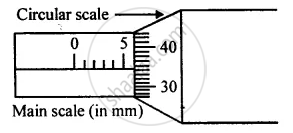
A micrometre screw gauge having a positive zero error of 5 divisions is used to measure diameter of a wire, when reading on the main scale is 3rd division and the 48th circular scale division coincides with baseline. If the micrometer has 10 divisions to a centimetre on the main scale and 100 divisions on a circular scale, calculate
- Pitch of screw
- Least count of screw
- Observed diameter
- Corrected diameter.
Advertisements
Solution
(1) Micrometre has 10 divisions in one centimetre on the main scale.
∴ Pitch = `"Unit"/"No. of divisions in unit"`
Pitch = `(1 "cm")/10`
= 0.1 cm
(2) No. of circular scale divisions = 100
∴ Least count (L.C.) = `"Pitch"/"No. of circular divisions"`
= `(0.1 "cm")/100`
= 0.001 cm
(3) Reading on main scale is 3rd division.
⇒ Main scale reading = 3 mm = 0.3 cm.
Circular scale reading = 48 div.
Observed diameter = M.S. reading + L.C. × C.S. reading
= 0.3 + 0.001 × 48
= 0.3 + 0.048
= 0.348 cm
(4) Positive zero error = +5 divisions
∴ Correction = −(Error × L.C.)
= −(5 × 0.001)
= −0.005 cm
∴ Corrected diameter = Observed diameter + Correction
= 0.348 − 0.005
= 0.343 cm
APPEARS IN
RELATED QUESTIONS
Name the part of the vernier callipers which is used to measure the following
External diameter of a tube
The diameter of a thin wire can be measured by
A screw has a pitch equal to 0.5 mm. What should be the number of divisions on its head so as to read correctly up to 0.001 mm with its help?
A pendulum completes 2 oscillations in 5 s. What is its time period? If g = 9.8 m s-2, find its length.
In a vernier callipers, 19 main scale divisions coincide with 20 vernier scale divisions. If the main scale has 20 divisions in a centimetre, calculate
- pitch
- L.C. of vernier callipers.
State the formula for calculating length if:
The reading of the main scale is known and the number of vernier scale divisions coinciding with the main scale is known.
State the correction if the negative error is 7 divisions when the least count is 0.01 cm.
Figure shows a screw gauge in which circular scale has 200 divisions. Calculate the least count and radius of the wire.
What is the backlash error?
