Advertisements
Advertisements
Question
A manufacturer produces nuts and bolts. It takes 1 hour of work on machine A and 3 hours on machine B to produce a package of nuts. It takes 3 hours on machine A and 1 hour on machine B to produce a package of bolts. He earns a profit of ₹ 35 per package of nuts and ₹ 14 per package of bolts. How many packages of each should be produced each day so as to maximize his profit, if he operates each machine for almost 12 hours a day? convert it into an LPP and solve graphically.
Advertisements
Solution
Let the manufacturer produce x packages of nuts and y packages of bolts. Therefore,
x ≥ 0 and y ≥ 0
The given information can be compiled in a table as follows.
| Nuts | Bolts | Availability | |
| Machine A (h) | 1 | 3 | 12 |
| Machine B (h) | 3 | 1 | 12 |
The profit on a package of nuts is Rs 35 and on a package of bolts is Rs 14. Therefore, the constraints are
x + 3y ≤ 12
3x + y ≤ 12
Total profit, Z = 35x + 14y
The mathematical formulation of the given problem is
Maximise Z = 35x + 14y ...… (1)
subject to the constraints,
x + 3y ≤ 12 ....… (2)
3x + y ≤ 12 ….... (3)
x, y ≥ 0 …........ (4)
The feasible region determined by the system of constraints is as follows.
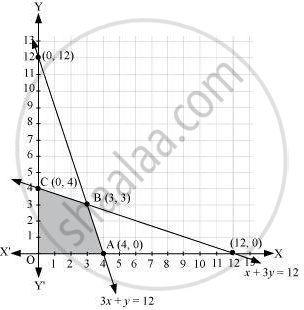
The corner points are A(4, 0), B(3, 3), and C(0, 4).
The values of Z at these corner points are as follows.
| Corner point | Z = 35 x + 14 y |
| O(0, 0) | 0 |
| A(4, 0) | 140 |
| B(3, 3) | 147 → Maximum |
| C(0, 4) | 56 |
The maximum value of Z is Rs 147 at (3, 3).
Thus, 3 packages of nuts and 3 packages of bolts should be produced each day to get the maximum profit of Rs 147.
