Advertisements
Advertisements
Question
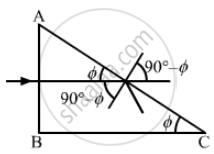
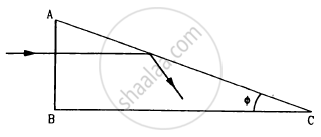
A light ray is incident normally on the face AB of a right-angled prism ABC (μ = 1.50) as shown in figure. What is the largest angle ϕ for which the light ray is totally reflected at the surface AC?
Advertisements
Solution
Given,
Refractive index (μ) of prism = 1.50
Let us take θc as the critical angle for the glass.
So, According to Snell's law,
\[\frac{\sin \theta_c}{\sin 90^\circ } = \frac{1}{\mu}\]
\[\Rightarrow \sin \theta c = \frac{1}{1 . 5} = \frac{2}{3}\]
\[\Rightarrow \theta_c = \sin^{- 1} \frac{2}{3}\]
Condition for total internal reflection: 90° − \[\phi\] θc
⇒ \[\phi\] < 90° - θc
\[\Rightarrow \theta_c = \sin^{- 1} \frac{2}{3}\]
\[\Rightarrow \phi < \cos^{- 1} \left( \frac{2}{3} \right)\]
Hence, the largest angle for which light is totally reflected at the surface AC is \[\cos^{- 1} \left( \frac{2}{3} \right)\]