Advertisements
Advertisements
Question
A ladder 10 meter long is leaning against a vertical wall. If the bottom of the ladder is pulled horizontally away from the wall at the rate of 1.2 meters per seconds, find how fast the top of the ladder is sliding down the wall when the bottom is 6 meters away from the wall
Advertisements
Solution
Let AC be the ladder. BC = x be the distance of the bottom of the ladder from the wall and AB = y be the distance of the top of the ladder from the floor.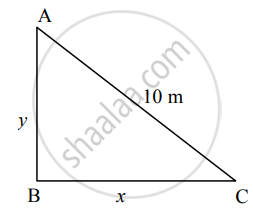
Then, `("d"x)/"dt"` = 1.2 m/sec, AC =10 m, BC = 6 m .......[Given]
By Pythagoras theorem, we get
x2 + y2 = AC2
∴ y2 = AC2 – x2
∴ y2 = (10)2 – x2 .......(i)
Differentiating w.r.t. t, we get
`2y ("d"y)/"dt" = -2x ("d"x)/"dt"`
∴ `("d"y)/"dt" = (-x)/y*("d"x)/"dt"`
= `(-6(1.2))/y` .......(ii)
Substituting x = 6 in (i), we get
y2 = (10)2 – (6)2
= 100 – 36
= 64
∴ y = 8
Substituting y = 8 in (ii), we get
`("d"y)/"dt" = ((-6)(1.2))/8`
= – 0.9 metre/sec
Thus, the top of the ladder is sliding down at the rate of 0.9 meters/sec.
