Advertisements
Advertisements
Question
A force is applied on (i) a non-rigid body and (ii) a rigid body. How does the effect of the force differ in the above two cases?
Advertisements
Solution
When force is applied on a non-rigid body it undergoes deformation i.e. change in size, shape, and position whereas a rigid body doesn’t undergo a change in shape, position, and size.
APPEARS IN
RELATED QUESTIONS
State two effects of a force when applied on a body.
State the S.I. unit of moment of force.
It is easier to open the door by pushing it at its free end.
Is moment of force a scalar or a vector?
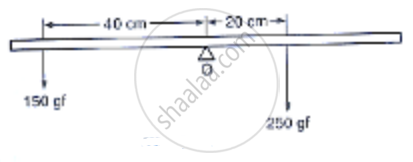
The diagram in the figure shows a uniform metre rule weighing 100 gf, pivoted as its centre O. two weight 150 gf and 250 gf hang from the point A and B respectively of the metre rule such that OA = 40 cm and OB = 20 cm . Calculate
the total anticlockwise moment about o.
One joule is the amount of work done when a force of ......... moves a body through a distance of .......
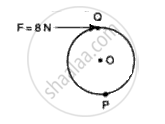
A wheel of diameter 3 m is shown in fig. 2 with axle at 0. A force F = 8 N is applied at Q in the direction shown in figure. Calculate the moment of force about:
(i) centre o, and
(ii) point p.
In a beam balance when the beam is balanced in a horizontal position, it is in ________ equilibrium.
A uniform metre rule rests horizontally on a knife-edge at the 60 cm mark when a mass of 10 gram is suspended from one end. At which end must this mass be suspended? What is the mass of the rule?
