Advertisements
Advertisements
Question
A deflection magnetometer is placed with its arms in north-south direction. How and where should a short magnet having M/BH = 40 A m2 T−1 be placed so that the needle can stay in any position?
Advertisements
Solution
Given :
Ratio , `M/B_H = 40 "Am"^2"/"T`
Since the magnet is short, l can be neglected.
So, using the formula for `M/B_H` from the magnetometer theory and substituting all values, we get
`M/B_H = (4pi)/(u_0) (d^3)/2 = 40`
⇒ `d^3 = 40 xx 10^-7 xx 2`
⇒ `d^3 = 8 xx 10^-6`
⇒ `d = 2 xx 10^-2 "m" = 2 "cm"`
Thus, the magnet should be placed in such a way that its north pole points towards the south and it is 2 cm away from the needle.
APPEARS IN
RELATED QUESTIONS
Can we have a single north pole, or a single south pole?
Compare the direction of the magnetic field inside a solenoid with that of the field there if the solenoid is replaced by its equivalent combination of north pole and south pole.
A dip circle is taken to geomagnetic equator. The needle is allowed to move in a vertical plane perpendicular to the magnetic meridian. The needle will stay ______.
Which of the following four graphs may best represent the current-deflection relation in a tangent galvanometer?
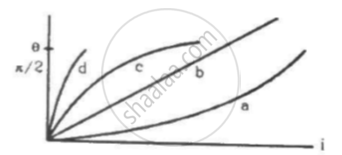
A tangent galvanometer is connected directly to an ideal battery. If the number of turns in the coil is doubled the deflection will
To measure the magnetic moment of a bar magnet, one may use
(a) a tangent galvanometer
(b) a deflection galvanometer if the earth's horizontal field is known
(c) an oscillation magnetometer if the earth's horizontal field is known
(d) both deflection and oscillation magnetometer if the earth's horizontal field is not known
Two long bare magnets are placed with their axes coinciding in such a way that the north pole of the first magnet is 2.0 cm from the south pole of the second. If both the magnets have a pole strength of 10 Am, find the force exerted by one magnet of the other.
The magnetic field at a point, 10 cm away from a magnetic dipole, is found to be `2.0 xx 10^-4 "T"` . Find the magnetic moment of the dipole if the point is (a) in end-on position of the dipole and (b) in broadside-on position of the dipole.
Show that the magnetic field at a point due to a magnetic dipole is perpendicular to the magnetic axis if the line joining the point with the centre of the dipole makes an angle of `tan^-1(sqrt 2)` with the magnetic axis
Do permeability and relative permeability have the same dimensions?
A short magnet produces a deflection of 37° in a deflection magnetometer in Tan-A position when placed at a separation of 10 cm from the needle. Find the ratio of the magnetic moment of the magnet to the earth's horizontal magnetic field.
The magnetometer of the previous problem is used with the same magnet in Tan-B position. Where should the magnet be placed to produce a 37° deflection of the needle?
A bar magnet takes π/10 second the complete one oscillation in an oscillation magnetometer. The moment of inertia of the magnet about the axis of rotation is 1.2 × 10⁻⁴ kg m2 and the earth's horizontal magnetic field is 30 μT. Find the magnetic moment of the magnet.
A short magnet makes 40 oscillations per minute when used in an oscillation magnetometer at a place where the earth's horizontal magnetic field is 25 μT. Another short magnet of magnetic moment 1.6 A m2 is placed 20 cm east of the oscillating magnet. Find the new frequency of oscillation if the magnet has its north pole (a) towards north and (b) towards south.
Which property of soft iron makes it useful for preparing electromagnet?
What should be retentivity and coercivity of permanent magnet?
Which magnetic properties are desirable for making a permanent magnet?
