Advertisements
Advertisements
Question
A current-carrying straight wire is held in exactly vertical position. If the current passes through this wire in the vertically upward direction, what is the direction of magnetic field produced by it? Name the rule used to find the direction of magnetic field.
Advertisements
Solution
It is given that the current-carrying straight wire is held in vertical position. If current passes through this wire in vertically upward direction, magnetic field produced by it will be in anticlockwise direction. Right hand thumb rule will be used to find the direction of magnetic field.
APPEARS IN
RELATED QUESTIONS
A positively-charged particle (alpha-particle) projected towards west is deflected towards north by a magnetic field. The direction of magnetic field is ______.
Which of the following correctly describes the magnetic field near a long straight wire?
What concealed do you get from the observation that a current-carrying wire deflects a compass needle placed near it?
State whether the following statement is true or false:
The magnetic field inside a long circular coil carrying current well be parallel straight lines.
Name any two factors on which the strength of magnetic field produced by a current-carrying solenoid depends. How does it depend on these factors?
What is a solenoid? Draw a sketch to show the magnetic field pattern produced by a current-carrying solenoid.
If the current in a wire is flowing in the vertically downward direction and a magnetic field is applied from west to east, what is the direction of force in the wire?
State condition when magnitude of force on a current carrying conductor placed in a magnetic field is maximum?
State the unit of magnetic field in terms of the force experienced by a current carrying conductor placed in a magnetic field
State under what conditions force acting on a current carrying conductor which is freely suspended in a magnetic field can be maximum.
Write Fleming’s left hand rule.
The north pole of Earth’s magnet is in the ____________.
A current-carrying conductor is held in an exactly vertical direction. In order to produce a clockwise magnetic field around the conductor, the current should be passed in the conductor:
A current flows in a wire running between the S and N poles of a magnet lying horizontally as shown in the figure below:

The force on the wire due to the magnet is directed ____________.
When current is parallel to a magnetic field, then force experience by the current-carrying conductor placed in a uniform magnetic field is ____________.
Which of the following factors affect the strength of force experience by current-carrying conduct in a uniform magnetic field?
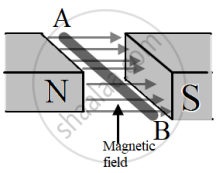
The diagram below shows a free conductor AB is kept in a magnetic field and is carrying current from A to B. (To avoid confusion complete path of the circuit is not shown) The direction of the force experienced by the conductor will be:
Describe the activity that shows that a current-carrying conductor experiences a force perpendicular to its length and the external magnetic field. How does Fleming’s left-hand rule help us to find the direction of the force acting on the current carrying conductor?
Two LED bulbs of 10W and 5W are connected in series. If the current flowing through 5W bulb is 0.005A, the current flowing through 10W bulb is ______.
If the strength of the current flowing through a wire is increased, the strength of the magnetic field produced by it ______.
