Advertisements
Advertisements
Question
A cottage industry manufactures pedestal lamps and wooden shades, each requiring the use of a grinding/cutting machine and a sprayer. It takes 2 hours on the grinding/cutting machine and 3 hours on the sprayer to manufacture a pedestal lamp. It takes 1 hour on the grinding/cutting machine and 2 hours on the sprayer to manufacture a shade. On any day, the sprayer is available for at the most 20 hours and the grinding/cutting machine for at most 12 hours. The profit from the sale of a lamp is Rs 25 and that from a shade is Rs 15. Assuming that the manufacturer can sell all the lamps and shades that he produces, how should he schedule his daily production in order to maximise his profit? Formulate an LPP and solve it graphically.
Advertisements
Solution
Let the cottage industry manufacture x pedestal lamps and y wooden shades.
Therefore,
\[x \geq 0\] and \[y \geq 0\].
The given information can be compiled in a table as shown:
| Pedestal Lamps(x) | Wooden Shades(y) | Time Available | |
| Grinding/Cutting(hours) | 2 | 1 | \[\leqslant\] 12 |
| Sprayer(hours) | 3 | 2 | \[\leqslant\]20 |
| Profit(Rs.) | 25 | 15 |
So,
total profit = 25x+15y
i.e. Z = 25x+15y
So, we have to maximise Z = 25x+15y, subject to the following constraints:
\[2x + y \leqslant 12\]
\[3x + 2y \leqslant 20\]
\[x \geqslant 0, y \geqslant 0 (\text { non - negative constraints })\]
The feasible region determined by the system of constraints is as shown:
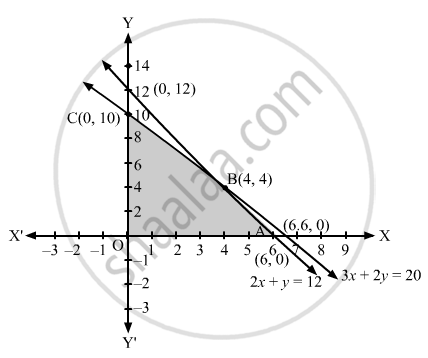
Now, evaluate the objective function Z at each corner point.
| Corner Point | Z=25x+15y |
| O(0,0) | 0 |
| A (6,0) | 150 |
| B(4,4) | 160 |
| C(0,10) | 150 |
So, maximum value of Z is 160 at B(4,4).
Hence, the manufacturer should produce 4 pedestal lamps and 4 wooden shades to maximise his profit.
