Advertisements
Advertisements
Question
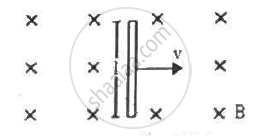
A conducting wire of length l, lying normal to a magnetic field B, moves with a velocity v,as shown in the figure. (a) Find the average magnetic force on a free electron of the wire. (b) Due to this magnetic force, electrons concentrate at one end, resulting in an electric field inside the wire. The redistribution stops when the electric force on the free electrons balances the magnetic force. Find the electric field developed inside the wire when the redistribution stops. (c) What potential difference is developed between the ends of the wire?
Advertisements
Solution
Given:-
Length of the conducting wire = l
Inward magnetic field = B
Velocity of the conducting wire = v
As the wire is moving with velocity v, we can consider this as the net motion of electrons inside the wire with velocity v.
(a) The average magnetic force on a free electron of the wire
= e(v × B) = evB, where e is the charge of an electron.
(b) The redistribution stops when the electric force is just balanced by the magnetic force.
Electric force, F = eE and also magnetic force, F = evB
On equatinging the two forces, we get:-
eE = evB
⇒ E = vB
(c) The potential difference is developed between the ends of the wire:-
V = lE = lvB, where V is the potential difference across the ends of the wire.
APPEARS IN
RELATED QUESTIONS
In a cyclotron, magnetic field of 3·5Wb/m2 is used to accelerate protons. What should be the time interval in which the electric field between the Dees be reversed?
(Mass of proton = 1· 67 x 10-27Kg, Charge on proton =1·6x10-19c).
State the underlying principle of a cyclotron. Write briefly how this machine is used to accelerate charged particles to high energies
Deduce an expression for the frequency of revolution of a charged particle in a magnetic field and show that it is independent of velocity or energy of the particle.
If a watch-glass containing a small quantity of water is placed on two dissimilar magnetic poles, then water ______.
A deuteron and a proton are accelerated by the cyclotron. Can both be accelerated with the same oscillator frequency? Give reason to justify your answer.
A proton and an electron travelling along parallel paths enter a region of uniform magnetic field, acting perpendicular to their paths. Which of them will move in a circular path with higher frequency?
Draw a schematic sketch of a cyclotron. Explain clearly the role of crossed electric and magnetic field in accelerating the charge. Hence derive the expression for the kinetic energy acquired by the particles.
Explain the principle and working of a cyclotron with the help of a schematic diagram. Write the expression for cyclotron frequency.
A cyclotron is used to accelerate protons to a kinetic energy of 5 MeV. If the strength of magnetic field in the cyclotron is 2T, find the radius and the frequency needed for the applied alternating voltage of the cyclotron. (Given : Velocity of proton= `3xx10^7 m//s`)
Verify that the units weber and volt second are the same.
If a charged particle kept at rest experiences an electromagnetic force,
(a) there must be an electric field
(b) there must be a magnetic field
(c) both fields cannot be zero
(d) both fields can be non-zero
An electron is projected horizontally with a kinetic energy of 10 keV. A magnetic field of strength 1.0 × 10⁻⁷ T exists in the vertically upward direction.
(a) Will the electron deflect towards the right or left of its motion?
(b) Calculate the sideways deflection of the electron while travelling through 1 m. Make appropriate approximations.
(a) An electron moves along a circle of radius 1 m in a perpendicular magnetic field of strength 0.50 T. What would be its speed? Is it reasonable? (b) If a proton moves along a circle of the same radius in the same magnetic field, what would be its speed?
Cyclotron is used to ______.
A charged particle is moving in a cyclotron, what effect on the radius of path of this charged particle will occur when the frequency of the ratio frequency field is doubled?
An aircraft executes a horizontal loop of radius 1.00 km with a steady speed of 900 km/h. Its centripetal acceleration is ______.
The life time of muon in the rest frame is 2 × 10⁻⁶ sec. A beam of muons emerges from a cyclotron with velocity where c is the velocity of light The mean life of muons observed in the laboratory frame will be ______.
In a cyclotron, a charged particle ______.
