Advertisements
Advertisements
प्रश्न
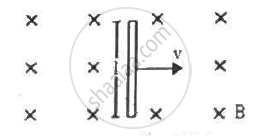
A conducting wire of length l, lying normal to a magnetic field B, moves with a velocity v,as shown in the figure. (a) Find the average magnetic force on a free electron of the wire. (b) Due to this magnetic force, electrons concentrate at one end, resulting in an electric field inside the wire. The redistribution stops when the electric force on the free electrons balances the magnetic force. Find the electric field developed inside the wire when the redistribution stops. (c) What potential difference is developed between the ends of the wire?
Advertisements
उत्तर
Given:-
Length of the conducting wire = l
Inward magnetic field = B
Velocity of the conducting wire = v
As the wire is moving with velocity v, we can consider this as the net motion of electrons inside the wire with velocity v.
(a) The average magnetic force on a free electron of the wire
= e(v × B) = evB, where e is the charge of an electron.
(b) The redistribution stops when the electric force is just balanced by the magnetic force.
Electric force, F = eE and also magnetic force, F = evB
On equatinging the two forces, we get:-
eE = evB
⇒ E = vB
(c) The potential difference is developed between the ends of the wire:-
V = lE = lvB, where V is the potential difference across the ends of the wire.
APPEARS IN
संबंधित प्रश्न
Which one of the following particles cannot be accelerated by a cyclotron?
(A) Electrons
(B) Protons
(C) Deuterons
(D) α- particles
State the underlying principle of a cyclotron. Write briefly how this machine is used to accelerate charged particles to high energies
Deduce an expression for the frequency of revolution of a charged particle in a magnetic field and show that it is independent of velocity or energy of the particle.
A deuteron and a proton are accelerated by the cyclotron. Can both be accelerated with the same oscillator frequency? Give reason to justify your answer.
A proton and an electron travelling along parallel paths enter a region of uniform magnetic field, acting perpendicular to their paths. Which of them will move in a circular path with higher frequency?
A cyclotron is used to accelerate protons to a kinetic energy of 5 MeV. If the strength of magnetic field in the cyclotron is 2T, find the radius and the frequency needed for the applied alternating voltage of the cyclotron. (Given : Velocity of proton= `3xx10^7 m//s`)
Consider a 10-cm long portion of a straight wire carrying a current of 10 A placed in a magnetic field of 0.1 T making an angle of 53° with the wire. What magnetic force does the wire experience?
\[\ce{Fe+}\] ions are accelerated through a potential difference of 500 V and are injected normally into a homogeneous magnetic field B of strength 20.0 mT. Find the radius of the circular paths followed by the isotopes with mass numbers 57 and 58. Take the mass of an ion = A (1.6 × 10⁻²⁷) kg, where A is the mass number.
Answer the following question.
State the underlying principle of a cyclotron. Explain its working with the help of a schematic diagram. Obtain the expression for cyclotron frequency.
Cyclotron is used to ______.
A charged particle is moving in a cyclotron, what effect on the radius of path of this charged particle will occur when the frequency of the ratio frequency field is doubled?
Which of the following is not correct about cyclotron?
An aircraft executes a horizontal loop of radius 1.00 km with a steady speed of 900 km/h. Its centripetal acceleration is ______.
The cyclotron was designed by ______
A cyclotron can accelerate ______.
In a cyclotron, a charged particle ______.
Describe the motion of a charged particle in a cyclotron if the frequency of the radio frequency (rf) field were doubled.
