Advertisements
Advertisements
Question
A concave lens always forms a virtual image.
Options
True
False
Advertisements
Solution
This statement is True.
Explanation:
A concave lens diverges light rays, resulting in a virtual, erect, and diminished image that cannot be projected onto a screen.
APPEARS IN
RELATED QUESTIONS
The distance between principal focus and optical centre of the lens is _________.
- diameter
- focal length
- principal axis
- optical centre
Define focal length of a divergent lens.
Suppose you have focused on a screen the image of candle flame placed at the farthest end of the laboratory table using a convex lens. If your teacher suggests you to focus the parallel rays of the sun, reaching your laboratory table, on the same screen, what you are expected to do is to move the:
(a) lens slightly towards the screen
(b) lens slightly away from the screen
(c) lens slightly towards the sun
(d) lens and screen both towards the sun
State two differences between a convex and a concave lens.
If a spherical lens has a power of, −0.25 D, the focal length of this lens will be :
(a) −4 cm
(b) −400 mm
(c) −4 m
(d) −40 cm
A convex lens forms an image of an object equal to the size of the object. Where is the object placed in front of the lens?
A lens forms the image of an object placed at a distance 15 cm from it, at a distance 60 cm in front of it. Find the nature of image.
My grandfather uses a bifocal lens in his spectacle. Explain why.
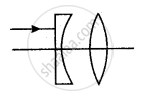
Complete the ray diagram to show how the rays pass into and out of the lens?
Complete the following table for convex lens:
| Sr. No. | Position of the object | Position of the image | Nature of the image |
| 1. | Beyond 2F1 | __________________ | ________________________ |
| 2. | __________________ | At infinity | ________________________ |
| 3. | __________________ | __________________ | Real, inverted and enlarged |
