Advertisements
Advertisements
Question
A company produces mixers and food processors. Profit on selling one mixer and one food processor is Rs 2,000 and Rs 3,000 respectively. Both the products are processed through three machines A, B, C. The time required in hours for each product and total time available in hours per week on each machine arc as follows:
| Machine | Mixer | Food Processor | Available time |
| A | 3 | 3 | 36 |
| B | 5 | 2 | 50 |
| C | 2 | 6 | 60 |
How many mixers and food processors should be produced in order to maximize the profit?
Advertisements
Solution
Let x = number of mixers are sold
y = number of food processors are sold
Profit function z = 2000x + 3000y
This is the objective function which is to be maximized. From the given table in the problem, the constraints are
3x + 3y ≤ 36 (above machine A)
5x 2y ≤ 50 ( about machine B)
2x + 6y ≤ 60 ( about machine C)
As the number of mixers and food processors are non-negative.
x ≥ 0, y ≥ 0
Mathematical model of L.P.P. is
Maximize Z = 2000x + 3000y Subject to
3x + 3y ≤ 36, 5x 2y ≤ 50, 2x + 6y ≤ 60
and x ≥ 0, y ≥ 0
First we draw the lines AB, CD and EF whose equations are 3x + 3y = 36, 5x + 2y = 50 and 2x + 6y = 60 respectively.
| Line | Equation | Points on the X-axis | Points on the Y-axis | Sign | Region |
| AB | 3x + 3y = 36 | A(12,0) | B(0,12) | ≤ | origin side of line AB |
| CD | 5x + 2y = 50 | C(10,0) | D(0,25) | ≤ | origin side of line CD |
| EF | 2x + 6y = 60 | E(30,0) | F(0,10) | ≤ | origin side of line EF |
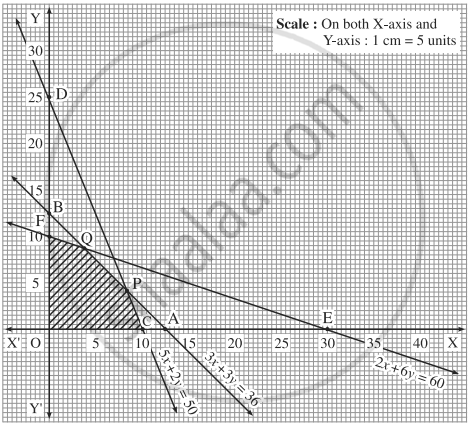
The feasible region is OCPQFO which is shaded in the graph.
The vertices of the feasible region are O (0, 0), C (10, 0), P, Q and F (0, 10).
P is the point of intersection of the lines
3x + 3y = 36 ....(1)
and 5x + 2y = 50 ....(2)
Multiplying equation (1) by 2 and equation (2) by 3, we get,
6x + 6y = 72
15x + 6y = 150
On subtracting, we get
9x = 78
∴ x = `26/3`
∴ from (1), `3(26/3) + 3"y" = 36`
∴ 3y = 10
∴ y = `10/3`
∴ P = `(26/3,10/3)`
Q is the point of intersection of the lines
3x + 3y = 36 . ...(1)
and 2x + 6y = 60 ...(2)
Multiplying equation (1) by 2, we get
6x + 6y = 72
Subtracting equation (3), from this equation, we get
4x = 12
∴ x = 3
∴ from (1), 3(3) + 3y = 36
∴ 3y = 27
∴ y = 9
∴ Q = (3, 9)
The values of the objective function z = 2000x + 3000y at these vertices are
z(O) = 2000(0) + 3000(0) = 0 + 0 = 0
z(C) = 2000(10) + 3000(0) = 20000 + 0 = 20000
z(P) = `2000(26/3) + 3000(10/3) = 52000/3 + 30000/3 = 82000/3`
z(Q) = 2000(3) + 3000(9) = 6000 + 27000 = 33000
z(F) = 2000(0) + 3000(10) = 30000 + 0 = 30000
∴ the maximum value of z is 33000 at the point (3, 9).
Hence, 3 mixers and 9 food processors should be produced in order to get the maximum profit of ₹ 33,000.
