Advertisements
Advertisements
Question
A company manufactures two types of novelty souvenirs made of plywood. Souvenirs of type A require 5 minutes each for cutting and 10 minutes each for assembling. Souvenirs of type B require 8 minutes each for cutting and 8 minutes each for assembling. There are 3 hours 20 minutes available for cutting and 4 hours of assembling. The profit is Rs 5 each for type A and Rs 6 each for type B souvenirs. How many souvenirs of each type should the company manufacture in order to maximize the profit?
Advertisements
Solution
Let the company manufacture x souvenirs of type A and y souvenirs of type B. Therefore,
x ≥ 0 and y ≥ 0
The given information can be complied in a table as follows
| Type A | Type B | Availability | |
| Cutting (min) | 5 | 8 | 3 × 60 + 20 =200 |
| Assembling (min) | 10 | 8 | 4 × 60 = 240 |
The profit on type A souvenirs is Rs 5 and on type B souvenirs is Rs 6. Therefore, the constraints are
`5x+8y<=200`
`10x+8y<=240` i.e.,`5x+4y<=120`
Total profit, Z = 5x + 6y
The mathematical formulation of the given problem is
Maximize Z = 5x + 6y … (1)
subject to the constraints,
`5x+8y<=200`… (2)
`5x+4y<=120` … (3)
x, y ≥ 0 … (4)
The feasible region determined by the system of constraints is as follows.
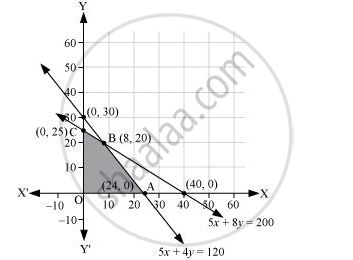
The corner points are A (24, 0), B (8, 20), and C (0, 25).
The values of Z at these corner points are as follows.
| Corner point | Z = 5x + 6y | |
| A(24, 0) | 120 | |
| B(8, 20) | 160 | → Maximum |
| C(0, 25) | 150 |
The maximum value of Z is 200 at (8, 20).
Thus, 8 souvenirs of type A and 20 souvenirs of type B should be produced each day to get the maximum profit of Rs 160.
