Advertisements
Advertisements
Question
A burning candle in water
Take a shoe box, open on one side. Place a small lighted candle in it. Place a clear glass sheet (roughly 25 cm × 25 cm) in front of this candle figure. Try to locate the image of the candle behind the glass sheet. Place a glass of water at its position. Ask your friends to look at the image of the candle through the sheet of glass. Ensure that candle is not visible to your friends. Your friends will be surprised to see the candle burning in water. Try to explain the reason.

Advertisements
Solution
A Burning candle in water
Materials:
- A shoe box, open on one side
- A small lighted candle
- A clear glass sheet (approximately 25 cm × 25 cm)
Procedure:
- Place the small lighted candle inside the shoe box.
- Position the clear glass sheet vertically in front of the candle.
- Look through the glass sheet and try to locate the image of the candle behind the glass.
Observation:
- When you look through the clear glass sheet, you will see the image of the candle behind the glass.
Explanation:
- The clear glass sheet acts as a transparent medium, allowing light to pass through while slightly refracting it.
- The image of the candle appears to be located behind the glass sheet due to the refraction of light as it passes through the glass.
Conclusion:
- By using a clear glass sheet in front of a lighted candle, you can observe the formation of an image behind the glass. This demonstrates the principles of light refraction and image formation through transparent materials.
APPEARS IN
RELATED QUESTIONS
A light ray is incident normally on a plane mirror. What is the direction of reflected ray? Show it on a diagram.
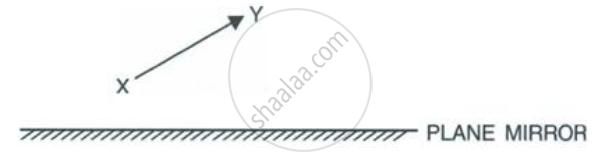
The diagram below in figure shows an object XY in front of a plane mirror MM1 . Draw on the diagram, path of two rays from each point X and Y of the object to show the formation of its image .
Draw a neat diagram of reflecting periscope.
Draw a neat two ray diagram to illustrate how a concave mirror is used as a shaving mirror.
Which of the following is the best reflector of light?
Differentiate between a reflection and a shadow
Which position of the object will produce a magnified virtual image, if a concave mirror of focal length 15 cm is being used?
Total internal reflection will occur if the angle of reflection is ______.
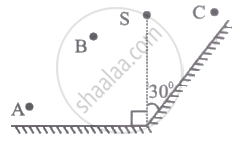
A point source of light S is placed in front of two large mirrors as shown. Which of the following observers will see only one image of S?