Advertisements
Advertisements
Question
A boy riding on a bicycle going at 12 km h−1 towards a vertical wall whistles at his dog on the ground. If the frequency of the whistle is 1600 Hz and the speed of sound in air is 330 m s−1, find (a) the frequency of the whistle as received by the wall (b) the frequency of the reflected whistle as received by the boy.
Advertisements
Solution
Given:
Velocity of sound in air v = 330 ms−1
(a) Frequency of whistle \[n_0\]=1600 Hz
Velocity of source vs = 12 km/h =\[12 \times \frac{5}{18} = \frac{10}{3} {\text { ms }}^{- 1}\]
Velocity of an observer \[v_0\] = 0 ms−1
Frequency of whistle received by wall n =?Frequency of sound received by the observer is given by :
\[n = \frac{v + v_0}{v - v_s} \times n_0\]
On substituting the respective values in the above formula, we get :
\[n = \frac{330 + 0}{330 - \frac{10}{3}} \times 1600 = 1616 \text{ Hz }\]
(b) Here,
Velocity of observer \[v_0\] \[\frac{10}{3} {\text { ms }}^{- 1}\]
Velocity of source vs = 0
Frequency of source \[n_0\]= 1616 Hz
Frequency of sound heard by observer is
\[n = \frac{v + v_0}{v + v_s} \times n_0 \]
On substituting the respective values in the above formula, we get :
\[= \frac{330 + \frac{10}{3}}{330 + 0} \times 1616 = 1632 \text{ Hz }\]
APPEARS IN
RELATED QUESTIONS
A string clamped at both ends vibrates in its fundamental mode. Is there any position (except the ends) on the string which can be touched without disturbing the motion? What if the string vibrates in its first overtone?
If you are walking on the moon, can you hear the sound of stones cracking behind you? Can you hear the sound of your own footsteps?
Can you hear your own words if you are standing in a perfect vacuum? Can you hear your friend in the same conditions?
The voice of a person, who has inhaled helium, has a remarkably high pitch. Explain on the basis of resonant vibration of vocal cord filled with air and with helium.
Two tuning forks vibrate with the same amplitude but the frequency of the first is double the frequency of the second. Which fork produces more intense sound in air?
The bulk modulus and the density of water are greater than those of air. With this much of information, we can say that velocity of sound in air
When sound wave is refracted from air to water, which of the following will remain unchanged?
A tuning fork of frequency 512 Hz is vibrated with a sonometer wire and 6 beats per second are heard. The beat frequency reduces if the tension in the string is slightly increased. The original frequency of vibration of the string is
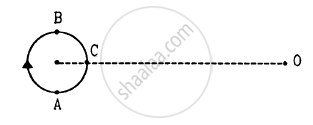
A small source of sounds moves on a circle as shown in figure and an observer is sitting at O. Let \[v_1, v_2, v_3\] be the frequencies heard when the source is at A, B and C respectively.
When you speak to your friend, which of the following parameters have a unique value in the sound produced?
An electrically maintained tuning fork vibrates with constant frequency and constant amplitude. If the temperature of the surrounding air increases but pressure remains constant, the produced will have
(a) larger wavelength
(b) larger frequency
(c) larger velocity
(d) larger time period.
A man stands before a large wall at a distance of 50.0 m and claps his hands at regular intervals. Initially, the interval is large. He gradually reduces the interval and fixes it at a value when the echo of a clap merges every 3 seconds, find the velocity of sound in air.
The equation of a travelling sound wave is y = 6.0 sin (600 t − 1.8 x) where y is measured in 10−5 m, t in second and x in metre. (a) Find the ratio of the displacement amplitude of the particles to the wavelength of the wave. (b) Find the ratio of the velocity amplitude of the particles to the wave speed.
Sound with intensity larger than 120 dB appears pain full to a person. A small speaker delivers 2.0 W of audio output. How close can the person get to the speaker without hurting his ears?
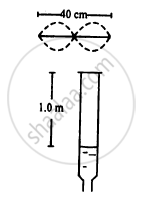
Consider the situation shown in the figure.The wire which has a mass of 4.00 g oscillates in its second harmonic and sets the air column in the tube into vibrations in its fundamental mode. Assuming that the speed of sound in air is 340 m s−1, find the tension in the wire.
The fundamental frequency of a closed pipe is 293 Hz when the air in it is a temperature of 20°C. What will be its fundamental frequency when the temperature changes to 22°C?
For the propagation of longitudinal waves, the medium must have
- elasticity
- mass
- inertia
- force of cohesion
A transverse wave is represented by y = 2sin (ωt - kx) cm. The value of wavelength (in cm) for which the wave velocity becomes equal to the maximum particle velocity, will be ______.
