Advertisements
Advertisements
Question
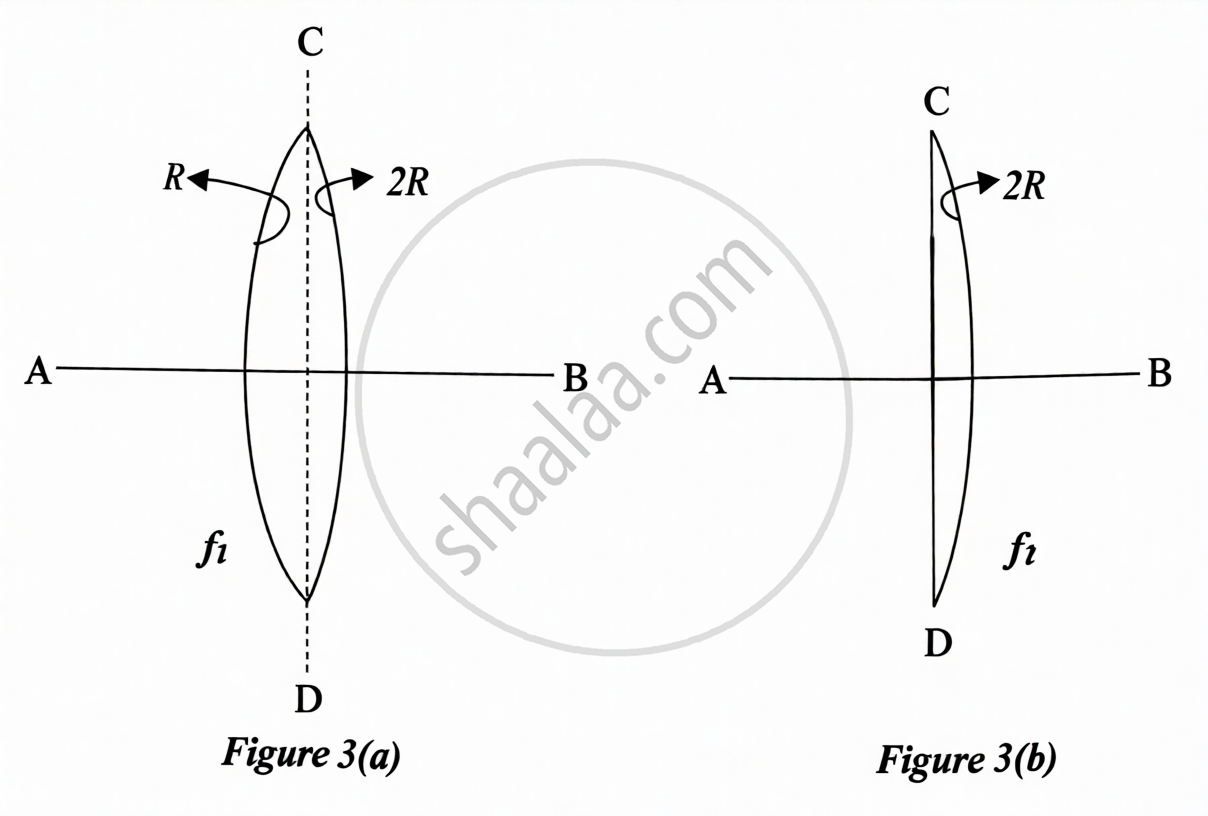
A bi-convex lens of focal length f1 is placed in air as shown in Figure 3(a) below. The radii of curvature of its first and second surfaces are R and 2R respectively. The lens is cut along the plane CD. Compare the focal length f2 of the resulting lens shown in Figure 3(b) with that of the original lens shown in Figure 3(a).
Advertisements
Solution
To compare the focal lengths of the two lenses, we apply the Lens Maker’s Formula:
`1/f = (mu - 1)(1/(R_1) - 1/(R_2))`
Focal length f1 of the original lens (Figure 3a):
For the bi-convex lens, using the standard sign convention (light traveling from left to right):
R1 = +R (convex surface)
R2 = −2R (convex surface)
`1/(f_1) = (mu - 1)(1/R - (-1/(2 R)))`
= `(mu - 1)(1/R + 1/(2 R))`
= `(mu - 1)((2 + 1)/(2 R))`
= `(3(mu - 1))/(2 R)` ...(i)
When the lens is cut along the plane CD, the resulting lens shown in Figure 3(b) is plano-convex.
The first surface is now the plane CD, so R1 = ∞
The second surface remains the original curved surface, so R2 = −2 R
`1/(f_2) = (mu - 1)(1/∞ - (-1/(2 R)))`
= `1/(f_2) = (mu - 1)(0 + 1/(2 R))`
= `(mu - 1)/(2 R)` ...(ii)
By dividing Equation (i) by Equation (ii):
`((1/(f_1)))/((1/(f_2))) = ((3(mu - 1))/(2 R))/((mu - 1)/(2 R))`
`(f_2)/(f_1) = (3(mu - 1))/(2 R) xx (2 R)/(mu - 1)`
`(f_2)/(f_1) = 3`
f2 = 3 f1
∴ The focal length of the resulting lens (f2) is three times the focal length of the original lens (f1).
