Advertisements
Advertisements
Question
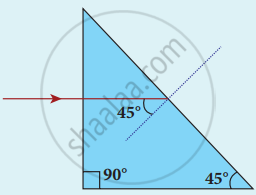
A beam of light consisting of red, green and blue is incident on a right-angled prism as shown in figure. The refractive index of the material of the prism for the above red, green and blue colours are 1.39, 1.44 and 1.47 respectively. What are the colours suffer total internal reflection?
Advertisements
Solution
i > c ∴ i = 45°
`mu = 1/(sin "c")`
sin c = `1/mu`
- Red-
`"C"_"R" = sin^-1 (1/mu)`
`= sin^-1 (1/1.39)`
CR ≈ 46°
i = 45°
i < CR
- Green-
`"C"_"G" = sin^-1 (1/mu)`
`= sin^-1 (1/1.44)`
CG ≈ 44°
i = 45°
i > CG
- Blue-
`"C"_"B" = sin^-1 (1/mu)`
`= sin^-1 (1/1.47)`
CG ≈ 43°
i = 45°
i > CB
Green and blue suffer total internal reflection.
APPEARS IN
RELATED QUESTIONS
Consider Galileo's method of measuring the speed of light using two lanterns. To get an accuracy of about 10%, the time taken by the experimenter in closing or opening the shutter should be about one tenth of the time taken by the light in going from one experimenter to the other. Assume that it takes 1/100 second for an experimenter to close or open the shutter. How far should the two experimenters be to get a 10% accuracy? What are the difficulties in having this separation?
In Fizeau method of measuring the speed of light, the toothed wheel is placed in the focal plane of a converging lens. How would the experiment be affected if the wheel is slightly away from the focal plane?
Light passes through a closed cylindrical tube containing a gas. If the gas is gradually pumped out, the speed of light inside the tube will
The speeds of red light and yellow light are exactly same
An illuminated object is placed on the principal axis of a converging lens so that a real image is formed on the other side of the lens. If the object is shifted a little,
Which of the following methods can be used to measure the speed of light in laboratory?
In an experiment with Foucault's apparatus, the various distances used are as follows:
Distance between the rotating and the fixed mirror = 16 m
Distance between the lens and the rotating mirror = 6 m,
Distance between the source and the lens = 2 m.
When the mirror is rotated at a speed of 356 revolutions per second, the image shifts by 0.7 mm. Calculate the speed of light from these data.
What is the speed of light in a denser medium of polarizing angle 30?
For light incident from air on a slab of refractive index 2, the maximum possible angle of refraction is ______.
| A ray of light travels from a denser to a rarer medium. After refraction, it bends away from the normal. When we keep increasing the angle of incidence, the angle of refraction also increases till the refracted ray grazes along the interface of two media. The angle of incidence for which it happens is called critical angle. If the angle of incidence is increased further the ray will not emerge and it will be reflected back in the denser medium. This phenomenon is called total internal reflection of light. |
The critical angle for a pair of two media A and B of refractive indices 2.0 and 1.0 respectively is:
