Advertisements
Advertisements
Question
‘a’ and ‘b’ are two different numbers taken from the numbers 1 – 50. What is the largest value that `(a - b)/(a + b)` can have? What is the largest value that `(a + b)/(a - b)` can have?
Advertisements
Solution
Given, a and b are two different numbers between 1 to 50.
Let a = 50 and b = 1
∴ `(a - b)/(a + b) = (50 - 1)/(50 + 1) = 49/51`, which is the largest value.
Similarly, Let a = 50 and b = 49
∴ `(a + b)/(a - b) = (50 + 49)/(50 - 49) = 99/1 = 99`, which is the largest value.
APPEARS IN
RELATED QUESTIONS
The product of two rational numbers is always a ________.
Find five rational numbers between `1/4 " and " 1/2`
Write four more rational numbers in the following pattern:
`(-3)/5, (-6)/10,(-9)/15, (-12)/20, ...`
Which of the following pairs represent the same rational number?
`(-3)/5 "and" (-12)/20`
Which is greater in the following?
`2/3,5/2`
The product of two rational numbers is 15. If one of the numbers is −10, find the other.
`(x + y)/2` is a rational number.
The table given below shows the distances, in kilometres, between four villages of a state. To find the distance between two villages, locate the square where the row for one village and the column for the other village intersect.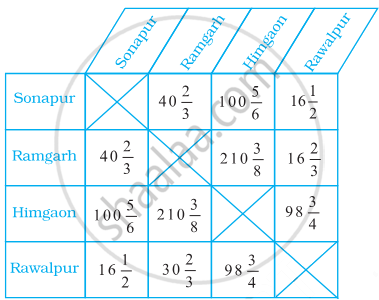
Compare the distance between Himgaon and Rawalpur to Sonapur and Ramgarh?
`(-16)/24` and `20/(-16)` represent ______ rational numbers.
