Advertisements
Advertisements
Question
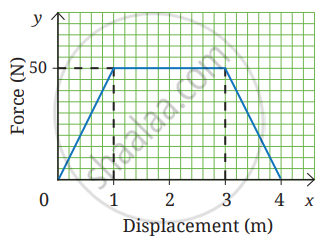
A 10.0 kg block is moving on horizontal floor with negligible friction. As shown in the Fig., a variable force is applied on the block in its direction of motion from its position at 0 m till 4 m. If the block had a kinetic energy of 180 J when it was at 0 m, find the block’s speed (i) at 0 m, and (ii) at 4 m. Does the block have negative acceleration in any portion of its motion?
Advertisements
Solution
Given,
Mass (m) = 10.0 kg
Kinetic energy at 0 m = 180 J
(i) Speed at 0 m:
kinetic anergy = `1/2 "mv"^2`
`180 = 1/2 xx 10 xx v^2`
`v^2 = (180 xx 2)/10 = 36`
v = 6 m s–1
Hence, the speed of the block at 0 m is 6 m s–1.
(ii) Speed at 4 m:
The area under the force-displacement graph (Fig.) between 0 and 4 meters represents the work that the variable force has done on the block.
Area under the graph = area of left triangle + area of rectangle + area of right triangle
= `1/2 xx 1 xx 50 + 2 xx 50 + 1/2 xx 1 xx 50`
= 25 + 100 + 25 = 150 J
Using the work-energy theorem,
Kinetic energy at 4 m = Kinetic energy at 0 m + Work done
Kinetic energy at 4 m = 180 + 150 = 330 J
Now,
`1/2 "mv"^2 = 330`
`1/2 xx 10 xx v^2 = 330`
v2 = 66
`v = sqrt(66) ≈ 8.1 "m s"^-1`
Hence, the speed of the block at 4 m is about 8.1 m s–1.
Negative acceleration: There is very little friction and the applied force is always in the block's direction of motion. Where the applied force is positive, the acceleration is positive; only when the force is 0 does the acceleration become zero. As a result, there is no negative acceleration throughout any part of the block's motion.
