R.S. Aggarwal solutions for माठेमटिक्स [इंग्रजी] इयत्ता १० आयसीएसई chapter 16 - Similarity of Triangles [Latest edition]
Online Mock Tests
Chapters
1: Goods and Services Tax (G.S.T.)
2: Banking
3: Shares and Dividends
UNIT 2: ALGEBRA
4: Linear Inequations
5: Quadratic Equation
6: Problems on Quadratic Equations
7: Ratio and Proportion
8: Remainder Theorem and Factor Theorem
9: Matrices
10: Arithmetic Progression
11: Geometric Progression
12: Reflection
13: Section and Mid-point Formulae
14: Equation of a Straight Line
UNIT 3: GEOMETRY
15: Similarity (As a Size Transformation)
▶ 16: Similarity of Triangles
17: Loci
Chapter 18: Angle and Cyclic Properties of a Circle
Chapter 19: Tangent Properties of Circles
20: Constructions
UNIT 4: MENSURATION
Chapter 21: Volume and Surface Area of Solids (Cylinder, Cone and Sphere)
UNIT 5: TRIGONOMETRY
Chapter 22: Trigonometrical Identities
Chapter 23: Heights and Distances
UNIT 6: STATISTICS
Chapter 24: Graphical Representation of Statistical Data
Chapter 25: Measures of Central Tendency (Mean)
Chapter 26: Median, Quartiles and Mode
UNIT 7: PROBABILITY
Chapter 27: Probability
Advertisements
Advertisements
Solutions for Chapter 16: Similarity of Triangles
Below listed, you can find solutions for Chapter 16 of CISCE R.S. Aggarwal for माठेमटिक्स [इंग्रजी] इयत्ता १० आयसीएसई.
Advertisements
R.S. Aggarwal solutions for माठेमटिक्स [इंग्रजी] इयत्ता १० आयसीएसई 16 Similarity of Triangles EXERCISE 16A [Pages 252 - 254]
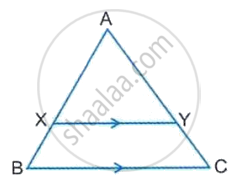
In the given figure, \(\mathrm{XY} \parallel \mathrm{BC}\).
Given that \(\mathrm{AX}=3 \mathrm{~cm}, \mathrm{XB}=1 \cdot 5 \mathrm{~cm}\) and \(\mathrm{BC}=6 \mathrm{~cm}\).
Calculate:
- \(\frac{\mathrm{AY}}{\mathrm{YC}}\)
- XY.
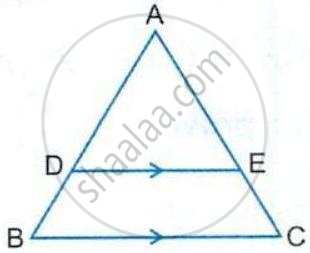
In the given figure, \(\mathrm{DE} \parallel \mathrm{BC}\).
- If \(\mathrm{AD}=3 \cdot 6 \mathrm{~cm}, \mathrm{AB}=9 \mathrm{~cm}\) and \(\mathrm{AE}=2 \cdot 4 \mathrm{~cm}\), find EC.
- If \(\frac{\mathrm{AD}}{\mathrm{DB}}=\frac{3}{5}\) and \(\mathrm{AC}=5 \cdot 6 \mathrm{~cm}\), find AE.
- If \(\mathrm{AD}=x \mathrm{~cm}, \mathrm{DB}=(x-2) \mathrm{~cm}, \mathrm{AE}=(x+2) \mathrm{~cm}\) and \(\mathrm{EC}=(x-1) \mathrm{~cm}\), find the value of x.
D and E are points on the sides AB and AC respectively of \(\Delta \mathrm{ABC}\). For the following cases, state whether \(\mathrm{DE} \parallel \mathrm{BC}\):
\(\mathrm{AD}=5 \cdot 7 \mathrm{~cm}, \mathrm{BD}=9 \cdot 5 \mathrm{~cm}, \mathrm{AE}=3 \cdot 6 \mathrm{~cm}\) and \(\mathrm{EC}=6 \mathrm{~cm}\)
D and E are points on the sides AB and AC respectively of \(\Delta \mathrm{ABC}\). For the following cases, state whether \(\mathrm{DE} \parallel \mathrm{BC}\):
\(\mathrm{AB} = 5 \cdot 6 \mathrm{~cm}, \mathrm{AD} = 1 \cdot 4 \mathrm{~cm}, \mathrm{AC} = 9 \cdot 6 \mathrm{~cm}\) and \(\mathrm{EC} = 2 \cdot 4 \mathrm{~cm}\)
D and E are points on the sides AB and AC respectively of \(\Delta \mathrm{ABC}\). For the following cases, state whether \(\mathrm{DE} \parallel \mathrm{BC}\):
\(\mathrm{AB} = 11 \cdot 7 \mathrm{~cm}, \mathrm{BD} = 5 \cdot 2 \mathrm{~cm}, \mathrm{AE} = 4 \cdot 4 \mathrm{~cm}\) and \(\mathrm{AC} = 9 \cdot 9 \mathrm{~cm}\)
D and E are points on the sides AB and AC respectively of \(\Delta \mathrm{ABC}\). For the following cases, state whether \(\mathrm{DE} \parallel \mathrm{BC}\):
\(\mathrm{AB} = 10 \cdot 8 \mathrm{~cm}, \mathrm{BD} = 4 \cdot 5 \mathrm{~cm}, \mathrm{AC} = 4 \cdot 8 \mathrm{~cm}\) and \(\mathrm{AE} = 2 \cdot 8 \mathrm{~cm}\)
In the given figure, it is given that \(\angle \mathrm{ABD} = \angle \mathrm{CDB} = \angle \mathrm{PQB} = 90^{\circ}\). If \(\mathrm{AB} = x\) units, \(\mathrm{CD} = y\) units and \(\mathrm{PQ} = z\) units, prove that \(\frac{1}{x} + \frac{1}{y} = \frac{1}{z}\).
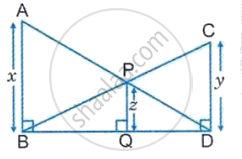
[Hint. \[\triangle PQD \sim \triangle ABD \Rightarrow \frac{PQ}{AB} = \frac{QD}{BD} \Rightarrow \frac{z}{x} = \frac{QD}{BD}.\]
\[\triangle PQB \sim \triangle CDB \Rightarrow \frac{PQ}{CD} = \frac{BQ}{BD} \Rightarrow \frac{z}{y} = \frac{BQ}{BD}.\]
Add the two results.]
In \(\triangle \mathrm{ABC}, \mathrm{AD}\) is the bisector of \(\angle \mathrm{A}\).
If \(\mathrm{BC} = 10 \mathrm{~cm}, \mathrm{BD} = 6 \mathrm{~cm}\) and \(\mathrm{AC} = 6 \mathrm{~cm}\), find AB.
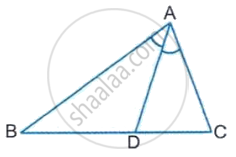
[\[\textbf{Hint.} \frac{BD}{DC} = \frac{AB}{AC}.\]]
In the given figure, AC || DE || BF. If AC = 24 cm, EG = 8 cm, GB = 16 cm, BF = 30 cm.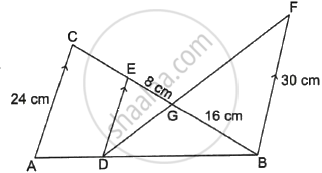
- Prove ΔGED ∼ ΔGBF
- Find DE
- DB : AB
In the adjoining figure, ABCD is a parallelogram, P is a point on side BC and DP when produced meets AB produced at L.
Prove that:
- $$\mathrm{DP} : \mathrm{PL} = \mathrm{DC} : \mathrm{BL}$$
- $$\mathrm{DL} : \mathrm{DP} = \mathrm{AL} : \mathrm{DC}$$
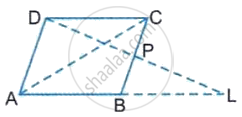
[Hint. In \(\triangle ALD, BP \parallel AD\). So, \(\frac{DP}{PL} = \frac{AB}{BL} = \frac{DC}{BL}\) and \(\frac{DL}{DP} = \frac{AL}{AB} = \frac{AL}{DC}\).]
In the given figure, ABCD is a parallelogram, E is a point on BC and the diagonal BD intersects AE at F.
Prove that: $$\mathrm{DF} \times \mathrm{FE} = \mathrm{FB} \times \mathrm{FA}$$.
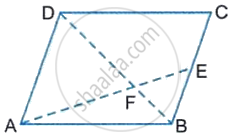
[\[\textbf{Hint.}\ \triangle {AFD} \sim \triangle EFB.\]]
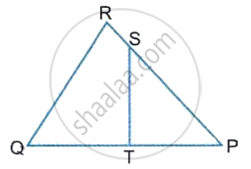
In the adjoining figure (not drawn to scale), \(\mathrm{PS} = 4 \mathrm{~cm}, \mathrm{SR} = 2 \mathrm{~cm}, \mathrm{PT} = 3 \mathrm{~cm}\) and \(\mathrm{QT} = 5 \mathrm{~cm}\).
- Show that \(\triangle \mathrm{PQR} \sim \triangle \mathrm{PST}\).
- Calculate \(\mathrm{ST}\), if \(\mathrm{QR} = 5.8 \mathrm{~cm}\).
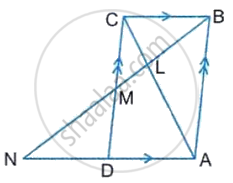
In the adjoining figure, ABCD is a parallelogram in which \(\mathrm{AB} = 16 \mathrm{~cm}, \mathrm{BC} = 10 \mathrm{~cm}\) and L is a point on AC such that \(\mathrm{CL} : \mathrm{LA} = 2 : 3\). If BL produced meets CD at M and AD produced at N, prove that:
- \(\triangle \mathrm{CLB} \sim \triangle \mathrm{ALN}\)
- \(\triangle \mathrm{CLM} \sim \triangle \mathrm{ALB}\)
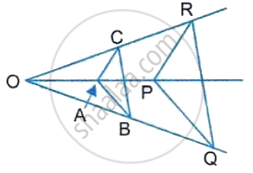
In the given figure, $$\mathrm{AB} \parallel \mathrm{PQ}$$ and $$\mathrm{AC} \parallel \mathrm{PR}$$. Prove that $$\mathrm{BC} \parallel \mathrm{QR}$$.
In the given figure, medians AD and BE of \(\triangle \mathrm{ABC}\) meet at G and \(\mathrm{DF} \parallel \mathrm{BE}\).
Prove that (i) \(\mathrm{EF} = \mathrm{FC}\) (ii) \(\mathrm{AG} : \mathrm{GD} = 2 : 1\).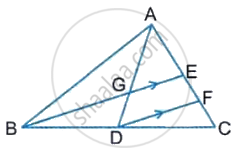
[\[\textbf{Hint.}\ \triangle EBC \sim \triangle FDC\]]
In the given figure, \(\mathrm{DE} \parallel \mathrm{BC}\) and \(\mathrm{BD} = \mathrm{DC}\).
(i) Prove that DE bisects \(\angle \mathrm{ADC}\).
(ii) If \(\mathrm{AD} = 4 \cdot 5 \mathrm{~cm}, \mathrm{AE} = 3 \cdot 9 \mathrm{~cm}\) and \(\mathrm{DC} = 7 \cdot 5 \mathrm{~cm}\), find CE.
(iii) Find the ratio AD : DB.
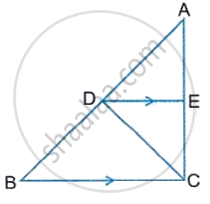
[Hint. (i) Since \[DE \parallel BC,\] we have
\[\frac{AD}{DB} = \frac{AE}{EC} \Rightarrow \frac{AD}{DC} = \frac{AE}{EC} \Rightarrow \frac{CE}{AE} = \frac{DC}{DA}.\]
Thus, \[DE\] divides \[CA\] in the ratio of other two sides.
(iii) \[\frac{AD}{DB} = \frac{AD}{DC} = \frac{AE}{EC}.\]]
In the given figure, \(\mathrm{BA} \parallel \mathrm{DC}\). Show that \(\Delta \mathrm{OAB} \sim \Delta \mathrm{ODC}\).
If \(\mathrm{AB} = 4 \mathrm{~cm}, \mathrm{CD} = 3 \mathrm{~cm}, \mathrm{OC} = 5 \cdot 7 \mathrm{~cm}\) and \(\mathrm{OD} = 3 \cdot 6\) cm, find OA and OB.
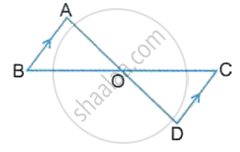
\[\left[\textbf {Hint. } \triangle OAB \sim \triangle ODC \Rightarrow \frac{OA}{OD}=\frac{OB}{OC}=\frac{AB}{DC} .\right]\]
In the given figure, \(\angle \mathrm{ABC} = 90^{\circ}\) and \(\mathrm{BD} \perp \mathrm{AC}\).
If \(\mathrm{AB} = 5 \cdot 7 \mathrm{~cm}, \mathrm{BD} = 3 \cdot 8 \mathrm{~cm}\) and \(\mathrm{CD} = 5 \cdot 4 \mathrm{~cm}\), find BC.
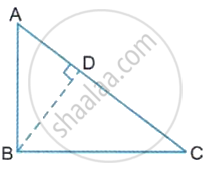
\[\left[\textbf {Hint. } \triangle ABC \sim \triangle BDC \Rightarrow \frac{AB}{BD} = \frac{BC}{DC}.\right]\]
R.S. Aggarwal solutions for माठेमटिक्स [इंग्रजी] इयत्ता १० आयसीएसई 16 Similarity of Triangles EXERCISE 16B [Pages 267 - 270]
In the given figure, \(\mathrm{DE} \parallel \mathrm{BC}\).
(i) Prove that: \(\triangle \mathrm{ADE} \sim \triangle \mathrm{ABC}\).
(ii) Given that \(\mathrm{AD} = \frac{1}{2} \mathrm{DB}\), calculate \(\mathrm{DE}\), if \(\mathrm{BC} = 4.5 \mathrm{~cm}\).
(iii) Find: \(\frac{\operatorname{ar}(\triangle \mathrm{ADE})}{\operatorname{ar}(\triangle \mathrm{ABC})}\)
(iv) Find: \(\frac{\operatorname{ar}(\triangle \mathrm{ADE})}{\operatorname{ar}(\operatorname{trap} . \mathrm{BCED})}\)
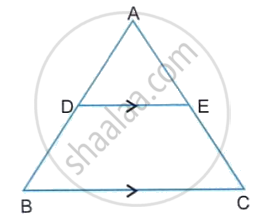
[Hint: (ii) \[\frac{AD}{DB} = \frac{1}{2} \Rightarrow \frac{AD}{AD + DB} = \frac{1}{1 + 2} \Rightarrow \frac{AD}{AB} = \frac{1}{3}.\]
\[\therefore\ \frac{DE}{BC} = \frac{AD}{AB} = \frac{1}{3}.\] Find \[DE.\]
(iii) \[\frac{ar(\triangle ADE)}{ar(\triangle ABC)} = \frac{DE^{2}}{BC^{2}} = \left(\frac{DE}{BC}\right)^{2} = \left(\frac{1}{3}\right)^{2} = \frac{1}{9}.\]
\[\begin{aligned} \textbf{(iv)}\frac{ar(\triangle ABC)}{ar(\triangle ADE)} = \frac{9}{1} \qquad &\Rightarrow \frac{ar(\triangle ABC)}{ar(\triangle ADE)} - 1 = 9 - 1 \\[6pt] &\Rightarrow \frac{ar(\triangle ABC) - ar(\triangle ADE)}{ar(\triangle ADE)} = 8 \\[6pt] &\Rightarrow \frac{ar(\mathit{trap.}BCED)}{ar(\triangle ADE)} = 8 \Rightarrow \frac{ar(\triangle ADE)}{ar(\mathit{trap.}BCED)} = \frac{1}{8}.] \end{aligned}\]
Given that $$\triangle \mathrm{ABC} \sim \triangle \mathrm{PQR}$$.
- If $$\operatorname{ar}(\triangle \mathrm{ABC}) = 49 \mathrm{~cm}^{2}$$ and $$\operatorname{ar}(\triangle \mathrm{PQR}) = 25 \mathrm{~cm}^{2}$$ and $$\mathrm{AB} = 5.6 \mathrm{~cm}$$, find the length of PQ.
- If $$\operatorname{ar}(\triangle \mathrm{ABC}) = 28 \mathrm{~cm}^{2}$$ and $$\operatorname{ar}(\triangle \mathrm{PQR}) = 63 \mathrm{~cm}^{2}$$ and $$\mathrm{PR} = 8.4 \mathrm{~cm}$$, find the length of AC.
- If $$\mathrm{BC} = 4 \mathrm{~cm}, \mathrm{QR} = 5 \mathrm{~cm}$$ and $$\operatorname{ar}(\triangle \mathrm{ABC}) = 32 \mathrm{~cm}^{2}$$ determine $$\operatorname{ar}(\triangle \mathrm{PQR})$$.
The areas of two similar triangles are $$48 \mathrm{~cm}^{2}$$ and $$75 \mathrm{~cm}^{2}$$ respectively. If the altitude of first triangle is 3.6 cm, find the corresponding altitude of the other.
In the given figure, $$\mathrm{AB} \perp \mathrm{BC}$$ and $$\mathrm{DE} \perp \mathrm{BC}$$.
If $$\mathrm{AB} = 9 \mathrm{~cm}, \mathrm{DE} = 3 \mathrm{~cm}$$ and $$\mathrm{AC} = 24 \mathrm{~cm}$$, calculate AD.
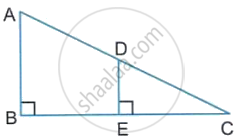
[Hint: \[\triangle ABC \sim \triangle DEC\] [By AA-similarity]
\[\therefore\ \frac{AB}{DE} = \frac{AC}{DC}\] and \[AD = (AC - DC)]\]
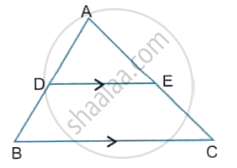
In the given figure, $$\mathrm{DE} \parallel \mathrm{BC}$$.
If $$\mathrm{DE} = 4 \mathrm{~cm}, \mathrm{BC} = 6 \mathrm{~cm}$$ and $$\operatorname{ar}(\triangle \mathrm{ADE}) = 20 \mathrm{~cm}^{2}$$, find the area of $$\triangle \mathrm{ABC}$$.
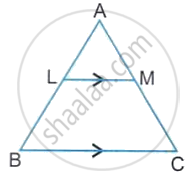
In the given figure, $$\mathrm{LM} \parallel \mathrm{BC}$$.
If $$\mathrm{AB} = 6 \mathrm{~cm}, \mathrm{AL} = 2 \mathrm{~cm}$$ and $$\mathrm{AC} = 9 \mathrm{~cm}$$, calculate:
- the length of CM,
- the value of $$\frac{\operatorname{ar}(\triangle \mathrm{ALM})}{\operatorname{ar}(\operatorname{trap}.\mathrm{LBCM})}$$
In \(\triangle \mathrm{ABC}\), it is given that \(\mathrm{AB} = 12 \mathrm{~cm}, \angle \mathrm{B} = 90^{\circ}\) and \(\mathrm{AC} = 15 \mathrm{~cm}\). If D and E are points on AB and AC respectively such that \(\angle \mathrm{AED} = 90^{\circ}\) and \(\mathrm{DE} = 3 \mathrm{~cm}\), then prove that:
(i) \(\triangle \mathrm{ABC} \sim \triangle \mathrm{AED}\);
(ii) \(\operatorname{ar}(\triangle \mathrm{AED}) = 6 \mathrm{~cm}^{2}\);
(iii) \(\operatorname{ar}(\mathrm{quad\ BCED}) : \operatorname{ar}(\triangle \mathrm{ABC}) = 8 : 9\).
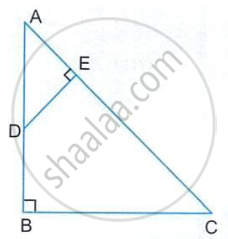
[Hint: (i) \[\triangle ABC \sim \triangle AED\ [\because \angle ABC = \angle AED,\ \angle BAC = \angle EAD\] (Common)]
(ii) \[BC^{2} = (AC^{2} - AB^{2}) = (225 - 144) = 81 \Rightarrow BC = 9\ cm.\]
\[\frac{ar(\triangle AED)}{ar(\triangle ABC)} = \frac{ED^{2}}{BC^{2}} = \frac{9}{81} = \frac{1}{9} \Rightarrow \frac{ar(\triangle AED)}{\left(\dfrac{1}{2} \times 9 \times 12\right)} = \frac{1}{9} \Rightarrow ar(\triangle AED) = 6\ cm^{2}.\]
(iii) \[ar(\mathit{quad.}\ BCED) = ar(\triangle ABC) - ar(\triangle AED) = \left[\left(\frac{1}{2} \times 9 \times 12\right) - 6\right]\ cm^{2} = 48\ cm^{2}.]\]
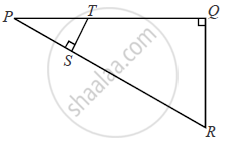
In the given figure, ∠PQR = ∠PST = 90°, PQ = 5cm and PS = 2cm.
- Prove that ΔPQR ~ ΔPST.
- Find the Area of ΔPQR : Area of quadrilateral SRQT.
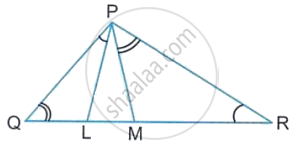
In a $$\triangle \mathrm{PQR}, \mathrm{L}$$ and $$\mathrm{M}$$ are two points on the base $$\mathrm{QR}$$ such that $$\angle \mathrm{LPQ} = \angle \mathrm{QRP}$$ and $$\angle \mathrm{RPM} = \angle \mathrm{RQP}$$.
Prove that:
- $$\triangle \mathrm{PQL} \sim \triangle \mathrm{RPM}$$;
- $$\mathrm{QL} \times \mathrm{RM}=\mathrm{PL} \times \mathrm{PM}$$;
- $$\mathrm{PQ}^{2} = \mathrm{QL} \times \mathrm{QR}$$.
In the adjoining figure, the medians BD and CE of a $$\triangle \mathrm{ABC}$$ meet at G.
Prove that:
- $$\triangle \mathrm{EGD} \sim \triangle \mathrm{CGB}$$,
- $$\mathrm{BG} = 2 \times \mathrm{GD}$$.
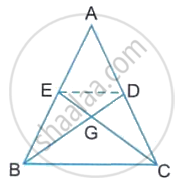
[Hint: The centroid divides a median in the ratio 2 : 1.]
In the given diagram, ΔADB and ΔACB are two right-angled triangles with ∠ADB = ∠BCA = 90°. If AB = 10 cm, AD = 6 cm, BC = 2.4 cm and DP = 4.5 cm.

- Prove that ΔAPD ∼ ΔBPC
- Find the length of BD and PB
- Hence, find the length of PA
- Find area ΔAPD : area ΔBPC.
In the adjoining figure, PQRS is a parallelogram with $$\mathrm{PQ} = 15 \mathrm{~cm}$$ and $$\mathrm{RQ} = 10 \mathrm{~cm}$$. If L is a point on RP such that $$\mathrm{RL} : \mathrm{PL} = 2 : 3$$ and QL produced meets RS at M and PS produced at N. Find the lengths of PN and RM.
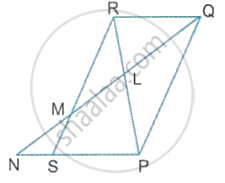
[Hint: \[\triangle RLQ \sim \triangle PLN \Rightarrow \frac{RL}{PL} = \frac{RQ}{PN}.\]
\[\triangle \mathrm{RLM} \sim \triangle \mathrm{PLQ} \Rightarrow \frac{RL}{PL} = \frac{RM}{PQ}.\]]
In the given figure, \(\triangle \mathrm{ABC} \sim \triangle \mathrm{PQR}, \mathrm{AM}\) and \(\mathrm{PN}\) are altitudes, where as \(\mathrm{AX}\) and \(\mathrm{PY}\) are medians.
Prove that: \(\frac{\mathrm{AM}}{\mathrm{PN}} = \frac{\mathrm{AX}}{\mathrm{PY}}\).
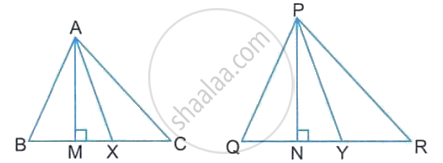
\[\textbf{[Hint: } \frac{\operatorname{ar}(\triangle ABC)}{\operatorname{ar}(\triangle PQR)} = \frac{AM^{2}}{PN^{2}} \text { and } \frac{\operatorname{ar}(\triangle ABC)}{\operatorname{ar}(\triangle PQR)} = \frac{AX^{2}}{PY^{2}} \text {]}\]
In the given figure, $$\mathrm{BC} \parallel \mathrm{DE}$$, area $$(\triangle \mathrm{ABC}) = 25 \mathrm{~cm}^{2}$$, area (trap. BCED)$$ = 24 \mathrm{~cm}^{2}$$ and $$\mathrm{DE} = 14 \mathrm{~cm}$$. Calculate the length of BC.
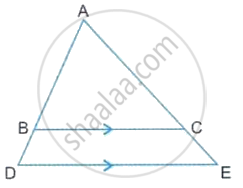
[Hint: \[\mathit{Area}\ (\triangle\ ADE) = \mathit{Area}\ (\triangle\ ABC) + \mathit{Area}\ (\mathit{trap.}\ BDEC) = 49\ cm^{2}.\]
\[\triangle ABC \sim \triangle ADE \Rightarrow \frac{\mathit{Area}(\triangle ABC)}{\mathit{Area}(\triangle ADE)} = \frac{BC^{2}}{DE^{2}}.\]]
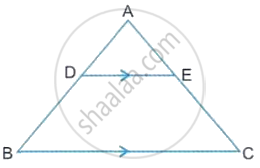
In the given figure, $$\mathrm{DE} \parallel \mathrm{BC}$$ and $$\mathrm{DE} : \mathrm{BC} = 3 : 5$$. Calculate : $$\operatorname{ar}(\triangle \mathrm{ADE}) : \operatorname{ar}(\operatorname{trap}.\mathrm{BCED})$$.
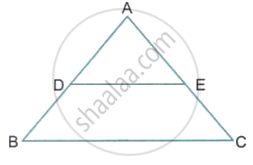
In $$\triangle \mathrm{ABC}, \mathrm{D}$$ and $$\mathrm{E}$$ are mid-points of $$\mathrm{AB}$$ and $$\mathrm{AC}$$ respectively.
Find: $$\operatorname{ar}(\triangle \mathrm{ADE}) : \operatorname{ar}(\triangle \mathrm{ABC})$$.
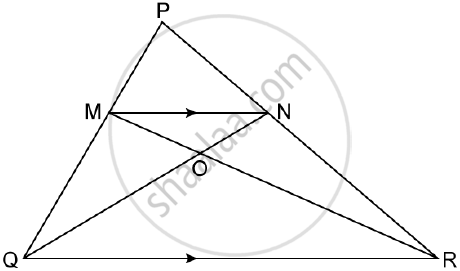
In ΔPQR, MN is parallel to QR and `(PM)/(MQ) = 2/3`
- Find `(MN)/(QR)`.
- Prove that ΔOMN and ΔORQ are similar.
- Find the area of ΔOMN : Area of ΔORQ.
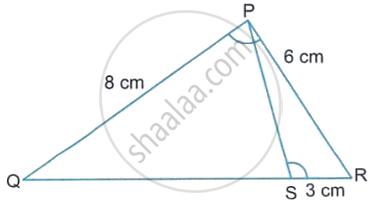
PQR is a triangle, S is a point on the side QR of \(\triangle \mathrm{PQR}\) such that \(\angle \mathrm{PSR} = \angle \mathrm{QPR}\).
Given \(\mathrm{QP} = 8 \mathrm{~cm}, \mathrm{PR} = 6 \mathrm{~cm}\) and \(\mathrm{SR} = 3 \mathrm{~cm}\).
- Prove \(\triangle \mathrm{PQR} \sim \triangle \mathrm{SPR}\)
- Find the length of QR and PS
- Find: \[\frac{\mathrm{area\ of}\ \triangle \mathrm{PQR}}{\mathrm{area\ of}\ \triangle \mathrm{SPR}}\]
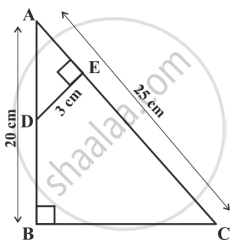
In ΔABC, ∠ABC = 90°, AB = 20 cm, AC = 25 cm, DE is perpendicular to AC such that ∠DEA = 90° and DE = 3 cm as shown in the given figure.
- Prove that ΔABC ~ ΔAED.
- Find the lengths of BC, AD, and AE.
- If BCED represents a plot of land on a map whose actual area on the ground is 576 m2, then find the scale factor of the map.
R.S. Aggarwal solutions for माठेमटिक्स [इंग्रजी] इयत्ता १० आयसीएसई 16 Similarity of Triangles COMPETENCY-FOCUSED QUESTIONS [Pages 270 - 279]
I. Multiple Choice Questions Choose the correct alternative:
If △ABC and △DEF are similar triangles in which ∠A = 47° and ∠E = 83°, then ∠C equals:
50°
60°
70°
80°
If △ABC ∼ △QRP, then the corresponding proportional sides are:
\[\frac{\mathrm{AB}}{\mathrm{PQ}} = \frac{\mathrm{BC}}{\mathrm{RP}}\]
\[\frac{\mathrm{AB}}{\mathrm{QR}} = \frac{\mathrm{BC}}{\mathrm{QP}}\]
\[\frac{\mathrm{AC}}{\mathrm{QR}} = \frac{\mathrm{BC}}{\mathrm{RP}}\]
\[\frac{\mathrm{AB}}{\mathrm{QR}} = \frac{\mathrm{BC}}{\mathrm{RP}}\]
If in △ABC and △PQR, we have \[\frac{\mathrm{AB}}{\mathrm{QR}} = \frac{\mathrm{BC}}{\mathrm{PR}} = \frac{\mathrm{CA}}{\mathrm{PQ}}\], then:
△PQR ∼ △CAB
△PQR ∼ △ABC
△BCA ∼ △PQR
△CBA ∼ △PQR
In the given figure, AB = 24 cm, AC = 18 cm, DE = 12 cm, DF = 9 cm and ∠BAC = ∠EDF. Then △ABC ∼ △DEF by the condition.
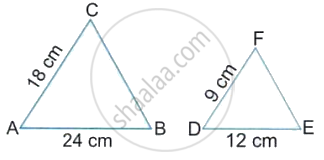
AAA
SAS
SSS
AAS
In the given figure, △ABC and △DEF (not drawn to scale) are such that ∠C = ∠F and \[\frac{\mathrm{AB}}{\mathrm{DE}} = \frac{\mathrm{BC}}{\mathrm{EF}}\], then
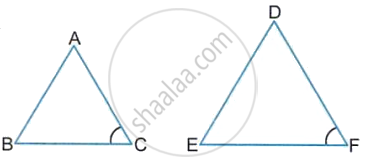
△ABC ∼ △DEF
△BCA ∼ △DEF
△CAB ∼ △DEF
the similarity of given triangles cannot be determined
If △ABC and △DEF are so related that \[\frac{\mathrm{AB}}{\mathrm{FD}} = \frac{\mathrm{BC}}{\mathrm{DE}} = \frac{\mathrm{CA}}{\mathrm{EF}}\], then which of the following is true?
∠A = ∠E and ∠B = ∠D
∠B = ∠F and ∠C = ∠D
∠A = ∠F and ∠B = ∠D
∠C = ∠F and ∠A = ∠D
In the given figure, PQ is parallel to TR, then by using condition of similarity:
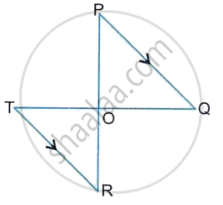
\[\frac{\mathrm{PQ}}{\mathrm{RT}} = \frac{\mathrm{OP}}{\mathrm{OT}} = \frac{\mathrm{OQ}}{\mathrm{OR}}\]
\[\frac{\mathrm{PQ}}{\mathrm{RT}} = \frac{\mathrm{OP}}{\mathrm{OR}} = \frac{\mathrm{OQ}}{\mathrm{OT}}\]
\[\frac{\mathrm{PQ}}{\mathrm{RT}} = \frac{\mathrm{OR}}{\mathrm{OP}} = \frac{\mathrm{OQ}}{\mathrm{OT}}\]
\[\frac{\mathrm{PQ}}{\mathrm{RT}} = \frac{\mathrm{OP}}{\mathrm{OR}} = \frac{\mathrm{OT}}{\mathrm{OQ}}\]
D and E are points on the sides AB and AC respectively of △ABC. In which of the following cases DE || BC?
AD = 3 cm, BD = 8 cm, AC = 8 cm, AE = 3 cm
AD = 5 cm, BD = 6 cm, AE = 6 cm, CE = 5 cm
AB = 18 cm, AD = 8 cm, AE = 12 cm, EC = 15 cm
none of these
In △ABC, DE || BC such that \[\frac{\mathrm{AD}}{\mathrm{DB}} = \frac{3}{5}\]. If AC = 5.6 cm, then AE = ?
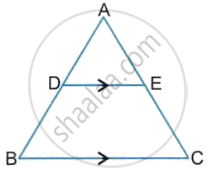
2.1 cm
2.8 cm
3.1 cm
4.2 cm
In △ABC, DE || BC so that AD = (7x – 4) cm, AE = (5x – 2) cm, DB = (3x + 4) cm and EC = (3x) cm. Then, x equals:
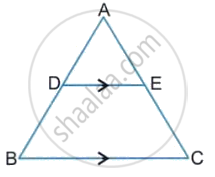
2.5
3
4
5
It is given that ΔABC ∼ ΔDEF. If ∠A = 30°, ∠C = 50°, AB = 5 cm, AC = 8 cm and DF = 7.5 cm, then which of the following is true?
DE = 12 cm, ∠F = 50°
DE = 12 cm, ∠F = 100°
EF = 12 cm, ∠D = 100°
EF = 12 cm, ∠D = 30°
In △DEF and △PQR, it is given that ∠D = ∠Q and ∠R = ∠E, then which of the following is not true?
\[\frac{\mathrm{DE}}{\mathrm{PQ}} = \frac{\mathrm{EF}}{\mathrm{RP}}\]
\[\frac{\mathrm{DE}}{\mathrm{QR}} = \frac{\mathrm{DF}}{\mathrm{PQ}}\]
\[\frac{\mathrm{EF}}{\mathrm{PR}} = \frac{\mathrm{DF}}{\mathrm{PQ}}\]
\[\frac{\mathrm{EF}}{\mathrm{RP}} = \frac{\mathrm{DE}}{\mathrm{QR}}\]
In △ABC, D and E are points on AB and AC respectively such that DE || BC. If AE = 2 cm, EC = 3 cm and BC = 10 cm, then DE is equal to ______.
4 cm
5 cm
`(20/3)` cm
15 cm
△ABC is such that AB = 3 cm, BC = 2 cm and CA = 2.5 cm. △DEF ∼ △ABC. If EF = 4 cm, then the perimeter of △DEF is ______.
7.5 cm
15 cm
22.5 cm
30 cm
In the given diagram, △ABC ∼ △PQR. If AD and PS are bisectors of ∠BAC and ∠QPR respectively, then
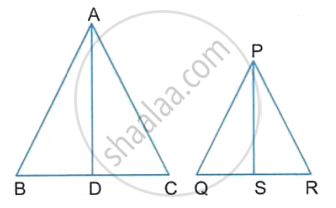
△ABC ∼ △PQS
△ABD ∼ △PQS
△ABD ∼ △PSR
△ABC ∼ △PSR
In the given figure ∠BAP = ∠DCP = 70°, PC = 6 cm and CA = 4 cm, then PD : DB is ______.

5 : 3
3 : 5
3 : 2
2 : 3
In the adjoining figure, DE || BC. If AD : DB = 3 : 1 and EA = 3.3 cm, then AC equals:
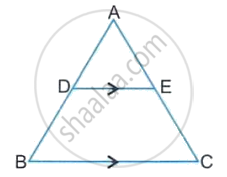
1.1 cm
4 cm
4.4 cm
5.5 cm
In the adjoining figure, ∠ADE = ∠ABC, AE = 8 cm, EB = 7 cm, BC = 9 cm, AD = 10 cm and DC = 2 cm. Then the length of DE is ______.
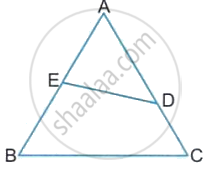
6 cm
6.75 cm
7.8 cm
13.5 cm
In ΔABC, it is given that AB = 9 cm, BC = 6 cm and CA = 7.5 cm. Also, ΔDEF is given such that EF = 8 cm and ΔDEF ~ ΔABC. Then, perimeter of ΔDEF is ______.
22.5 cm
25 cm
27 cm
30 cm
In a △ABC, AB = 10 cm, AC = 14 cm and BC = 6 cm. If AD is the internal bisector of ∠A, then CD is equal to ______.
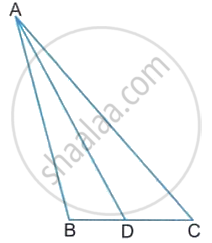
3.5 cm
4.8 cm
7 cm
10.5 cm
In the given figure, two line segments AC and BD intersect each other at point P such that PA = 6 cm, PB = 3 cm, PC = 2.5 cm, PD = 5 cm, ∠APB = 50° and ∠CDP = 30°. Then ∠PBA = ?
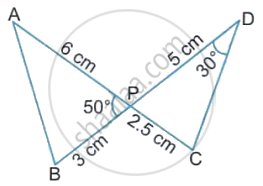
30°
50°
60°
100°
ABCD is a trapezium with AB parallel to DC. Then the triangle similar to △AOB is ______.
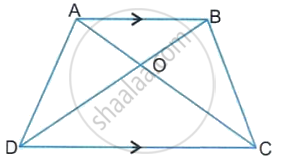
△ACB
△ADB
△COB
△COD
The ratio of the corresponding sides of two similar triangles is 1 : 3. The ratio of their corresponding heights is ______.
1 : 3
1 : 9
3 : 1
9 : 1
If in triangles ABC and DEF, ∠A = ∠E = 40°, AB : ED = AC : EF and ∠F = 65°, then ∠B is equal to ______.
35°
65°
75°
85°
In the given figure, AB || CD and OA = (2x + 4) cm, OB = (9x – 21) cm, OC = (2x – 1) cm and OD = 3 cm. Then x equals:
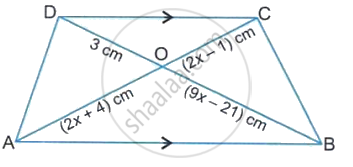
2.1
3
4
6
The shadow of a 5-m-long stick is 2 m long. At the same time, the length of the shadow of a 12.5-m-high tree is ______.
3 m
3.5 m
4.5 m
5 m
In a right-angled △ABC, right-angled at A, if AD ⊥ BC such that AD = p, BC = a, CA = b and AB = c, then:
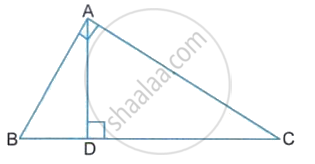
`p/a = p/b`
`p^2 = b^2 + c^2`
`p^2 = b^2c^2`
`1/p^2 = 1/b^2 + 1/c^2`
In a right-angled △ABC in which ∠A = 90°, if AD ⊥ BC, then which of the following statements is correct?
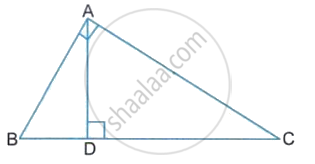
AB = BD × AD
AB2 = BC × BD
AB2 = BD × DC
AB2 = BC × DC
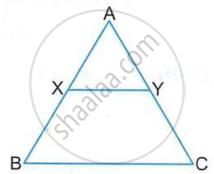
In the adjoining figure, XY is parallel to BC. If XY divides the triangle into two equal parts, then \[\frac{\mathrm{AX}}{\mathrm{AB}}\] equals:
\[\frac{1}{\sqrt2}\]
\[\frac{1}{2}\]
\[\frac{\sqrt2 + 1}{\sqrt2}\]
\[\frac{\sqrt2 - 1}{\sqrt2}\]
Which of the following is true in the given figure, where AD is the altitude to the hypotenuse of a right-angled △ABC?
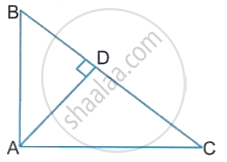
(I) △ABD ∼ △CAD
(II) △ADB ≅ △CDA
(III) △ADB ∼ △CAB
I and II
II and III
I and III
I, II and III
The areas of two similar triangles are 49 cm2 and 64 cm2 respectively. The ratio of their corresponding sides is ______.
7 : 8
49 : 64
8 : 7
64 : 49
The areas of two similar triangles are 12 cm2 and 48 cm2 respectively. If the height of the smaller one is 2.1 cm, then the corresponding height of the bigger one is ______.
0.525 cm
4.2 cm
4.41 cm
8.4 cm
The areas of two similar triangles are 81 cm2 and 144 cm2. If the largest side of the smaller triangle is 27 cm, then largest side of the larger triangle is ______.
24 cm
36 cm
48 cm
none of these
△ABC and △DEF are similar to each other. If the ratio of side AB to side DE is `(sqrt(2) + 1) : sqrt(3)`, then the ratio of area of △ABC to that of △DEF is ______.
`(3 + 2sqrt(2)) : 3`
`1 : (9 - 6sqrt(2))`
`(9 - 6sqrt(2)) : 2`
`(3 - 2sqrt(2)) : 3`
If △ABC ∼ △QRP, \[\frac{\mathrm{ar}(\triangle \mathrm{ABC})}{\mathrm{ar}(\triangle \mathrm{PQR})} = \frac{9}{4}\], AB = 18 cm and BC = 15 cm, then PR = ?
`(20/3)` cm
8 cm
10 cm
12 cm
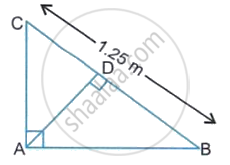
In the given figure, ∠CAB = 90° and AD ⊥ BC. If AC = 75 cm, AB = 1 m and BC = 1.25 m, then AD equals:
50 cm
60 cm
65 cm
70 cm
A street lamp is fixed on a lamp-post at a height of 3.3 m from the ground. A boy 110 cm tall walks away from the base of this lamp post at a speed of 0.8 m/s. The length of the shadow of the boy after 4 seconds is ______.
1.1 m
1.6 m
2.1 m
2.6 m
In the given diagram (not drawn to scale), railway stations A, B, C, P and Q are connected by straight tracks. Track PQ is parallel to BC. The time taken by a train travelling at 90km/hr to reach B from A by the shortest route is:
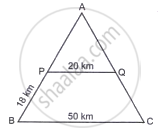
8 minutes
12 minutes
16.8 minutes
20 minutes
The lengths of the sides of triangle P are 3, 4 and 5 units. Another triangle Q, which is similar to P, has one side of length 60 units, what is the smallest possible perimeter of triangle Q?
120 units
144 units
180 units
240 units
Which of the following statements is correct?
If D is a point on side AB of △ABC such that AD : DB = 5 : 2 and E is a point on BC such that DE || AC, then ar(△ABC) : ar(△DBE) = 9 : 4.
If the areas of two similar triangles are in the ratio 25 : 64, then their perimeters are in the ratio 5 : 8.
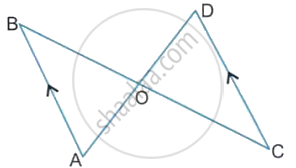
In the adjoining figure if AB || CD, then △AOB ∼ △COD.
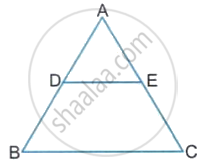
In the adjoining figure, if D and E are the mid-points of AB and AC respectively, then ar(ΔADE) = `1/2` × ar(ΔABC).
In the given figure, D, E and F are the mid-points of the sides BC, AC and AB respectively of △ABC. Then which of the following does not hold true?
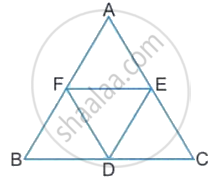
△AFE ∼ △ABC
△FBD ∼ △ABC
△EDC ∼ △ABC
△DFE ∼ △ABC
A triangle with sides 6, 9 and 12 units has area A sq. units. What is the area (in sq. units) of a triangle with sides 8, 12 and 16 units in terms of A?
`3/2` A
`4/3` A
`16/9` A
`25/16` A
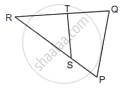
In the adjoining diagram, ST is not parallel to PQ. The necessary and sufficient conditions for ΔPQR ~ ΔTSR is:
∠PQR = ∠STR
∠QPR = ∠TSR
∠PQR = ∠TSR
∠PRQ = ∠RST
Directions (Q. 44 to 47): These questions are based on the following information:
In the given figure, ABC is a triangle and PQ is a straight line meeting AB in P and AC in Q. It is given that AP = 1 cm, PB = 3 cm, AQ = 1.5 cm, QC = 4.5 cm and PQ = 2 cm.
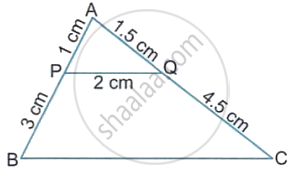
The perimeter of △ABC is ______.
12 cm
16 cm
18 cm
24 cm
In the given figure, ABC is a triangle and PQ is a straight line meeting AB in P and AC in Q. It is given that AP = 1 cm, PB = 3 cm, AQ = 1.5 cm, QC = 4.5 cm and PQ = 2 cm.
The ratio of the areas of ΔAPQ and ΔABC is ______.
1 : 3
1 : 4
1 : 9
1 : 16
In the given figure, ABC is a triangle and PQ is a straight line meeting AB in P and AC in Q. It is given that AP = 1 cm, PB = 3 cm, AQ = 1.5 cm, QC = 4.5 cm and PQ = 2 cm.
Which of the following holds true?
△APQ ∼ △ABC
△AQP ∼ △ABC
△APQ ∼ △ACB
none of these
In the given figure, ABC is a triangle and PQ is a straight line meeting AB in P and AC in Q. It is given that AP = 1 cm, PB = 3 cm, AQ = 1.5 cm, QC = 4.5 cm and PQ = 2 cm.
Which axiom of similarity applies in the above case?
AAA
AA
SSS
SAS
Directions (Q. 48 to 51): Using the given diagram answer the following questions:
In ΔPQR, AB || QR, QP || CB and AR intersects CB at O.
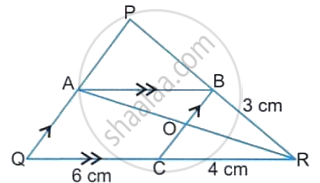
The triangle similar to △ARQ is ______.
△ORC
△ARP
△OBR
△QRP
In ΔPQR, AB || QR, QP || CB and AR intersects CB at O.
△PQR ∼ △BCR by axiom:
SAS
AAA
SSS
AAS
In ΔPQR, AB || QR, QP || CB and AR intersects CB at O.
If QC = 6 cm, CR = 4 cm, BR = 3 cm, then the length of RP is ______.
4.5 cm
5 cm
7.5 cm
8 cm
In ΔPQR, AB || QR, QP || CB and AR intersects CB at O.
The ratio PQ : BC is ______.
2 : 3
3 : 2
2 : 5
5 : 2
Directions (Q. 52 to 55): Answer these questions on the basis of the following information:
Through the mid-point M of the side CD of a ||gm ABCD, the line BM is drawn, intersecting AC on L and AD produced in E.
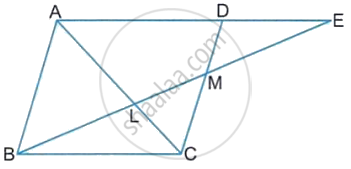
Which of the following is true for triangles BMC and EMD?
I. They are similar to each other.
II. They are congruent to each other.
III. Their areas are equal.
IV. Their perimeters are equal.
I and II
II and III
I, II and III
I, II, III and IV
Through the mid-point M of the side CD of a ||gm ABCD, the line BM is drawn, intersecting AC on L and AD produced in E.
△AEL is similar to ______.
△CBL
△CML
△DME
△BMC
Through the mid-point M of the side CD of a ||gm ABCD, the line BM is drawn, intersecting AC on L and AD produced in E.
By which axiom are the above triangles similar?
AA
SSS
SAS
ASA
Through the mid-point M of the side CD of a ||gm ABCD, the line BM is drawn, intersecting AC on L and AD produced in E.
EL : BL is equal to ______.
1 : 2
2 : 1
1 : 3
3 : 1
Directions (Q. 56 to 59): Study the following diagram carefully and answer the given questions:
In △ABC, D and E are points on AB and AC respectively such that AD = a, DB = 3a, AE = b and EC = 3b. DQ || EA and EP || DA are drawn. QP is joined.
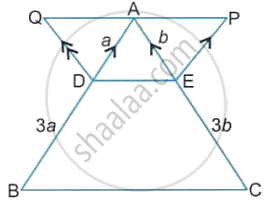
△ADE is similar to which of the following triangles?
I. △ABC
II. △DAQ
III. △ADQ
IV. △EPA
V. △EAP
I, II and IV only
I, III and V only
I, II and V only
I, III, and IV only
In △ABC, D and E are points on AB and AC respectively such that AD = a, DB = 3a, AE = b and EC = 3b. DQ || EA and EP || DA are drawn. QP is joined.
If DE = 2 cm, then BC is equal to ______.
4 cm
6 cm
7 cm
8 cm
In △ABC, D and E are points on AB and AC respectively such that AD = a, DB = 3a, AE = b and EC = 3b. DQ || EA and EP || DA are drawn. QP is joined.
The ratio of the perimeters of △ADE and △ABC is ______.
1 : 2
1 : 3
1 : 4
1 : 6
In △ABC, D and E are points on AB and AC respectively such that AD = a, DB = 3a, AE = b and EC = 3b. DQ || EA and EP || DA are drawn. QP is joined.
The ratio of the areas of △ADE and trapezium DBCE is ______.
1 : 8
1 : 9
1 : 15
1 : 16
Directions (Q. 60 to 63): Study the given information and answer the questions that follow:
In the given figure ABCD is a trapezium in which DC is parallel to AB.
AB = 16 cm and DC = 8 cm, OD = 5 cm, OB = (y + 3) cm, OA = 11 cm and OC = (x – 1) cm.
Using the given information answer the following questions.
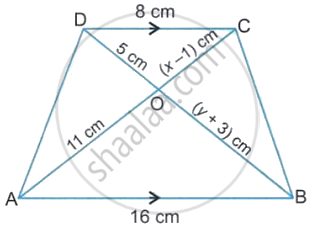
From the given figure name the pair of similar triangles:
△OAB, △OBC
△COD, △AOB
△ADB, △ACB
△COD, △COB
In the given figure ABCD is a trapezium in which DC is parallel to AB.
AB = 16 cm and DC = 8 cm, OD = 5 cm, OB = (y + 3) cm, OA = 11 cm and OC = (x – 1) cm.
Using the given information answer the following questions.
The corresponding proportional sides with respect to the pair of similar triangles obtained above is ______.
\[\frac{\mathrm{CD}}{\mathrm{AB}} = \frac{\mathrm{OC}}{\mathrm{OA}} = \frac{\mathrm{OD}}{\mathrm{OB}}\]
\[\frac{\mathrm{AD}}{\mathrm{BC}} = \frac{\mathrm{OC}}{\mathrm{OA}} = \frac{\mathrm{OD}}{\mathrm{OB}}\]
\[\frac{\mathrm{AD}}{\mathrm{BC}} = \frac{\mathrm{BD}}{\mathrm{AC}} = \frac{\mathrm{AB}}{\mathrm{DC}}\]
\[\frac{\mathrm{OD}}{\mathrm{OB}} = \frac{\mathrm{CD}}{\mathrm{CB}} = \frac{\mathrm{OC}}{\mathrm{OA}}\]
In the given figure ABCD is a trapezium in which DC is parallel to AB.
AB = 16 cm and DC = 8 cm, OD = 5 cm, OB = (y + 3) cm, OA = 11 cm and OC = (x – 1) cm.
Using the given information answer the following questions.
The ratio of the sides of the pair of similar triangles is ______.
1 : 3
1 : 2
2 : 3
3 : 1
In the given figure ABCD is a trapezium in which DC is parallel to AB.
AB = 16 cm and DC = 8 cm, OD = 5 cm, OB = (y + 3) cm, OA = 11 cm and OC = (x – 1) cm.
Using the given information answer the following questions.
Using the ratio of sides of the pair of similar triangles, the values of x and y are respectively:
x = 4.6, y = 7
x = 7, y = 7
x = 6.5, y = 7
x = 6.5, y = 2
In the given diagram △ABC ∼ △EFG. If ∠ABC = ∠EFG = 60°, then the length of the side FG is ______.
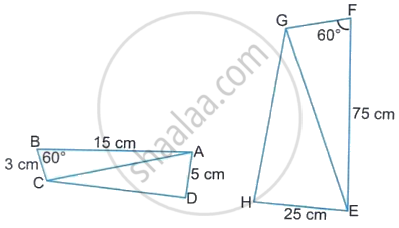
15 cm
20 cm
25 cm
30 cm
In the adjoining figure, AC is a diameter of the circle. AP = 3 cm and PB = 4 cm and QP ⊥ AB. If the area of ΔAPQ is 18 cm2, then the area of shaded portion QPBC is ______.
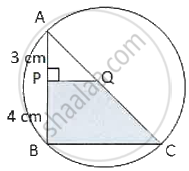
32 cm2
49 cm2
80 cm2
98 cm2
II. Assertion-Reason Type Questions Directions : In each question below, there are two statements labelled as Assertion (A) and Reason (R). Choose the correct answer as per the options given below:
Assertion (A): In \(\triangle \mathrm{ABC}\) and \(\triangle \mathrm{PQR}\), if \(\angle \mathrm{BAC} = \angle \mathrm{QPR}\) and \(\angle \mathrm{ABC} = \angle \mathrm{PQR}\), then \(\triangle \mathrm{ABC} \sim \triangle \mathrm{PQR}\).
Reason (R): \(\triangle \mathrm{ABC} \sim \triangle \mathrm{PQR}\) by SSS axiom.
Both A and R are true, and R is the correct explanation of A.
Both A and R are true, but R is not the correct explanation of A.
A is true, but R is false.
A is false, but R is true.
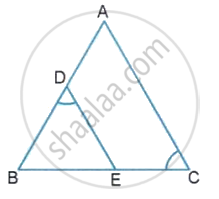
Assertion (A): In the figure, if \(\angle \mathrm{EDB} = \angle \mathrm{ACB}, \mathrm{BE} = 6 \mathrm{~cm}\), \(\mathrm{EC} = 4 \mathrm{~cm}\) and \(\mathrm{BD} = 5 \mathrm{~cm}\), then the length of AB is 12 cm.
Reason (R): If two triangles have two pairs of corresponding angles equal, then the triangles are similar.
Both A and R are true, and R is the correct explanation of A.
Both A and R are true, but R is not the correct explanation of A.
A is true, but R is false.
A is false, but R is true.
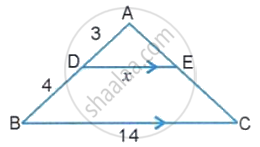
Assertion (A): In the figure, if \(\mathrm{DE} \parallel \mathrm{BC}\), then the value of x is 6 units.
Reason (R): Two similar triangles are always congruent.
Both A and R are true, and R is the correct explanation of A.
Both A and R are true, but R is not the correct explanation of A.
A is true, but R is false.
A is false, but R is true.
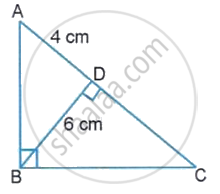
Assertion (A): In the figure, \(\angle \mathrm{ABC} = \angle \mathrm{BDC} = 90^{\circ}\). If \(\mathrm{AD} = 4 \mathrm{~cm}, \mathrm{BD} = 6 \mathrm{~cm}\), then area of \(\triangle \mathrm{ABC}\) is \(40 \mathrm{~cm}^{2}\).
Reason (R): Areas of two similar triangles are proportional to the squares of their corresponding sides.
Both A and R are true, and R is the correct explanation of A.
Both A and R are true, but R is not the correct explanation of A.
A is true, but R is false.
A is false, but R is true.
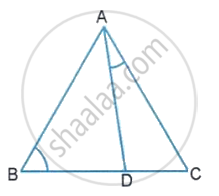
Assertion (A): In \(\triangle \mathrm{ABC}\), if \(\angle \mathrm{ABC} = \angle \mathrm{DAC}, \mathrm{AB} = 8 \mathrm{~cm}\), \(\mathrm{AC} = 4 \mathrm{~cm}, \mathrm{AD} = 5 \mathrm{~cm}\), then \(\mathrm{BC} = 6.4 \mathrm{~cm}\).
Reason (R): SAS and SSS both are valid criteria for similarity of two triangles.
Both A and R are true, and R is the correct explanation of A.
Both A and R are true, but R is not the correct explanation of A.
A is true, but R is false.
A is false, but R is true.
Assertion (A): In \(\triangle \mathrm{ABC}\) and \(\triangle \mathrm{PQR}\), if \(\angle \mathrm{BAC} = \angle \mathrm{QPR}\) and \(\angle \mathrm{ABC} = \angle \mathrm{PQR}\), then \(\triangle \mathrm{ABC} \sim \triangle \mathrm{PQR}\).
Reason (R): \(\triangle \mathrm{ABC} \sim \triangle \mathrm{PQR}\) by SSS axiom.
Both A and R are true, and R is the correct explanation of A.
Both A and R are true, but R is not the correct explanation of A.
A is true, but R is false.
A is false, but R is true.
III. Analytical and Application Based Questions
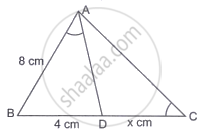
Given a triangle ABC and D is a point on BC such that BD = 4 cm and DC = x cm. If ∠BAD = ∠C and AB = 8 cm, then,
- prove that triangle ABD is similar to triangle CBA.
- find the value of ‘x’.
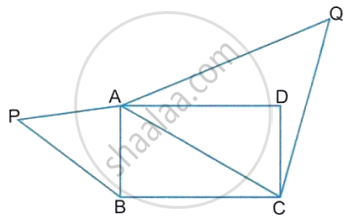
ABCD is a rectangle in which side BC is twice side AB. If \(\triangle \mathrm{ACQ} \sim \triangle \mathrm{BAP}\), find area of \(\Delta \mathrm{BAP}\) : area of \(\Delta \mathrm{ACQ}\).
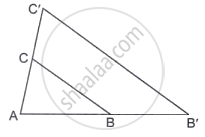
While preparing a Power Point presentation, ΔABC is enlarged along the side BC to ΔAB’C’, as shown in the diagram, such that BC : B’C’ is 3 : 5. Find:
- AB : BB’
- length AB, if BB’ = 4 cm.
- Is ΔABC ~ ΔАВ’C’? Justify your answer.
- ar (ΔABC) : ar (quad. BB’C’C).
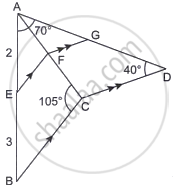
In the given figure(not drawn to scale), BC is parallel to EF, CD is parallel to FG, AE : EB = 2 : 3, ∠BAD = 70°, ∠ACB = 105°, ∠ADC = 40° and AC is bisector of ∠BAD.
- Prove ΔAEF ~ ΔAGF
- Find:
- AG : AD
- area of ΔACB : area ΔACD
- area of quadrilateral ABCD : area of ΔАСВ.
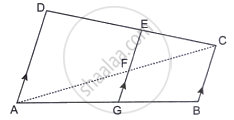
In the figure given above (not drawn to scale), AD || GE || BC, DE = 18 cm, EC = 3 cm, AD = 35 cm.
Find:
- AF : FC
- length of EF
- area (trapezium ADEF) : area (ΔEFC)
- BC : GF
IV. Case Study Based Questions Directions: Read the following case study carefully and answer the questions based on it:
|
Amit is trying to find the average height of a tower near his house. The height of Amit's house is 20 m. At a certain time of the day, when Amit's house casts a shadow 10 m long on the ground, the tower casts a shadow 50 m long on the ground and Sumit's house casts a 20 m long shadow on the ground.
|
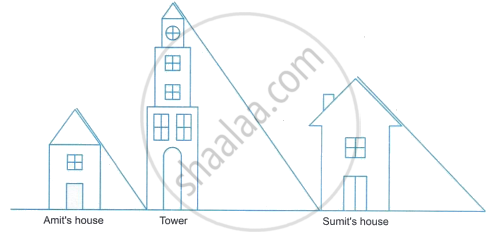
What is the height of the tower?
50 m
80 m
100 m
150 m
|
Amit is trying to find the average height of a tower near his house. The height of Amit's house is 20 m. At a certain time of the day, when Amit's house casts a shadow 10 m long on the ground, the tower casts a shadow 50 m long on the ground and Sumit's house casts a 20 m long shadow on the ground.
|
What will be the length of the shadow of the tower when Amit’s house casts a shadow 12 m long?
50 m
60 m
75 m
90 m
|
Amit is trying to find the average height of a tower near his house. The height of Amit's house is 20 m. At a certain time of the day, when Amit's house casts a shadow 10 m long on the ground, the tower casts a shadow 50 m long on the ground and Sumit's house casts a 20 m long shadow on the ground.
|
What is the height of Sumit’s house?
20 m
30 m
40 m
50 m
|
Amit is trying to find the average height of a tower near his house. The height of Amit's house is 20 m. At a certain time of the day, when Amit's house casts a shadow 10 m long on the ground, the tower casts a shadow 50 m long on the ground and Sumit's house casts a 20 m long shadow on the ground.
|
At a time when the tower casts a shadow 40 m long, what will be the length of the shadow of Sumit’s house?
8 m
16 m
20 m
32 m
|
Amit is trying to find the average height of a tower near his house. The height of Amit's house is 20 m. At a certain time of the day, when Amit's house casts a shadow 10 m long on the ground, the tower casts a shadow 50 m long on the ground and Sumit's house casts a 20 m long shadow on the ground.
|
When the tower casts a shadow 30 m long, at the same time what will be the length of the shadow of Amit’s house?
15 m
8 m
6 m
4 m
Solutions for 16: Similarity of Triangles
R.S. Aggarwal solutions for माठेमटिक्स [इंग्रजी] इयत्ता १० आयसीएसई chapter 16 - Similarity of Triangles
Shaalaa.com has the CISCE Mathematics माठेमटिक्स [इंग्रजी] इयत्ता १० आयसीएसई CISCE solutions in a manner that help students grasp basic concepts better and faster. The detailed, step-by-step solutions will help you understand the concepts better and clarify any confusion. R.S. Aggarwal solutions for Mathematics माठेमटिक्स [इंग्रजी] इयत्ता १० आयसीएसई CISCE 16 (Similarity of Triangles) include all questions with answers and detailed explanations. This will clear students' doubts about questions and improve their application skills while preparing for board exams.
Further, we at Shaalaa.com provide such solutions so students can prepare for written exams. R.S. Aggarwal textbook solutions can be a core help for self-study and provide excellent self-help guidance for students.
Concepts covered in माठेमटिक्स [इंग्रजी] इयत्ता १० आयसीएसई chapter 16 Similarity of Triangles are .
Using R.S. Aggarwal माठेमटिक्स [इंग्रजी] इयत्ता १० आयसीएसई solutions Similarity of Triangles exercise by students is an easy way to prepare for the exams, as they involve solutions arranged chapter-wise and also page-wise. The questions involved in R.S. Aggarwal Solutions are essential questions that can be asked in the final exam. Maximum CISCE माठेमटिक्स [इंग्रजी] इयत्ता १० आयसीएसई students prefer R.S. Aggarwal Textbook Solutions to score more in exams.
Get the free view of Chapter 16, Similarity of Triangles माठेमटिक्स [इंग्रजी] इयत्ता १० आयसीएसई additional questions for Mathematics माठेमटिक्स [इंग्रजी] इयत्ता १० आयसीएसई CISCE, and you can use Shaalaa.com to keep it handy for your exam preparation.
