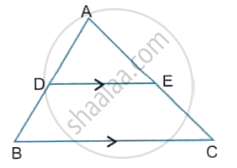
In the given figure, $$\mathrm{DE} \parallel \mathrm{BC}$$. If $$\mathrm{DE} = 4 \mathrm{~cm}, \mathrm{BC} = 6 \mathrm{~cm}$$ and $$\operatorname{ar}(\triangle \mathrm{ADE}) = 20 \mathrm{~cm}^{2}$$
Advertisements
प्रश्न
In the given figure, $$\mathrm{DE} \parallel \mathrm{BC}$$.
If $$\mathrm{DE} = 4 \mathrm{~cm}, \mathrm{BC} = 6 \mathrm{~cm}$$ and $$\operatorname{ar}(\triangle \mathrm{ADE}) = 20 \mathrm{~cm}^{2}$$, find the area of $$\triangle \mathrm{ABC}$$.
Advertisements
उत्तर
In $$\triangle \mathrm{ADE}$$ and $$\triangle \mathrm{ABC}$$:
$$\angle \mathrm{ADE} = \angle \mathrm{ABC}$$ (Corresponding angles, as $$\mathrm{DE} \parallel \mathrm{BC}$$)
$$\angle \mathrm{DAE} = \angle \mathrm{BAC}$$ (Common angle)
Therefore, by AA-similarity criterion: $$\triangle \mathrm{ADE} \sim \triangle \mathrm{ABC}$$.
The areas of two similar triangles are proportional to the squares of their corresponding sides:
$$\frac{\operatorname{ar}(\triangle \mathrm{ADE})}{\operatorname{ar}(\triangle \mathrm{ABC})} = \left(\frac{\mathrm{DE}}{\mathrm{BC}}\right)^2$$
$$\Rightarrow \frac{20}{\operatorname{ar}(\triangle \mathrm{ABC})} = \left(\frac{4}{6}\right)^2$$
$$= \left(\frac{2}{3}\right)^2$$
$$= \frac{4}{9}$$
$$\Rightarrow \operatorname{ar}(\triangle \mathrm{ABC}) = \frac{20 \times 9}{4}$$
$$= 5 \times 9$$
$$= 45\text{ cm}^2$$
Hence, the area of $$\triangle \mathrm{ABC}$$ is $$45\text{ cm}^2$$.
