Assertion (A): In (\triangle \mathrm{ABC}), if (\angle \mathrm{ABC} = \angle \mathrm{DAC}, \mathrm{AB} = 8 \mathrm{~cm}), (\mathrm{AC} = 4 \mathrm{~cm}, \mathrm{AD} = 5 \mathrm{~cm})
Advertisements
प्रश्न
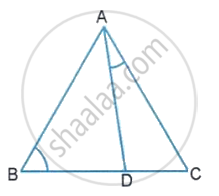
Assertion (A): In \(\triangle \mathrm{ABC}\), if \(\angle \mathrm{ABC} = \angle \mathrm{DAC}, \mathrm{AB} = 8 \mathrm{~cm}\), \(\mathrm{AC} = 4 \mathrm{~cm}, \mathrm{AD} = 5 \mathrm{~cm}\), then \(\mathrm{BC} = 6.4 \mathrm{~cm}\).
Reason (R): SAS and SSS both are valid criteria for similarity of two triangles.
पर्याय
Both A and R are true, and R is the correct explanation of A.
Both A and R are true, but R is not the correct explanation of A.
A is true, but R is false.
A is false, but R is true.
Advertisements
उत्तर
Both A and R are true, but R is not the correct explanation of A.
Explanation:
ΔACD ∼ ΔBCA by AA (∠DAC = ∠ABC and ∠ACD = ∠ACB), so $$\frac{AD}{AB} = \frac{AC}{BC}$$ gives $$\frac{5}{8} = \frac{4}{BC}$$, hence $$BC = 6.4$$ cm. R is true because SAS and SSS are valid similarity criteria, but they are not the criteria actually used, so R is not the correct explanation.
