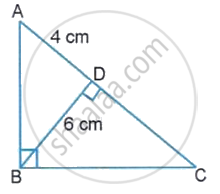
Assertion (A): In the figure, (\angle \mathrm{ABC} = \angle \mathrm{BDC} = 90^{\circ}). If (\mathrm{AD} = 4 \mathrm{~cm}, \mathrm{BD} = 6 \mathrm{~cm}), then area of (\triangle \mathrm{ABC}) is
Advertisements
प्रश्न
Assertion (A): In the figure, \(\angle \mathrm{ABC} = \angle \mathrm{BDC} = 90^{\circ}\). If \(\mathrm{AD} = 4 \mathrm{~cm}, \mathrm{BD} = 6 \mathrm{~cm}\), then area of \(\triangle \mathrm{ABC}\) is \(40 \mathrm{~cm}^{2}\).
Reason (R): Areas of two similar triangles are proportional to the squares of their corresponding sides.
पर्याय
Both A and R are true, and R is the correct explanation of A.
Both A and R are true, but R is not the correct explanation of A.
A is true, but R is false.
A is false, but R is true.
Advertisements
उत्तर
A is false, but R is true.
Explanation:
Using $$BD^2 = AD \times DC$$, $$6^2 = 4 \times DC$$ gives $$DC = 9$$, so $$AC = 13$$. Thus area of ΔABC = $$\frac{1}{2} \times AC \times BD = \frac{1}{2} \times 13 \times 6 = 39\ \mathrm{cm}^2$$, not 40 cm2. R is true: areas of similar triangles are proportional to the squares of their corresponding sides.
