R.S. Aggarwal solutions for माठेमटिक्स [इंग्रजी] इयत्ता १० आयसीएसई chapter 12 - Reflection [Latest edition]
Online Mock Tests
Chapters
1: Goods and Services Tax (G.S.T.)
2: Banking
3: Shares and Dividends
UNIT 2: ALGEBRA
4: Linear Inequations
5: Quadratic Equation
6: Problems on Quadratic Equations
7: Ratio and Proportion
8: Remainder Theorem and Factor Theorem
9: Matrices
10: Arithmetic Progression
11: Geometric Progression
▶ 12: Reflection
13: Section and Mid-point Formulae
14: Equation of a Straight Line
UNIT 3: GEOMETRY
15: Similarity (As a Size Transformation)
16: Similarity of Triangles
17: Loci
Chapter 18: Angle and Cyclic Properties of a Circle
Chapter 19: Tangent Properties of Circles
20: Constructions
UNIT 4: MENSURATION
Chapter 21: Volume and Surface Area of Solids (Cylinder, Cone and Sphere)
UNIT 5: TRIGONOMETRY
Chapter 22: Trigonometrical Identities
Chapter 23: Heights and Distances
UNIT 6: STATISTICS
Chapter 24: Graphical Representation of Statistical Data
Chapter 25: Measures of Central Tendency (Mean)
Chapter 26: Median, Quartiles and Mode
UNIT 7: PROBABILITY
Chapter 27: Probability
Advertisements
Advertisements
Solutions for Chapter 12: Reflection
Below listed, you can find solutions for Chapter 12 of CISCE R.S. Aggarwal for माठेमटिक्स [इंग्रजी] इयत्ता १० आयसीएसई.
Advertisements
R.S. Aggarwal solutions for माठेमटिक्स [इंग्रजी] इयत्ता १० आयसीएसई 12 Reflection EXERCISE 12A [Page 186]
Draw co-ordinate axes and represent the following points:
- A(2, 4)
- B(–1, 3)
- C(4, –3)
- D(–3, –4)
- E(0, 6)
- F(–2, 0)
On which axis does the following point lie?
- \(\mathrm{P}(3, 0)\)
- \(\mathrm{Q}(0, 4)\)
- \(\mathrm{R}(-2, 0)\)
- \(\mathrm{S}(0, -3)\)
Find the distance of the following point from x-axis and y-axis:
\(\mathrm{A}(7, 4)\)
Find the distance of the following point from x-axis and y-axis:
\(\mathrm{B}(3, -5)\)
Find the distance of the following point from x-axis and y-axis:
\(\mathrm{C}(-4, -2)\)
Find the distance of the following point from x-axis and y-axis:
\(\mathrm{D}(-3, 6)\)
A point lies on x-axis at a distance of 4 units from y-axis. What are the co-ordinates of this point?
A point lies on y-axis at a distance of 5 units from x-axis. What are the co-ordinates of this point?
What do you mean by the line x = 0?
What do you mean by the line x = 4?
What do you mean by the line y = 0?
What do you mean by the line y = 4?
What do you mean by the line x = –3?
What do you mean by the line y = –2?
R.S. Aggarwal solutions for माठेमटिक्स [इंग्रजी] इयत्ता १० आयसीएसई 12 Reflection EXERCISE 12B [Pages 196 - 199]
Find the image of the following point under reflection in x-axis:
(6, 3)
Find the image of the following point under reflection in x-axis:
(7, –5)
Find the image of the following point under reflection in x-axis:
(– 4, 3)
Find the image of the following point under reflection in x-axis:
(– 2, – 4)
Find the image of the following point under reflection in x-axis:
(0, 3)
Find the image of the following point under reflection in y-axis:
(2, 6)
Find the image of the following point under reflection in y-axis:
(–3, 8)
Find the image of the following point under reflection in y-axis:
(–5, –3)
Find the image of the following point under reflection in y-axis:
(0, –1)
Find the image of the following point under reflection in y-axis:
(4, 0)
Find the image of the following point when reflected in the origin:
(–5, 8)
Find the image of the following point when reflected in the origin:
(– 6, – 4)
Find the image of the following point when reflected in the origin:
(7, 4)
Find the image of the following point when reflected in the origin:
(9, 0)
Find the image of the following point when reflected in the origin:
(0, 7)
Find the image of the following point under reflection in the line x = 0:
(4, 7)
Find the image of the following point under reflection in the line x = 0:
(–3, –5)
Find the image of the following point under reflection in the line x = 0:
(– 8, 6)
Find the image of the following point under reflection in the line x = 0:
(5, 0)
Find the image of the following point under reflection in the line x = 0:
(0, –2)
Find the image of the following point under reflection in the line y = 0:
(6, –7)
Find the image of the following point under reflection in the line y = 0:
(– 8, 4)
Find the image of the following point under reflection in the line y = 0:
(– 3, – 8)
Find the image of the following point under reflection in the line y = 0:
(7, 9)
Find the image of the following point under reflection in the line y = 0:
(0, – 6)
The point P(– 6, – 3) on reflection in y-axis is mapped on P'. The point P' on reflection in the origin is mapped on P''.
- Find the co-ordinates of P'.
- Find the co-ordinates of P''.
- Write down a single transformation that maps P onto P''.
The point P(4, –7) is reflected in the origin to point P'. The point P' is then reflected in x-axis to the point P''.
- Find the co-ordinates of P'.
- Find the co-ordinates of P''.
- Write down a single transformation that maps P onto P''.
The vertices of a ABC are A(2, –3), B(–1, 2) and C(3, 0). This triangle is reflected in x-axis to form ΔA'B'C'. Find the co-ordinates of A', B' and C'. Are the two triangles congruent?
The points P(–2, 4), Q(3, –1) and R(6, 2) are the vertices of a triangle. ΔPQR is reflected in y-axis to form ΔP'Q'R'. Find the co-ordinates of P', Q' and R'.
Use a graph paper for this question (Take 2 cms = 1 unit on both x and y-axis)
1) Plot the following points: A(0, 4), B(2, 3), C(1, 1) and D(2, 0)
2) Reflect points B, C, D on the y-axis and write down their coordinates. Name the images as B’, C’, D’ respectively
3) Join the points A, B, C, D, D’, C’, B’ and A in order, so as to form a closed figure. Write down the equation of the line of symmetry of the figure formed.
(i) Plot the points A(3, 2) and B(5, 4) on a graph paper.
(ii) Reflect A and B in the x-axis to A' and B' respectively. Plot A' and B' on the same graph paper. Write the co-ordinates of A' and B'.
(iii) Write down:
(a) the geometrical name of the figure ABB'A'.
(b) m∠ABB'.
(c) the image A'' of A when reflected in the origin.
(d) the single transformation that maps A' to A''.
[Hint: (ii) Rx (3, 2) = (3, –2) and Ry (5, 4) = (–5, 4).
(iii) (a) Clearly AA' || BB' and AB = A'B'.
∴ ABB'A' is an isosceles trapezium.
(b) m∠ABB' = 45°. (c) A" is (–3, –2).
(d) Reflect A' in y-axis to get A".]
Points P and Q have coordinates (0, 5) and (–2, 4).
(i) P is invariant when reflected in an axis. Name the axis.
(ii) Find the image of Q on reflection in the axis found in (i).
(iii) (0, k) on reflection in the origin is invariant. Write the value of k.
(iv) Write the co-ordinates of the image of Q, obtained by reflecting it in the origin followed by reflection in the x-axis.
[Hint: (iii) Ro(0, k) = (0, – k). But Ro(0, k) = (0, k) [Given]
∴ (0, – k) = (0, k) ⇒ – k = k ⇒ 2k = 0 ⇒ k = 0.]
Use a graph paper for this question. Plot the points P(3, 2) and Q(–3, –2). From P and Q, draw perpendiculars PM and QN on the x-axis.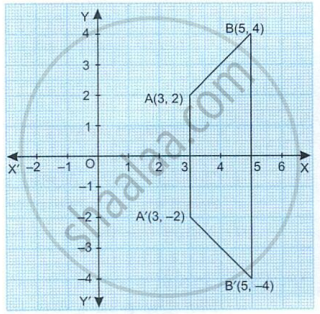
(i) Name the image of P on reflection in the origin.
(ii) Assign the special name to the geometrical figure PMQN and find its area.
(iii) Write the co-ordinates of the point to which M is mapped on reflection in (a) x-axis (b) y-axis (c) origin.
The point P(3, 4) is reflected to P' in x-axis and O' is the image of O (origin) when reflected in the line PP'. Using graph paper, give: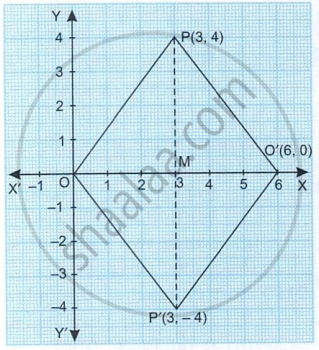
(i) the coordinates of P' and O'.
(ii) the length of the segments PP' and OO'.
(iii) the geometrical name of the figure POP'O'.
(iv) the perimeter of the quadrilateral POP'O'.
[Hint: (i) Rx (3, 4) = (3, – 4). So, we get P'(3, – 4).
MO' = OM = 3 units. So, we get O'(6, 0)
(ii) PP' = (PM + MP') = (4 + 4) = 8 units.
OO' = (ΟM + MΟ') = (3 + 3) = 6 units.
(iii) Diagonals of ΡΟΡΌ' are unequal and bisect each other at right angles. So, it is a rhombus.
(iv) OP2 = (OM2 + PM2) = (32 + 42) = (9 + 16) = 25.
∴ OP = ΟΡ' = Ο'P = Ο'P' = 5 units.
∴ Perimeter of POP'O' = (4 × 5) = 20 units.]
Use a graph paper for this question. A(1, 1), B(5, 1), C(4, 2) and D(2, 2) are the vertices of a quadrilateral.
- Name the quadrilateral ABCD.
- A, B, C, D are reflected in the origin onto A', B', C' and D' respectively. Locate A', B', C', D' on the graph paper and write their co-ordinates.
- Are D, A, A' and D' collinear?
A ΔABC with vertices A(1, 2), B(4, 4) and C(3, 7) is first reflected in the line y = 0 onto ΔA'B'C' and then ΔA'B'C' is reflected in the origin onto ΔA''B''C''.
Write down the co-ordinates of: (i) A', B' and C' (ii) A'', B'' and C''.
Write down the single transformation that maps ΔABC directly onto ΔA''B''C''.
Use graph paper for this question.
The points A (2, 3), B (4, 5) and C (7, 2) are the vertices of A ABC.
- Write down the coordinates of A’, B’, C’ if Δ A’B’C’ is the image of Δ ABC, when reflected in the origin.
- Write down the co-ordinates of A”, B”, C” if A” B” C” is the image of Δ ABC, when reflected in the x-axis.
- Mention the special name of the quadrilateral BCC” B” and find its area.
Use graph paper for this question.
(Take 2 cm = 1 unit along both x-axis and y-axis.)
Plot the points O(0, 0), A(–4, 4), B(–3, 0) and C(0, –3).
- Reflect points A and B on the y-axis and name them A' and B' respectively. Write down their co-ordinates.
- Name the figure OABCB'A'.
- State the line of symmetry of this figure.
Use a graph paper for this question taking 1 cm = 1 unit along both the x and y-axis :
1) Plot the points A(0, 5), B(2, 5), C(5, 2), D(5, −2), E(2, −5) and F(0, −5).
2) Reflect the points B, C, D and E on the y-axis and name them respectively as B', C', D’ and E'.
3) Write the coordinates of B', C', D' and E'.
4) Name the figure formed by B C D E E' D' C' B'.
5) Name a line of symmetry for the figure formed.
Use graph paper to answer the following questions. (Take 2 cm = 1 unit)
- Plot the points A(– 4, 2) and B(2, 4).
- A' is the image of A when reflected in the y-axis. Plot it on the graph paper and write the co-ordinates of A'.
- B' is the image of B when reflected in the line AA'. Write the co-ordinates of B'.
- Write the geometric name of the figure ABA'B'.
- Name a line of symmetry of the figure formed.
Use graph paper for this question (Take 2 cm = 1 unit along both x and y-axis). ABCD is a quadrilateral whose vertices are A(2, 2), B(2, –2), C(0, –1) and D(0, 1).
1) Reflect quadrilateral ABCD on the y-axis and name it as A'B'CD
2) Write down the coordinates of A' and B'.
3) Name two points which are invariant under the above reflection
4) Name the polygon A'B'CD
Find the image of the following points as directed.
(i) Point A(4, 5) reflected in the line x = 6.
(ii) Point B(–3, 2) reflected in the line x = –5.
(iii) Point C(3, 6) reflected in the line y = –2.
(iv) Point D(–2, –5) reflected in the line y = 5.
Use graph sheet for this question. Take 2 cm = 1 unit along the axes.
- Plot A(0, 3), B(2, 1) and C(4, –1).
- Reflect point B and C in y-axis and name their images as B' and C' respectively. Plot and write coordinates of the points B' and C'.
- Reflect point A in the line BB' and name its images as A'.
- Plot and write coordinates of point A'.
- Join the points ABA'B' and give the geometrical name of the closed figure so formed.
Use graph paper for this question. Take 1 cm = 1 unit on both x and y axes.
- Plot the following points on your graph sheets: A(– 4, 0), B(– 3, 2), C(0, 4), D(4, 1) and E(7, 3)
- Reflect the points B, C, D and E on the x-axis and name them as B', C', D' and E' respectively.
- Join the points A, B, C, D, E, E', D' and A in order.
- Name the closed figure formed.
Use a graph paper for this question. Take 2 cm = 1 unit along both the axes.
- Plot the points A(0, 4), B(2, 2), C(5, 2) and D(4, 0). E(0, 0) is the origin.
- Reflect B, C, D on the y-axis and name them as B', C' and D' respectively.
- Join the points ABCD D'C'B' and A in order and give a geometrical name to the closed figure.
Use a graph sheet for this question. Take 1 cm = 1 unit along both the x and y axis. Plot ABCDE, where A(4, 0), B(4, 2), C(2, 2), D(2, 4) and E(0, 4).
- Reflect the points A, B, C and D on the y-axis and name them as F, G, H and I, respectively.
- Join the points A, B, C, D, E, I, H, G and F in order. Reflect the figure ABCDEIHGF on the x-axis and name it as AMNPQRSTF.
- Give the geometrical name of the closed figure AEFQ.
R.S. Aggarwal solutions for माठेमटिक्स [इंग्रजी] इयत्ता १० आयसीएसई 12 Reflection COMPETENCY-FOCUSED QUESTIONS [Pages 199 - 202]
I. Multiple Choice Questions Choose the correct alternative:
The distance of the point P(–3, –4) from the x-axis is ______.
3 units
4 units
5 units
none of these
The distance of the point A(– 6, 8) from the y-axis is ______.
8 units
10 units
6 units
none of these
A point lies on the x-axis at a distance of 5 units from the y-axis to the left side of the origin. The coordinates of this point are ______.
(0, 5)
(0, –5)
(5, 0)
(–5, 0)
A point lies on the y-axis at a distance of 3 units below the x-axis. The coordinates of this point are ______.
(0, 3)
(0, –3)
(3, 0)
(–3, 0)
What does the line, x = – 4 represent?
A line parallel to the x-axis at a distance of 4 units above the x-axis.
A line parallel to the x-axis at a distance of 4 units below the x-axis.
A line parallel to the y-axis at a distance of 4 units to the left of the y-axis.
A line parallel to the y-axis at a distance of 4 units to the right of the y-axis.
What does the line, \(\mathrm{y} = 8\) represent?
A line parallel to the y-axis at a distance of 8 units to the left of the y-axis.
A line parallel to the y-axis at a distance of 8 units to the right of the y-axis.
A line parallel to the x-axis at a distance of 8 units below the x-axis.
A line parallel to the x-axis at a distance of 8 units above the x-axis.
Reflection of point \(\mathrm{P}(a, b)\) in x-axis is ______.
\(\mathrm{P}^{\prime}(a, b)\)
\(\mathrm{P}^{\prime}(-a, b)\)
\(\mathrm{P}^{\prime}(a, -b)\)
\(\mathrm{P}^{\prime}(-a, -b)\)
Reflection of point \(\mathrm{P}(a, b)\) in y-axis is ______.
\(\mathrm{P}^{\prime}(a, b)\)
\(\mathrm{P}^{\prime}(-a, b)\)
\(\mathrm{P}^{\prime}(a, -b)\)
\(\mathrm{P}^{\prime}(-a, -b)\)
Reflection of point \(\mathrm{P}(a, b)\) in the origin is ______.
\(\mathrm{P}^{\prime}(a, b)\)
\(\mathrm{P}^{\prime}(-a, b)\)
\(\mathrm{P}^{\prime}(a, -b)\)
\(\mathrm{P}^{\prime}(-a, -b)\)
The image of the point \(\mathrm{P}(-5, -6)\) when reflected in the x-axis is ______.
\((5, -6)\)
\((5, 6)\)
\((-5, -6)\)
\((-5, 6)\)
The coordinates of the point \(\mathrm{P}(-3, 5)\) on reflecting on the x-axis are ______.
\((3, 5)\)
\((-3, -5)\)
\((3, -5)\)
\((-3, 5)\)
The image of the point \(\mathrm{A}(3, 4)\) when reflected in the y-axis is ______.
(\(3, -4)\)
(\(-3, 4)\)
(\(-3, -4)\)
(\(3, 4)\)
The reflection of the point \(\mathrm{A}(4, -7)\) in the y-axis is ______.
\((4, -7)\)
\((-4, 7)\)
\((4, 7)\)
\((-4, -7)\)
The image of the point (–7, 8) when reflected in the origin is ______.
(–7, 8)
(–7, –8)
(7, –8)
(7, 8)
The reflection of the point (4, –11) in the origin is ______.
(–4, 11)
(–4, –11)
(4, 11)
(4, –11)
Which of the following points is invariant under reflection in the x-axis?
(–3, 4)
(7, –6)
(0, –4)
(–5, 0)
Which of the following points is invariant under reflection in the y-axis?
(14, 0)
(0, 8)
(–12, 3)
(4, –5)
Which of the following points is invariant with respect to the line y = –2?
(2, 3)
(–3, 2)
(–2, 3)
(3, –2)
Reflection of \(\mathrm{P}(a, b)\) in x-axis followed by the reflection in y-axis is ______.
\((a, b)\)
\((-a, b)\)
\((a, -b)\)
\((-a, -b)\)
Reflection of \(\mathrm{P}(a, b)\) in y-axis followed by the reflection in x-axis is ______.
\((-a, b)\)
\((a, -b)\)
\((-a, -b)\)
\((a, b)\)
Reflection of \(\mathrm{P}(a, b)\) in x-axis followed by the reflection in origin is ______.
\((a, b)\)
\((-a, -b)\)
\((-a, b)\)
\((a, -b)\)
Reflection of \(\mathrm{P}(a, b)\) in y-axis followed by the reflection in origin is ______.
\((-a, -b)\)
\((a, b)\)
\((-a, b)\)
\((a, -b)\)
The co-ordinates of the point (4, –7) when reflected in the x-axis followed by the reflection in the y-axis is ______.
(4, –7)
(–4, 7)
(4, 7)
(–4, –7)
The co-ordinates of the image of the point (–6, 9) when reflected in y-axis followed by the reflection in x-axis is ______.
(–6, 9)
(6, 9)
(–6, –9)
(6, –9)
The co-ordinates of the image of the point (–5, –8) when reflected in y-axis followed by the reflection in origin is ______.
(–5, 8)
(5, –8)
(–5, –8)
(5, 8)
The co-ordinates of the image of the point (7, 11) when reflected in x-axis followed by the reflection in origin is ______.
(–7, 11)
(7, 11)
(–7, –11)
(7, –11)
The point \(\mathrm{P}(-14, -18)\) is reflected in origin and after that reflected in x-axis. The co-ordinates of the image of point P are ______.
\((-14, -18)\)
\((14, -18)\)
\((-14, 18)\)
\((14, 18)\)
The point \(\mathrm{P}(-7, 13)\) is reflected in origin followed by reflection in y-axis. The co-ordinates of the image of point P are ______.
\((7, 13)\)
\((-7, -13)\)
\((7, -13)\)
\((-7, 13)\)
If the point \(\mathrm{P}(a, b)\) is reflected in the x-axis to \(\mathrm{P}^{\prime}(3, -7)\), then the value of \((a - b)\) is ______.
10
–10
4
–4
If the point \(\mathrm{P}(a, b)\) is reflected in the y-axis to \(\mathrm{P}^{\prime}(-3, -9)\), then the value of \((a + b)\) is ______.
–6
6
–15
–12
If the point \(\mathrm{P}(a, b)\) is reflected in the origin to \(\mathrm{P}^{\prime}(7, -13)\), then the value of \((a - b)\) is ______.
20
6
–20
–6
If the point \(\mathrm{P}(a, b)\) is first reflected in the origin and then reflected in the x-axis to the point \(\mathrm{P}^{\prime \prime}(12, -5)\), then the value of \((b - a)\) is ______.
–17
17
7
–7
If the point \(\mathrm{P}(a, b)\) is first reflected in the origin and then reflected in the y-axis to the point \(\mathrm{P}^{\prime \prime}(-9, -7)\), then the value of \((2a - 3b)\) is ______.
–16
–25
–3
–39
If the point \(\mathrm{P}(a, b)\) is first reflected in the x-axis and then reflected in the origin to the point \(\mathrm{P}^{\prime \prime}(-8, -2)\), then the value of \((a - 2b)\) is ______.
–12
12
10
–10
If the point \(\mathrm{A}(p, q)\) is first reflected in the y-axis and then reflected in the origin to the point \(\mathrm{A}^{\prime \prime}(-6, 15)\), then the value of \((2p + 3q)\) is ______.
–57
–21
43
57
If the point \(\mathrm{A}(m, n)\) is first reflected in the x-axis and then reflected in the y-axis to the point \(\mathrm{A}^{\prime \prime}(-12, -18)\), then the value of \((2m - n)\) is ______.
6
–6
–30
30
If the point \(\mathrm{A}(m, n)\) is first reflected in the y-axis and then reflected in the x-axis to the point \(\mathrm{A}^{\prime \prime}(-10, 15)\), then the value of \((m - n)\) is ______.
–25
–5
5
25
II. Assertion-Reason Type Questions Directions: In each question below, there are two statements labelled as Assertion (A) and Reason (R). Choose the correct answer as per the options given below:
Assertion (A): The point $$(0, 7)$$ is invariant under the reflection in $$y$$-axis.
Reason (R): The image of a point $$P(x, y)$$ when reflected in the $$y$$-axis is $$P'(x, -y)$$.
Both A and R are true, and R is the correct explanation of A.
Both A and R are true, but R is not the correct explanation of A.
A is true, but R is false.
A is false, but R is true.
Assertion (A): The reflection of the point $$A(-4, 2)$$ in the origin is the point $$A'(4, 2)$$.
Reason (R): The image of a point $$P(x, y)$$ when reflected in the origin is $$P'(-x, -y)$$.
Both A and R are true, and R is the correct explanation of A.
Both A and R are true, but R is not the correct explanation of A.
A is true, but R is false.
A is false, but R is true.
Assertion (A): The point $$(6, 3)$$ is invariant when reflected in the line $$x = 6$$.
Reason (R): A point $$M(a, y)$$ is invariant on the line $$x = a$$.
Both A and R are true, and R is the correct explanation of A.
Both A and R are true, but R is not the correct explanation of A.
A is true, but R is false.
A is false, but R is true.
Assertion (A): The point $$(-2, 8)$$ is invariant under reflection in line $$x = -2$$.
Reason (R): If a point has its x-coordinate 0, it is invariant under reflection in both axes.
Both A and R are true, and R is the correct explanation of A.
Both A and R are true, but R is not the correct explanation of A.
A is true, but R is false.
A is false, but R is true.
III. Analytical and Application Based Questions
ABC is a triangle as shown in the figure below.
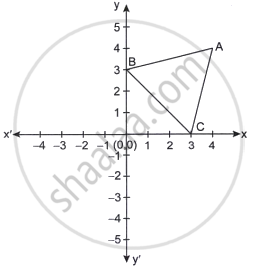
- Write down the coordinates of A, B and C on reflecting through the origin.
- Write down the coordinates of the point/s which remain invariant on reflecting the triangle ABC on the x-axis and y-axis respectively.
- Point P(2, –3) on reflection becomes P’(2, 3). Name the line of reflection (say L1).
- Point P’ is reflected to P” along the line (L2), which is perpendicular to the line L1 and passes through the point, which is invariant along both axes. Write the coordinates of Р”.
- Name and write the coordinates of the point of intersection of the lines L1 and L2.
- Point P is reflected to P” on reflection through the point named in the answer of part I of this question. Write the coordinates of P”. Comment on the location of the points P” and P”.
(For this question, use a graph paper. Scale: 1 cm = 1 unit along both x and y-axis.)
Plot points A(0, 3), B(4, 0), C(6, 2) and D(5, 0). Reflect the points as given below and write their coordinates:
- Reflect A on x-axis to A’.
- Reflect B on y-axis to B’.
- Reflect C on x-axis to C’.
- D remain invariant when reflected on the line whose equation is ______.
- Join the points A, B, C, D, C’, B, A’, B’ and A to form a closed figure. Name the closed figure BCDC’.
(For this question, use a graph paper. Scale: 2 cm = 1 unit along both x and y-axis.)
Plot the points A(2, 2) and B(6, –2) in the graph and answer the following:
- Reflect points A in origin to point D and write the co-ordinates of point D.
- Reflect points A in line y = –2 to point C and write the co-ordinates of points C.
- Find a point P on CD which is invariant under reflection in x = 0, write its co-ordinates.
- Write the geometrical name of the closed figure ABCD.
- Write the co-ordinates of the point of intersection of the diagonals of ABCD.
Solutions for 12: Reflection
R.S. Aggarwal solutions for माठेमटिक्स [इंग्रजी] इयत्ता १० आयसीएसई chapter 12 - Reflection
Shaalaa.com has the CISCE Mathematics माठेमटिक्स [इंग्रजी] इयत्ता १० आयसीएसई CISCE solutions in a manner that help students grasp basic concepts better and faster. The detailed, step-by-step solutions will help you understand the concepts better and clarify any confusion. R.S. Aggarwal solutions for Mathematics माठेमटिक्स [इंग्रजी] इयत्ता १० आयसीएसई CISCE 12 (Reflection) include all questions with answers and detailed explanations. This will clear students' doubts about questions and improve their application skills while preparing for board exams.
Further, we at Shaalaa.com provide such solutions so students can prepare for written exams. R.S. Aggarwal textbook solutions can be a core help for self-study and provide excellent self-help guidance for students.
Concepts covered in माठेमटिक्स [इंग्रजी] इयत्ता १० आयसीएसई chapter 12 Reflection are Advanced Concept of Reflection in Mathematics, Invariant Points, Combination of Reflections, Using Graph Paper for Reflection, Foundation of Coordinate Geometry, Advanced Concept of Reflection in Mathematics, Invariant Points, Combination of Reflections, Using Graph Paper for Reflection, Foundation of Coordinate Geometry.
Using R.S. Aggarwal माठेमटिक्स [इंग्रजी] इयत्ता १० आयसीएसई solutions Reflection exercise by students is an easy way to prepare for the exams, as they involve solutions arranged chapter-wise and also page-wise. The questions involved in R.S. Aggarwal Solutions are essential questions that can be asked in the final exam. Maximum CISCE माठेमटिक्स [इंग्रजी] इयत्ता १० आयसीएसई students prefer R.S. Aggarwal Textbook Solutions to score more in exams.
Get the free view of Chapter 12, Reflection माठेमटिक्स [इंग्रजी] इयत्ता १० आयसीएसई additional questions for Mathematics माठेमटिक्स [इंग्रजी] इयत्ता १० आयसीएसई CISCE, and you can use Shaalaa.com to keep it handy for your exam preparation.
