The point P(3, 4) is reflected to P' in x-axis and O' is the image of O (origin) when reflected in the line PP'. Using graph paper, give: (i) the coordinates of P' and O'.
Advertisements
प्रश्न
The point P(3, 4) is reflected to P' in x-axis and O' is the image of O (origin) when reflected in the line PP'. Using graph paper, give: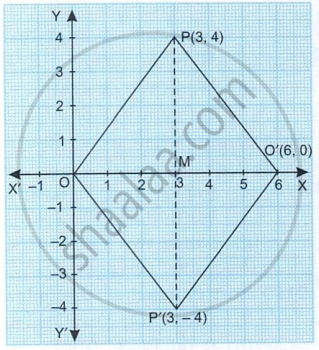
(i) the coordinates of P' and O'.
(ii) the length of the segments PP' and OO'.
(iii) the geometrical name of the figure POP'O'.
(iv) the perimeter of the quadrilateral POP'O'.
[Hint: (i) Rx (3, 4) = (3, – 4). So, we get P'(3, – 4).
MO' = OM = 3 units. So, we get O'(6, 0)
(ii) PP' = (PM + MP') = (4 + 4) = 8 units.
OO' = (ΟM + MΟ') = (3 + 3) = 6 units.
(iii) Diagonals of ΡΟΡΌ' are unequal and bisect each other at right angles. So, it is a rhombus.
(iv) OP2 = (OM2 + PM2) = (32 + 42) = (9 + 16) = 25.
∴ OP = ΟΡ' = Ο'P = Ο'P' = 5 units.
∴ Perimeter of POP'O' = (4 × 5) = 20 units.]
Advertisements
उत्तर
Here’s the graph:
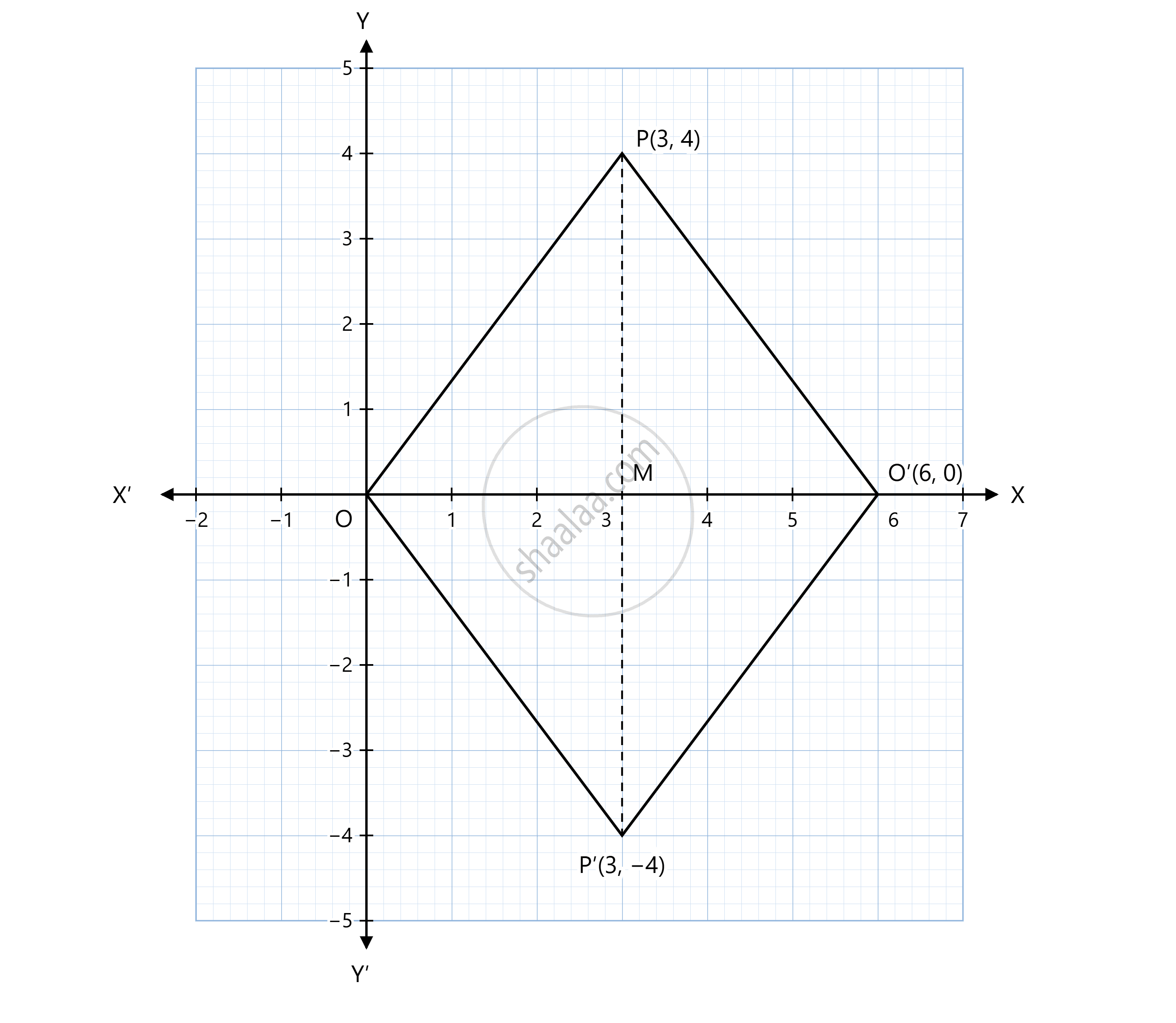
(i) Reflection in the x-axis maps (x, y) to (x, –y), so P′ is (3, –4).
PP′ cuts the x-axis at M(3, 0). Reflecting O in the line PP′ (the line x = 3) gives MO′ = OM = 3 units, so O′ is (6, 0).
(ii) PP′ = PM + MP′
= 4 + 4
= 8 units
OO′ = OM + MO′
= 3 + 3
= 6 units
(iii) The diagonals PP′ and OO′ are unequal (8 ≠ 6) and they bisect each other at right angles at M. So POP′O′ is a rhombus.
(iv) In right △OMP:
OP2 = OM2 + PM2
= 32 + 42
= 9 + 16
= 25
So OP = 5 units
All four sides of a rhombus are equal, so OP = OP′ = O′P = O′P′ = 5 units.
Perimeter of POP′O′ = 4 × 5 = 20 units.
