R.S. Aggarwal solutions for माठेमटिक्स [इंग्रजी] इयत्ता १० आयसीएसई chapter 17 - Loci [Latest edition]
Online Mock Tests
Chapters
1: Goods and Services Tax (G.S.T.)
2: Banking
3: Shares and Dividends
UNIT 2: ALGEBRA
4: Linear Inequations
5: Quadratic Equation
6: Problems on Quadratic Equations
7: Ratio and Proportion
8: Remainder Theorem and Factor Theorem
9: Matrices
10: Arithmetic Progression
11: Geometric Progression
12: Reflection
13: Section and Mid-point Formulae
14: Equation of a Straight Line
UNIT 3: GEOMETRY
15: Similarity (As a Size Transformation)
16: Similarity of Triangles
▶ 17: Loci
Chapter 18: Angle and Cyclic Properties of a Circle
Chapter 19: Tangent Properties of Circles
20: Constructions
UNIT 4: MENSURATION
Chapter 21: Volume and Surface Area of Solids (Cylinder, Cone and Sphere)
UNIT 5: TRIGONOMETRY
Chapter 22: Trigonometrical Identities
Chapter 23: Heights and Distances
UNIT 6: STATISTICS
Chapter 24: Graphical Representation of Statistical Data
Chapter 25: Measures of Central Tendency (Mean)
Chapter 26: Median, Quartiles and Mode
UNIT 7: PROBABILITY
Chapter 27: Probability
Advertisements
Advertisements
Solutions for Chapter 17: Loci
Below listed, you can find solutions for Chapter 17 of CISCE R.S. Aggarwal for माठेमटिक्स [इंग्रजी] इयत्ता १० आयसीएसई.
Advertisements
R.S. Aggarwal solutions for माठेमटिक्स [इंग्रजी] इयत्ता १० आयसीएसई 17 Loci EXERCISE 17 [Pages 289 - 291]
Describe and construct the following loci:
The locus of the tip of a minute hand of a watch.
Describe and construct the following loci:
The locus of the tip of the pendulum of a clock.
Describe and construct the following loci:
The locus of a point 5 cm from a fixed point O.
Describe and construct the following loci:
The locus of a point at a distance of 3 cm from a fixed line AB.
Describe and construct the following loci:
The locus of a point equidistant from the arms OA and OB of ∠AOB.
Describe and construct the following loci:
The locus of the centres of all circles, each of radius 1 cm and touching externally a fixed circle with centre O and radius 3 cm.
Describe and construct the following loci:
The locus of the centres of all circles to which both the arms of an angle ∠AOB are tangents.
Describe and construct the following loci:
The locus of a point 1 cm from the circumference of a fixed circle towards the centre O, whose radius is 3 cm.
Describe and construct the following loci:
The locus of a point 1 cm from the centre of a circle of radius 2.5 cm.
Describe and construct the following loci:
The locus of a stone dropped from a tower.
Describe and construct the following loci:
AB is a fixed line. State the locus of a point P such that ∠APB = 90°.
Describe the locus of a point in a rhombus ABCD which is equidistant from (i) AB and AD (ii) A and С.
Construct a ΔABC in which BC = 5.3 cm, CA = 4.8 cm and AB = 4 cm. Find by construction a point P which is equidistant from BC and AB and also equidistant from B and C.
Construct ∠AOB = 60°. Mark a point P equidistant from OA and OB such that its distance from another given line CD is 3 cm.
Use ruler and compass to answer this question. Construct ∠ABC = 90°, where AB = 6 cm, BC = 8 cm.
- Construct the locus of points equidistant from B and C.
- Construct the locus of points equidistant from A and B.
- Mark the point which satisfies both the conditions (i) and (ii) as O. Construct the locus of points keeping a fixed distance OA from the fixed point O.
- Construct the locus of points which are equidistant from BA and BC.
Using ruler and compasses only, construct a ΔABC such that AB = 4.6 cm, BC = 3 cm and ∠ABC = 30°. Complete the rhombus ABDE such that C is equidistant from AB and BD. Locate the point Q on BC such that Q is equidistant from A and B.
AB and CD are two intersecting lines. Find the position of the point distant 2 cm from AB and 1.8 cm from CD.
Using ruler and compasses only, construct a rhombus ABCD whose diagonals AC and BD are 8 cm and 6 cm long respectively. Find by construction, a point P equidistant from AB, AD and also equidistant from C and D. Measure PC.
Using ruler and compasses only, construct a ΔABC in which AB = 4 cm, BC = 5 cm and ∠ABC = 120°.
- Locate the point P such that ∠BAP = 90° and BP = CP.
- Measure the length of BP.
Using ruler and compasses only, construct a ΔABC in which AB = 6 cm, BC = 3.5 cm and CA = 4.6 cm.
- Draw the locus of a point P which moves so that it is always 3 cm from B.
- Draw the locus of a point which moves so that it is equidistant from BC and CA.
- Mark the point of intersection of the two loci obtained above. Measure PC.
Use ruler and compass for the following constructions:
Construct:
(i) an isosceles ΔABC in which AB = AC = 7 cm and BC = 6 cm.
(ii) the locus of points which moves such that it is 2.5 cm from the point A.
(iii) the locus of points equidistant from B and C. Mark point P which satisfies both the conditions mentioned in (ii) and (iii).
(iv) a circle passing through P, B and C.
Using ruler and compasses only, construct a quadrilateral ABCD in which AB = 6 cm, BC = 5 cm, ∠B = 60°, AD = 5 cm and D is equidistant from AB and BC.
Using ruler and compasses only, construct a parallelogram ABCD in which AB = 5.1 cm, diagonal AC = 5.6 cm and diagonal BD = 7 cm. Locate the point P on DC, which is equidistant from AB and BC.
Draw a circle of radius 4 cm and mark two chords AB and AC of the circle of length 6 cm and 5 cm respectively.
- Construct the locus of points inside the circle, that are equidistant from A and C.
- Construct the locus of points, inside the circle, that are equidistant from AB and AC.
A and B are fixed points 5 cm apart. The locus of the point P is the set of those points for which AP = 4 cm and the locus of Q is the set of those points for which BQ = 3.5 cm.
Construct the loci of P and Q and the points of intersection of the two loci. How many such points are there?
Using only a ruler and compasses, construct ∠ABC = 120°, where AB = BC = 5 cm.
- Mark two points D and E which satisfy the condition that they are equidistant from both BA and BC.
- In the above figure, join AE and EC. Describe the figures.
- ABCD
- BD
- ABE
Using ruler and compass only:
- Construct a triangle ABC with BC = 6 cm, ∠ABC = 120° and AB = 3.5 cm.
- In the above figure, draw a circle with BC as diameter. Find a point ‘P’ on the circumference of the circle which is equidistant from AB and BC.
- Measure ∠BCP.
Use a ruler and a pair of compasses to construct ΔABC in which BC = 4.2 cm, ∠ ABC = 60°, and AB 5 cm. Construct a circle of radius 2 cm to touch both the arms of ∠ ABC of Δ ABC.
Using ruler and compasses construct:
(i) a triangle ABC in which AB = 5.5 cm, BC = 3.4 cm and CA = 4.9 cm.
(ii) the locus of point equidistant from A and C.
(iii) a circle touching AB at A and passing through C.
Use ruler and compasses for the following question taking a scale of 10 m = 1 cm. A park in a city is bounded by straight fences AB, BC, CD and DA. Given that AB = 50 m, BC = 63 m, ∠ABC = 75°. D is a point equidistant from the fences AB and BC. If ∠BAD = 90°, construct the outline of the park ABCD. Also locate a point P on the line BD for the flag post which is equidistant from the corners of the park A and B.
Use a ruler and compass to answer this question.
- Construct a circle of radius 4.5 cm and draw a chord AB of length 6.5 cm.
- At A, construct ∠CAB = 75°, where C lies on the circumference of the circle.
- Construct the locus of all points equidistant from A and B.
- Construct the locus of all points equidistant from CA and BA.
- Mark the point of intersection of the two loci as P. Measure and write down the length of CP.
R.S. Aggarwal solutions for माठेमटिक्स [इंग्रजी] इयत्ता १० आयसीएसई 17 Loci COMPETENCY-FOCUSED QUESTIONS [Pages 291 - 293]
I. Multiple Choice Questions Choose the correct alternative:
The locus of a point which moves in a plane in such a way that its distance from a fixed point is always constant, is ______.
a square
an angle
a circle
a line segment
The locus of a point which is equildistant from two given fixed points, is the ______ of the line segment joining the given fixed points.
median
angle bisector
altitude
perpendicular bisector
The locus of a point which is equidistant from two intersecting lines is the ______ formed by the given lines.
pair of lines bisecting the angles
pair of parallel lines
pair of perpendicular lines
none of these
The locus of a toy bird fixed at the tip of one of the blades of a rotating ceiling fan is a ______.
straight line
circle
semi-circular arc
diameter of the circle so formed
If A and B arc two fixed points, then the locus of a point P such that \(\angle \mathrm{APE} = 90^{\circ}\), is the ______.
square
rectangle
circle
rhombus
A point P moves such that its distance from a fixed line AB is always the same. What is the relation between AB and the path travelled by P?
It is a set of two lines perpendicular to AB.
It is a set of two lines parallel to AB drawn on either side at equal distance from it.
It is a set of two concentric circles.
It is a set of two intersecting lines with AB bisecting the angle between them.
A point P moves so that its perpendicular distance from two given parallel lines AB and CD are equal. Then, the locus of the point P is ______.
a line \(l\) anywhere in between AB and CD and parallel to them.
a line \(l\) perpendicular to both AB and CD.
a line \(l\) in the midway of AB and CD and parallel to them.
none of these
The locus of a point equidistant from two concentric circles is ______.
a circle concentric with the given circles and inside the smaller circle.
a circle concentric with the given circles and outside the larger circle.
a circle concentric with the given circles and midway between them.
the common centre of the two circles.
The locus of a point which is equidistant from a given circle consists of ______.
a pair of circles concentric with the given circle.
a circle concentric with the given circle and inside it.
a circle concentric with the given circle and outside it.
a pair of lines parallel to each other on either side of the centre.
A and B are two fixed points in a plane. Then, the locus of a point P which moves in such a way that \(\mathrm{PA}^{2} + \mathrm{PB}^{2} = \mathrm{AB}^{2}\), is ______.
a square with AB as one of its sides.
a rectangle with AB as one of its sides.
a rhombus with AB as one of its diagonal.
the circumference of a circle with AB as its diameter.
The locus of the tip of the pendulum of a clock is ______.
a circle
a chord of a circle
an arc of a circle
a diameter of a circle
The circumcentre of a triangle is the point which is ______.
at equal distance from the three sides of the triangle
at equal distance from the three vertices of the triangle.
the point of intersection of the three medians
the point of intersection of the three altitudes of the triangle.
II. Assertion-Reason Type Questions Directions: In each question below, there are two statements labelled as Assertion (A) and Reason (R). Choose the correct answer as per the options given below:
Assertion (A): In the figure, D is the mid-point of BC and AD ⊥ BC. If E lies on AD, then BE = CE.
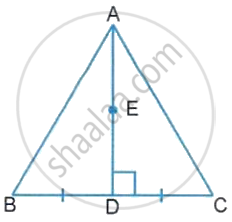
Reason (R): Every point on the perpendicular bisector of a line segment is equidistant from its end points.
Both A and R are true, and R is the correct explanation of A.
Both A and R are true, but R is not the correct explanation of A.
A is true, but R is false.
A is false, but R is true.
Assertion (A): In the figure, ∠ABD = ∠CBD, so DE = DF.
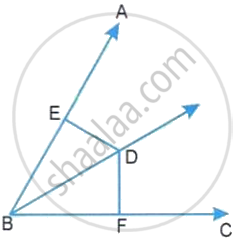
Reason (R): Every point on the angle bisector of two intersecting lines is equidistant from the lines.
Both A and R are true, and R is the correct explanation of A.
Both A and R are true, but R is not the correct explanation of A.
A is true, but R is false.
A is false, but R is true.
III. Analytical and Application Based Questions
Construct a triangle ABC such that AB = 7 cm, BC = 6 cm and CA = 5 cm. (use ruler and compass to do so).
(a) Draw the locus of the points such that
(i) it is equidistant from BC and BA.
(ii) it is equidistant from points A and B.
(b) Mark P where the loci (i) and (ii) meet, measure and write length of PA.
(Use a ruler and a compass for this question.)
- Construct the locus of a moving point which moves such that it keeps a fixed distance of 4.5 cm from a fixed-point O.
- Draw line segment AB of 6 cm where A and B are two points on the locus (a).
- Construct the locus of all points equidistant from A and B. Name the points of intersection of the loci (a) and (c) as P and Q respectively.
- Join PA. Find the locus of all points equidistant from AP and AB.
- Mark the point of intersection of the locus (a) and (d) as R. Measure and write down the length of AR.
R.S. Aggarwal solutions for माठेमटिक्स [इंग्रजी] इयत्ता १० आयसीएसई 17 Loci Graphical Depiction
Use graph paper for this question. Take 2 cm = 1 unit on both the axes.
- Plot the points A(1, 1), B(5, 3) and C(2, 7).
- Construct the locus of points equidistant from A and B.
- Construct the locus of points equidistant from AB and AC.
- Locate the point P such that PA = PB and P is equidistant from AB and AC.
- Measure and record the length PA in cm.
Solutions for 17: Loci
R.S. Aggarwal solutions for माठेमटिक्स [इंग्रजी] इयत्ता १० आयसीएसई chapter 17 - Loci
Shaalaa.com has the CISCE Mathematics माठेमटिक्स [इंग्रजी] इयत्ता १० आयसीएसई CISCE solutions in a manner that help students grasp basic concepts better and faster. The detailed, step-by-step solutions will help you understand the concepts better and clarify any confusion. R.S. Aggarwal solutions for Mathematics माठेमटिक्स [इंग्रजी] इयत्ता १० आयसीएसई CISCE 17 (Loci) include all questions with answers and detailed explanations. This will clear students' doubts about questions and improve their application skills while preparing for board exams.
Further, we at Shaalaa.com provide such solutions so students can prepare for written exams. R.S. Aggarwal textbook solutions can be a core help for self-study and provide excellent self-help guidance for students.
Concepts covered in माठेमटिक्स [इंग्रजी] इयत्ता १० आयसीएसई chapter 17 Loci are Points Equidistant from Two Given Points, Points Equidistant from Two Intersecting Lines, Summary of Important Results on Locus, Locus, Important Points on Concurrency in a Triangle, Points Equidistant from Two Given Points, Points Equidistant from Two Intersecting Lines, Summary of Important Results on Locus, Locus, Important Points on Concurrency in a Triangle.
Using R.S. Aggarwal माठेमटिक्स [इंग्रजी] इयत्ता १० आयसीएसई solutions Loci exercise by students is an easy way to prepare for the exams, as they involve solutions arranged chapter-wise and also page-wise. The questions involved in R.S. Aggarwal Solutions are essential questions that can be asked in the final exam. Maximum CISCE माठेमटिक्स [इंग्रजी] इयत्ता १० आयसीएसई students prefer R.S. Aggarwal Textbook Solutions to score more in exams.
Get the free view of Chapter 17, Loci माठेमटिक्स [इंग्रजी] इयत्ता १० आयसीएसई additional questions for Mathematics माठेमटिक्स [इंग्रजी] इयत्ता १० आयसीएसई CISCE, and you can use Shaalaa.com to keep it handy for your exam preparation.
