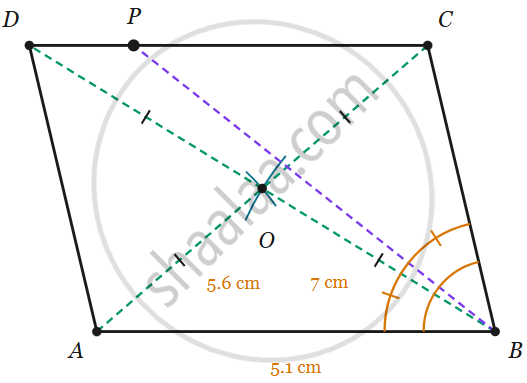
Using ruler and compasses only, construct a parallelogram ABCD in which AB = 5.1 cm, diagonal AC = 5.6 cm and diagonal BD = 7 cm. Locate the point P on DC, which is equidistant from AB and BC.
Advertisements
प्रश्न
Using ruler and compasses only, construct a parallelogram ABCD in which AB = 5.1 cm, diagonal AC = 5.6 cm and diagonal BD = 7 cm. Locate the point P on DC, which is equidistant from AB and BC.
Advertisements
उत्तर
\[\begin{array}{r l} \textbf{Given:} & \text{A parallelogram } ABCD \text{ in which } AB = 5.1 \text{ cm, the diagonal } AC = 5.6 \text{ cm and the diagonal } BD = 7 \text{ cm.} \\[4pt] \textbf{To Find:} & \text{The point } P \text{ on } DC \text{ which is equidistant from } AB \text{ and } BC, \text{ and the lengths } CP \text{ and } DP. \\[4pt] \textbf{Solution:} & \text{Step 1: The diagonals of a parallelogram bisect each other, so } AO = OC = 2.8 \text{ cm and } BO = OD = 3.5 \text{ cm.} \\[4pt] & \text{Step 2: Draw } AB = 5.1 \text{ cm; with centre } A \text{ and radius } 2.8 \text{ cm and with centre } B \text{ and radius } 3.5 \text{ cm draw arcs meeting at } O. \\[4pt] & \text{Step 3: Produce } AO \text{ to } C \text{ with } OC = 2.8 \text{ cm and } BO \text{ to } D \text{ with } OD = 3.5 \text{ cm, then join } BC, CD \text{ and } DA. \\[4pt] & \text{Step 4: The locus of a point equidistant from two intersecting lines is the bisector of the angle between them, so draw the bisector of } \angle ABC; \text{ it meets } DC \text{ at the required point } P. \\[4pt] & \text{Step 5: Since } DC \text{ is parallel to } AB, \text{ the alternate angles give } \angle BPC = \angle ABP = \angle PBC, \text{ so the triangle } BCP \text{ is isosceles with } CP = CB. \\[4pt] & \text{By the parallelogram law, the sum of the squares of the diagonals equals twice the sum of the squares of two adjacent sides:} \\[4pt] & \begin{aligned} AC^{2} + BD^{2} &= 2\left(AB^{2} + BC^{2}\right) \\[4pt] 31.36 + 49 &= 2\left(26.01 + BC^{2}\right) \\[4pt] BC^{2} &= 14.17 \\[4pt] BC &= \frac{\sqrt{1417}}{10} \\[4pt] CP &= CB \\[4pt] &= \frac{\sqrt{1417}}{10} \\[4pt] &\approx 3.76 \\[4pt] DP &= DC - CP \\[4pt] &= \frac{51 - \sqrt{1417}}{10} \\[4pt] &\approx 1.34 \end{aligned} \\[4pt] \textbf{Answer:} & P \text{ is the point where the bisector of } \angle ABC \text{ meets } DC, \text{ with } CP = \dfrac{\sqrt{1417}}{10} \text{ cm} \approx 3.76 \text{ cm and } DP = \dfrac{51 - \sqrt{1417}}{10} \text{ cm} \approx 1.34 \text{ cm.} \end{array}\]