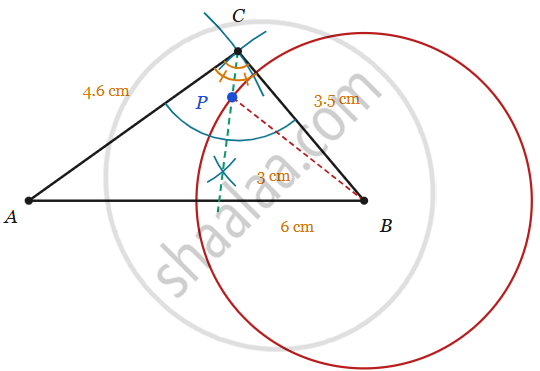
Using ruler and compasses only, construct a triangle ABC in which AB = 6 cm, BC = 3.5 cm and CA = 4.6 cm. i. Draw the locus of a point P which moves so that it is always 3 cm from B.
Advertisements
प्रश्न
Using ruler and compasses only, construct a ΔABC in which AB = 6 cm, BC = 3.5 cm and CA = 4.6 cm.
- Draw the locus of a point P which moves so that it is always 3 cm from B.
- Draw the locus of a point which moves so that it is equidistant from BC and CA.
- Mark the point of intersection of the two loci obtained above. Measure PC.
Advertisements
उत्तर
\[\begin{array}{r l} \textbf{Given:} & \text{A triangle } ABC \text{ in which } AB = 6 \text{ cm, } BC = 3.5 \text{ cm and } CA = 4.6 \text{ cm.} \\[4pt] \textbf{To Find:} & \text{The locus of a point always } 3 \text{ cm from } B, \text{ the locus of a point equidistant from } BC \text{ and } CA, \text{ their point of intersection } P, \text{ and the length } PC. \\[4pt] \textbf{Solution:} & \text{Step 1: Draw } AB = 6 \text{ cm; with centre } A \text{ and radius } 4.6 \text{ cm and with centre } B \text{ and radius } 3.5 \text{ cm draw arcs meeting at } C, \text{ and join } CA \text{ and } CB. \\[4pt] & \text{Step 2: The locus of a point at a fixed distance from a fixed point is a circle, so the locus in (i) is the circle with centre } B \text{ and radius } 3 \text{ cm.} \\[4pt] & \text{Step 3: The locus of a point equidistant from two intersecting lines is the bisector of the angle between them, so the locus in (ii) is the bisector of } \angle BCA. \\[4pt] & \text{Step 4: The bisector cuts the circle at } P, \text{ the required point, and } PC \text{ is measured.} \\[4pt] & \text{Let } F \text{ be the foot of the perpendicular from } B \text{ to } CP, \text{ and let } \angle BCA = C, \text{ so that by the cosine rule and the half angle formulae:} \\[4pt] & \begin{aligned} \cos C &= \frac{CA^{2} + CB^{2} - AB^{2}}{2 \times CA \times CB} \\[4pt] &= \frac{21.16 + 12.25 - 36}{32.2} \\[4pt] &= -\frac{37}{460} \\[4pt] \cos^{2}\frac{C}{2} &= \frac{1 + \cos C}{2} \\[4pt] &= \frac{423}{920} \\[4pt] \sin^{2}\frac{C}{2} &= \frac{1 - \cos C}{2} \\[4pt] &= \frac{497}{920} \\[4pt] CF &= CB\cos\frac{C}{2} \\[4pt] &= \frac{21\sqrt{10810}}{920} \\[4pt] FP^{2} &= BP^{2} - CB^{2}\sin^{2}\frac{C}{2} \\[4pt] &= 9 - \frac{24353}{3680} \\[4pt] &= \frac{8767}{3680} \\[4pt] FP &= \frac{\sqrt{2016410}}{920} \\[4pt] PC &= CF - FP \\[4pt] &= \frac{21\sqrt{10810} - \sqrt{2016410}}{920} \\[4pt] &\approx 0.83 \end{aligned} \\[4pt] \textbf{Answer:} & P \text{ is the point where the bisector of } \angle BCA \text{ cuts the circle of centre } B \text{ and radius } 3 \text{ cm, and } PC = \dfrac{21\sqrt{10810} - \sqrt{2016410}}{920} \text{ cm} \approx 0.83 \text{ cm.} \end{array}\]