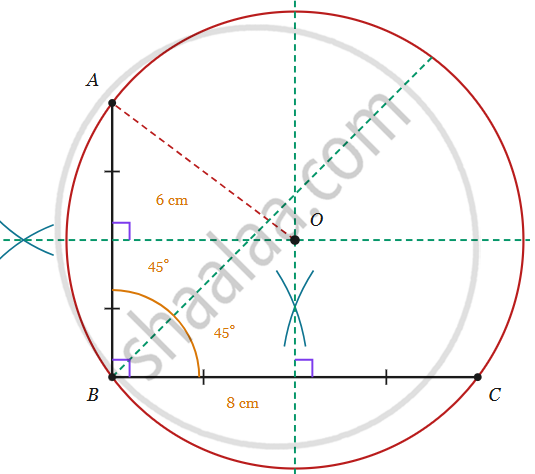
Use ruler and compass to answer this question. Construct ∠ABC = 90°, where AB = 6 cm, BC = 8 cm. i. Construct the locus of points equidistant from B and C.
Advertisements
प्रश्न
Use ruler and compass to answer this question. Construct ∠ABC = 90°, where AB = 6 cm, BC = 8 cm.
- Construct the locus of points equidistant from B and C.
- Construct the locus of points equidistant from A and B.
- Mark the point which satisfies both the conditions (i) and (ii) as O. Construct the locus of points keeping a fixed distance OA from the fixed point O.
- Construct the locus of points which are equidistant from BA and BC.
Advertisements
उत्तर
\[\begin{array}{r l} \textbf{Given:} & \text{An angle } ABC = 90^\circ \text{ with } AB = 6 \text{ cm and } BC = 8 \text{ cm.} \\[4pt] \textbf{To Find:} & \text{The locus of points equidistant from } B \text{ and } C, \text{ the locus of points equidistant from } A \text{ and } B, \text{ their common point } O, \text{ the locus at the fixed distance } OA \text{ from } O, \text{ and the locus of points equidistant from } BA \text{ and } BC. \\[4pt] \textbf{Solution:} & \text{Step 1: Draw } BC = 8 \text{ cm, construct } \angle ABC = 90^\circ \text{ at } B \text{ with ruler and compass, and cut off } BA = 6 \text{ cm.} \\[4pt] & \text{Step 2: The locus of a point equidistant from two fixed points is the perpendicular bisector of the line segment joining them, so the locus in (i) is the perpendicular bisector of } BC. \\[4pt] & \text{Step 3: By the same property, the locus in (ii) is the perpendicular bisector of } AB. \\[4pt] & \text{Step 4: These two perpendicular bisectors meet at } O, \text{ so } OA = OB = OC, \text{ and since } \angle ABC = 90^\circ \text{ the angle in a semicircle being a right angle makes } AC \text{ a diameter, so } O \text{ is the midpoint of } AC. \\[4pt] & \text{Step 5: In the right triangle } ABC, \text{ by Pythagoras' theorem:} \\[4pt] & \begin{aligned} AC^{2} &= AB^{2} + BC^{2} \\[4pt] &= 6^{2} + 8^{2} \\[4pt] &= 36 + 64 \\[4pt] &= 100 \\[4pt] AC &= 10 \\[4pt] OA = OB = OC &= \frac{AC}{2} \\[4pt] &= 5 \\[4pt] &= 5.00 \end{aligned} \\[4pt] & \text{Step 6: The locus of a point at a fixed distance from a fixed point is a circle, so the locus in (iii) is the circle with centre } O \text{ and radius } OA, \text{ which passes through } A, B \text{ and } C. \\[4pt] & \text{Step 7: The locus of a point equidistant from two intersecting lines is the bisector of the angle between them, so the locus in (iv) is the bisector of } \angle ABC, \text{ making } 45^\circ \text{ with each of } BA \text{ and } BC. \\[4pt] \textbf{Answer:} & O \text{ is the midpoint of } AC \text{ with } OA = 5 \text{ cm} = 5.00 \text{ cm, so the locus in (iii) is the circle of centre } O \text{ and radius } 5 \text{ cm through } A, B \text{ and } C, \text{ and the locus in (iv) is the bisector of } \angle ABC. \\[4pt] \end{array}\]